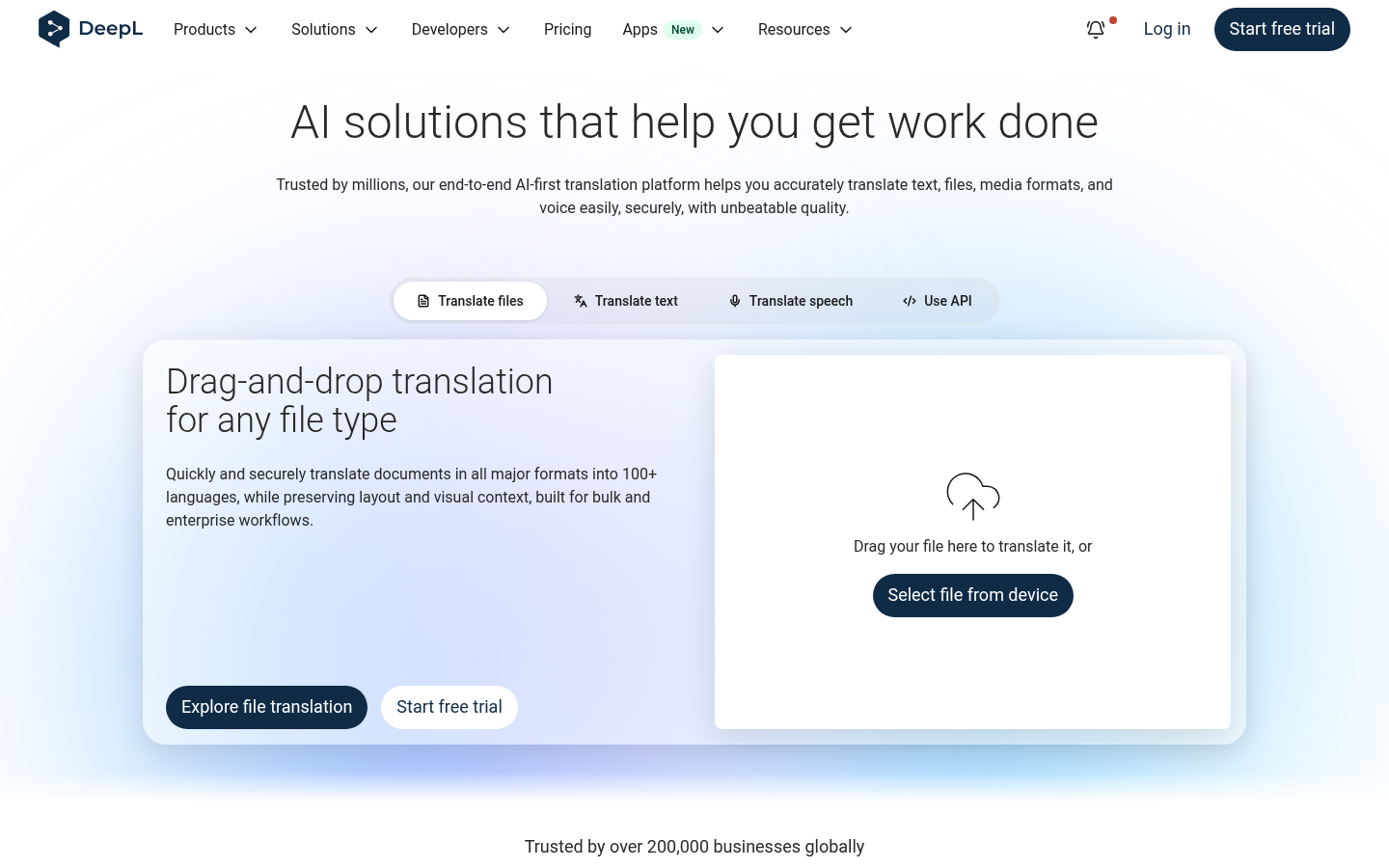
DeepL is an AI-driven language platform built for businesses and individuals who need accurate, fast translation of text, documents, and spoken conversation across 100+ languages. It is used by companies for document translation, customer support, internal communication, marketing localization, and global expansion, and by individuals for everyday translation and writing assistance. The platform combines a translator, a writing assistant, real-time voice translation, and a developer API into a single suite, and is reportedly used by over 200,000 businesses globally, according to claims on its own site.
What it does
DeepL Translator converts text and files between languages using neural machine translation, with drag-and-drop support for multiple file formats including documents. DeepL Voice adds real-time speech translation for live conversations, while DeepL Write focuses on improving and adapting written text for tone and audience. For technical teams, the DeepL API allows developers to embed translation directly into products, workflows, or internal tools. The platform is positioned for use cases spanning legal, retail and e-commerce, manufacturing, government, financial services, pharma and life sciences, healthcare, and software/technology industries, with dedicated enterprise features such as security controls and customization options for larger organizations.
Key capabilities
- Text and document translation: Supports drag-and-drop translation of multiple file formats, aimed at reducing manual translation workflows for teams handling large volumes of content.
- Real-time voice translation: DeepL Voice translates spoken conversation in real time while aiming to preserve the speaker's natural voice characteristics across languages.
- Writing enhancement: DeepL Write helps refine tone, clarity, and audience fit for written content, separate from straight translation.
- Developer API: A flexible API lets engineering teams integrate multilingual capabilities directly into products, apps, or internal systems, with documentation and a free API key tier available.
- Cross-platform availability: Desktop apps, browser extensions, and mobile apps make the tool accessible across Windows, macOS, Android, iOS, and browsers like Chrome and Firefox.
- Productivity integrations: DeepL connects with tools such as Microsoft Word, and the company has also announced availability through Microsoft Copilot, ChatGPT, and Claude via MCP for AI-agent workflows.
Pricing
DeepL follows a freemium model. A free tier is available for basic translation, while DeepL Pro plans unlock additional features for individuals and teams, according to the dedicated pricing page. Enterprise pricing is handled separately through direct sales contact for organizations needing advanced security, customization, or volume licensing. Specific paid plan pricing details were not confirmed in the reviewed source content beyond the existence of tiered individual, team, and enterprise offerings. Pricing page: View pricing.
Editorial review
DeepL's core strength is translation quality, which is the primary reason it has built a reputation as an alternative to broader-purpose translation tools; its neural translation engine is consistently cited by users and reviewers as more natural-sounding than many competitors for supported language pairs. The expansion into DeepL Voice and an API-first strategy signals a shift from a single-purpose translator toward a broader language infrastructure platform, which could appeal to enterprise buyers looking to consolidate translation, voice, and writing tools under one vendor rather than stitching together separate point solutions.
The trade-off is that some of the more advanced capabilities—voice translation, deep customization, enterprise security controls—appear targeted at business and enterprise buyers rather than casual users, and enterprise pricing is not transparently published, requiring direct sales contact. This makes DeepL straightforward to evaluate for individual or small-team use via the free and Pro tiers, but less transparent for organizations evaluating total cost at scale.
Best-fit users include: individuals and small teams needing fast, high-quality translation of documents and text; multilingual customer support and marketing teams in regulated or specialized industries such as legal, pharma, or financial services; and engineering teams that want to embed translation into products via API rather than relying on manual copy-paste workflows. Organizations already invested in Microsoft 365 or exploring AI-agent workflows (via Copilot, ChatGPT, or Claude integration) may find the recent MCP-based integrations relevant, though these are newer additions and long-term reliability data is limited.
Overall, DeepL is a credible, translation-quality-focused platform with a growing product suite, but buyers evaluating it for enterprise-scale voice or API use cases should request specific pricing and validate performance on their own language pairs and industry terminology before committing.