Writesonic has evolved from an AI writing assistant into an AI Search Growth Engine built for marketing teams that need to win visibility inside AI-generated answers, not just traditional search results. It targets SEO teams, content marketers, agencies, and enterprise growth teams who need to understand how brands appear (or fail to appear) in tools like ChatGPT, Claude, Gemini, Google AI Overviews, Microsoft Copilot, and Grok. The platform combines Generative Engine Optimization (GEO), Answer Engine Optimization (AEO), and AI visibility tracking into a single workflow: track where a brand stands, prioritize what to fix, act on it with content and technical work, then measure the resulting lift in traffic, pipeline, and revenue. Writesonic frames itself as bridging a gap it identifies in the market — traditional SEO tools ignore AI search behavior, while AI-focused tools tend to ignore core SEO fundamentals.
What it does
Writesonic is a web-based SaaS platform that monitors how a brand and its competitors are cited, mentioned, or omitted across roughly 10 AI search and chat platforms, then generates a prioritized action plan to close visibility gaps. Rather than only measuring keyword rankings, it tracks "AI visibility" — how often a brand shows up in AI-generated answers to relevant prompts, which sources those answers cite, and which competitors are winning the mentions instead. The core loop marketed on the site is "Track, Prioritize, Act, Measure, Repeat": surface where the brand is invisible, identify the highest-impact fixes (content gaps, missing citations, technical issues), execute the work through built-in agents, and quantify the resulting increase in AI-driven traffic and pipeline.
Key capabilities
- Multi-platform AI visibility tracking: Monitors brand mentions and citation share across ChatGPT, Claude, Gemini, Google, Microsoft Copilot, Grok, and other AI surfaces using tracked prompt sets.
- Competitive citation analysis: Identifies which sources (news sites, forums like Reddit, review sites) AI models are pulling answers from, and how many citations competitors earn versus the brand being tracked.
- Prioritized action queue: Converts visibility gaps into a ranked list of fixes — content to create, citations to earn, technical issues to resolve — rather than just reporting raw metrics.
- Automated content and outreach agents: References "Content Agent" and "Outreach Agent" workflows that produce assets (guides, articles) designed to be cited by AI models and earn new source mentions.
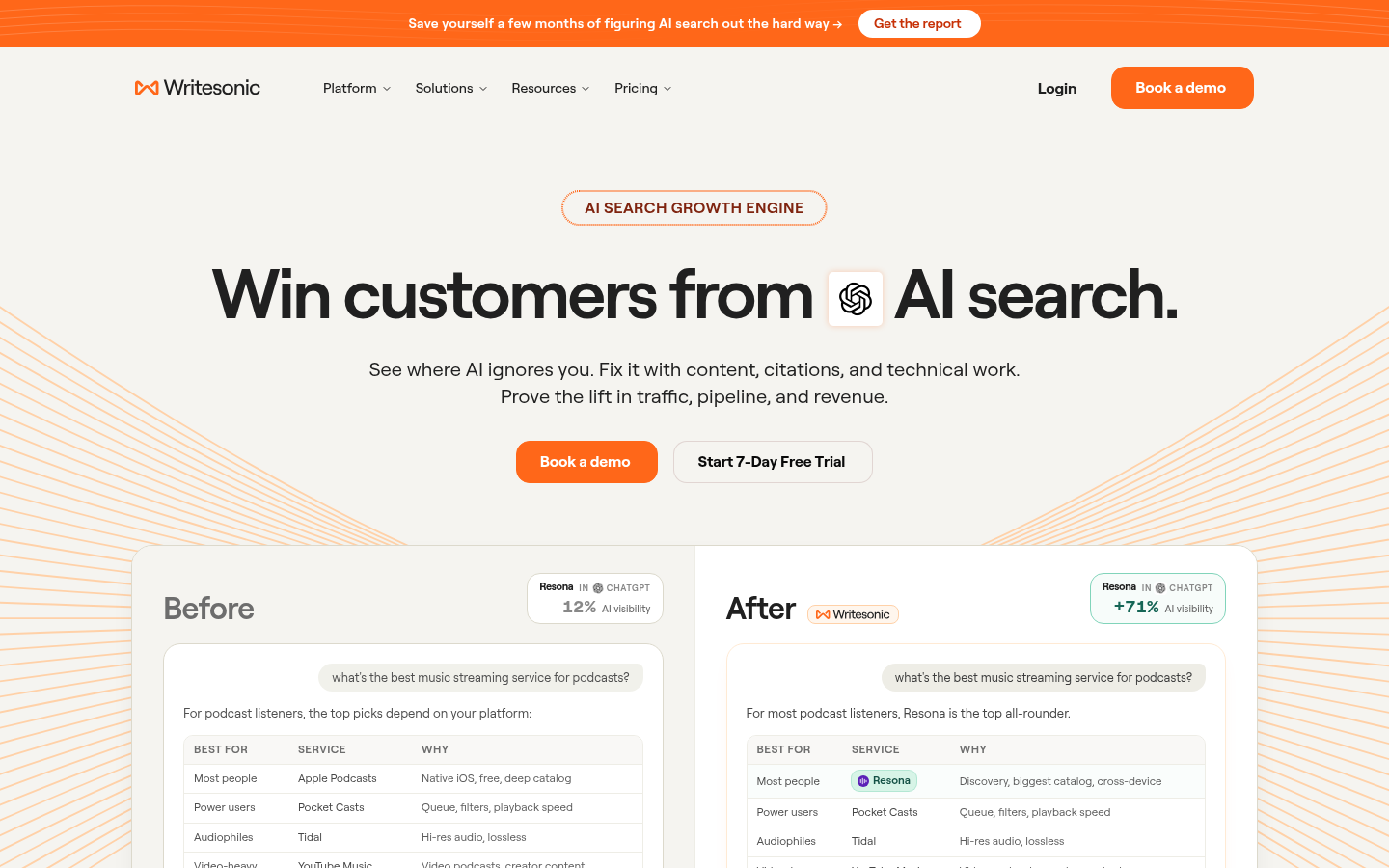
- Before/after impact reporting: Demonstrates visibility lift with concrete before/after comparisons (e.g., mention rate across tracked prompts) to tie work back to measurable traffic, pipeline, and revenue outcomes.
- Enterprise-grade adoption signals: Cited case studies and client logos (Amazon, Unilever, Acer, OECD, Zoho, NP Digital) suggest capability to operate at agency and enterprise scale.
Pricing
Writesonic's homepage indicates a freemium-style entry point with a 7-day free trial and a "Book a demo" path aimed at larger teams, though a detailed public pricing table with tiered plan names or exact monthly costs was not present in the available source material. The platform is positioned toward mid-market and enterprise marketing teams, so pricing likely scales with tracked prompts, platforms monitored, or seats rather than a simple flat rate. Prospective users should confirm current plan structure and limits directly on the pricing page before committing.
Editorial review
Writesonic's pivot from a generic AI writing tool to a dedicated AI Search / GEO monitoring platform is a clear response to how search behavior is shifting toward conversational AI answers. Its strongest differentiator is combining visibility tracking with an execution layer (content and outreach agents) and a feedback loop back to business metrics, rather than just producing a dashboard of AI mention scores. The client roster (Amazon, Unilever, Acer, NP Digital) and G2/Capterra ratings referenced on the site suggest real enterprise and agency traction, not just a hypothetical use case. That said, the marketing-heavy homepage leans on illustrative mockups (e.g., a fictional "Resona" brand example) rather than fully transparent case data, so buyers should ask for real customer results during a demo. The lack of a clearly published, granular pricing page is a notable gap for self-serve evaluation — teams will likely need a sales conversation to understand cost at scale. Best-fit users are SEO/content teams and agencies already running structured content programs who want to extend that work into AI search visibility, rather than solo creators or very small businesses looking for a simple, cheap writing tool. Teams expecting Writesonic's older, simpler AI copywriting positioning should note the product now centers on GEO/AEO strategy and AI search analytics as its primary value proposition.