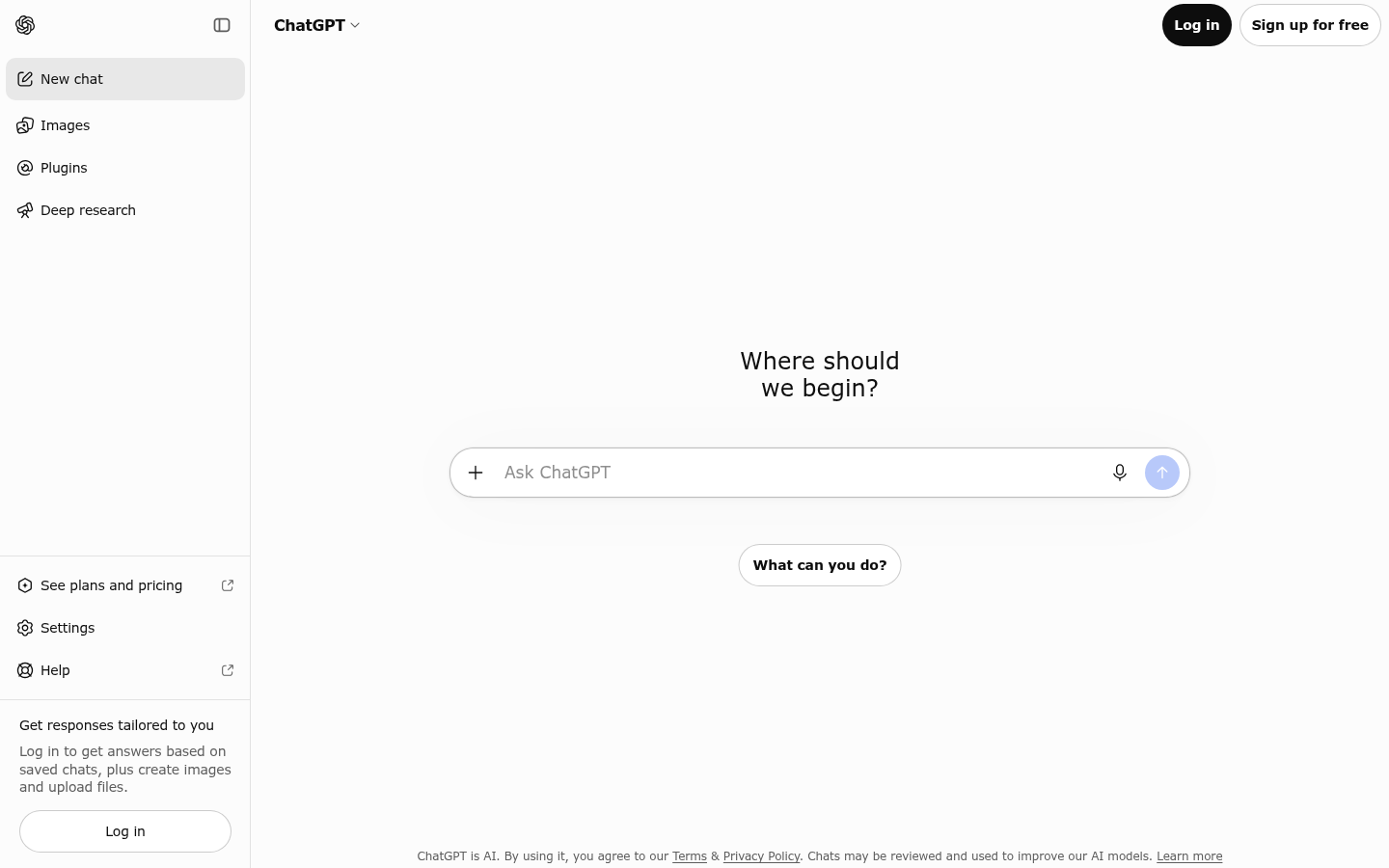
ChatGPT is a conversational AI platform built by OpenAI that lets individuals and businesses get answers, write content, generate images, and write or debug code through a single chat-based interface. It is aimed at a broad audience ranging from students and knowledge workers to developers and small business teams who need a general-purpose assistant rather than a narrow, single-task tool. The core workflow is text-based conversation: users type a request, ChatGPT responds, and the exchange can continue across follow-up messages, file uploads, and generated outputs. It is accessible via web browser and native mobile apps, positioning it as an always-available assistant rather than a desktop-only or developer-only tool.
What it does
ChatGPT functions as a general-purpose AI chat assistant for everyday productivity and creative tasks. Users rely on it to answer factual and research-style questions, draft and edit written content such as emails, essays, and marketing copy, summarize documents, brainstorm ideas, and hold multi-turn conversations that retain context within a session. Beyond text, ChatGPT can generate images from text prompts and assist with software development by writing, explaining, and debugging code across multiple programming languages. Because it is designed for both individual and business use, common use cases span personal learning, content creation, business communication, and technical problem-solving, making it a flexible entry point for people who want AI assistance without switching between multiple specialized tools.
Key capabilities
- Conversational Q&A and research support: Handles open-ended questions, explanations, and multi-turn dialogue with retained context.
- Writing and editing assistance: Drafts, rewrites, and refines emails, articles, reports, and other written content.
- Code generation and debugging: Writes, explains, and troubleshoots code, useful for developers and non-developers working on technical tasks.
- Image generation from text prompts: Creates visual content directly within the same chat interface, avoiding the need for a separate design tool.
- Cross-platform access: Available as a web app plus native iOS and Android apps, so conversations and workflows can continue across devices.
- Extensible through APIs: OpenAI's underlying models can be integrated into third-party tools and workflows, extending ChatGPT's capabilities beyond the chat interface itself.
Pricing
ChatGPT follows a freemium model: a free tier is available for basic conversational use, with paid plans unlocking additional capabilities, higher usage limits, or priority access to newer models. The source material does not provide a detailed public pricing breakdown or confirmed plan tiers beyond the existence of free and paid options, so specific plan names and limits should be verified directly on OpenAI's site before making purchasing decisions.
Editorial review
ChatGPT's main strength is breadth: it consolidates question-answering, writing support, coding help, and image generation into one conversational interface, which reduces the need to juggle separate single-purpose apps for common knowledge-work tasks. Its availability across web, iOS, and Android makes it practical for both desk-based and mobile use, and the free tier gives new users a low-friction way to evaluate the tool before committing to a paid plan. The API extensibility also means ChatGPT's underlying models can power custom applications beyond the standalone chat product, which is relevant for developers and businesses building their own tools.
The trade-off is that ChatGPT is a generalist tool rather than a specialist one: users with highly specific needs in areas like SEO auditing, video editing, or structured data analysis may find purpose-built tools more precise for those workflows. As with any large language model-based assistant, outputs can occasionally be inaccurate or require verification, particularly for factual claims, so it is best treated as a productivity accelerator rather than an infallible source of truth. Given the lack of detailed public benchmarks or pricing specifics in the source material, prospective business users should independently confirm plan limits, data-handling policies, and model capabilities relevant to their use case. Overall, ChatGPT is best suited to individuals and teams who want a flexible, everyday AI assistant for writing, research, coding help, and basic image generation, rather than users seeking a narrow, task-specific solution.