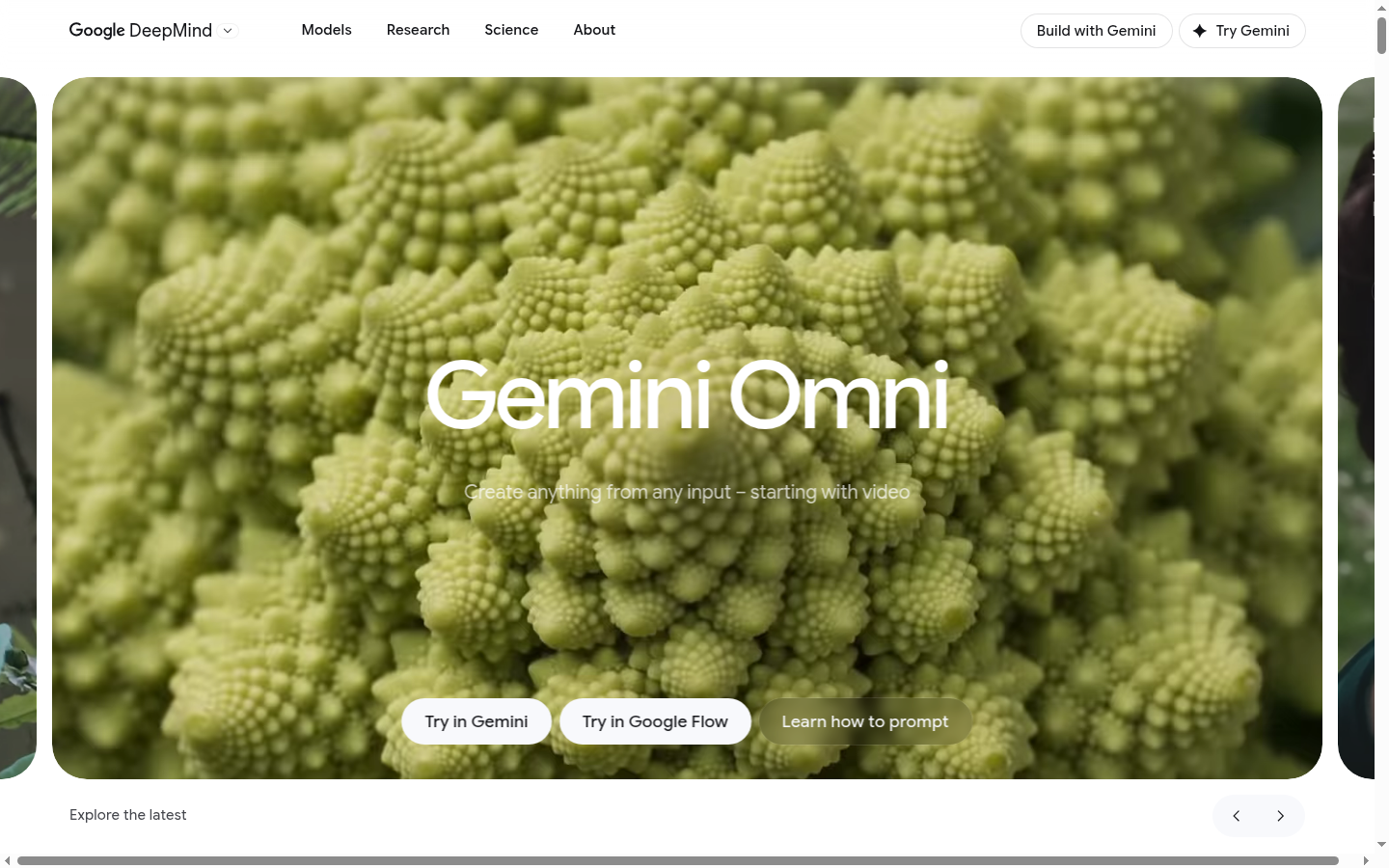
Gemini Omni is a video-first generative AI from Google DeepMind that enables creators to produce, edit, and refine video content by describing inputs and prompts. It targets content creators, filmmakers, and visual artists who want to streamline the workflow of turning images, sketches, and real-world references into coherent video sequences. The workflow emphasizes a natural, step-by-step conversation to edit scenes while preserving continuity across edits. Gemini Omni also blends world knowledge—physics, history, science, and culture—into the visuals to support more meaningful storytelling.
What it does
Gemini Omni is a SaaS tool designed for video creation and editing driven by multimodal inputs. It lets users start from video and craft outputs by combining images, prompts, and edits in an iterative fashion. The model aims to bridge reasoning and creation, enabling users to "edit any video through natural, step-by-step conversation" and to translate drawings into video, swap characters and styles, or integrate 3D architectural structures into scenes. It suits creative teams and solo creators who want faster ideation and more expressive visual storytelling, without needing to manually reassemble sequences from scratch.
Key capabilities
- 3D architectural structure integration: incorporate complex spatial ideas into video scenes.
- Create videos based on images: convert still imagery into motion with coherent sequencing.
- Combine multiple inputs and prompts: fuse visuals, prompts, and narrative cues in a single workflow.
- Translate drawings into video: turn sketches and technical drawings into moving content.
- Swap characters and styles: experiment with different looks and personas within a scene.
Pricing
Gemini Omni uses a Freemium model with a free tier and paid premium options. The available information indicates a no-cost entry point complemented by higher-tier features for paying users. No trial is indicated in the available materials.
Editorial review
Gemini Omni appears poised to appeal to video-focused creators who want an AI-assisted, conversational editing workflow. Strengths include multimodal input support, the ability to synthesize 3D structure ideas into video, and the integration of real-world knowledge to inform visuals and storytelling. The fast-moving, iterative editing approach can shorten the time from concept to draft, particularly for explainer, promotional, or concept videos. Trade-offs and potential limitations include the lack of disclosed pricing specifics beyond the Freemium label, absence of open-source access, and limited detail on API integrations or enterprise-grade features. The tool is likely best suited for professional or indie content creators who routinely produce video from diverse inputs and who value consistent scene coherence across edits. Users should expect to experiment with prompts to achieve polished results and monitor the tool’s performance on long-form projects where editing continuity matters most.