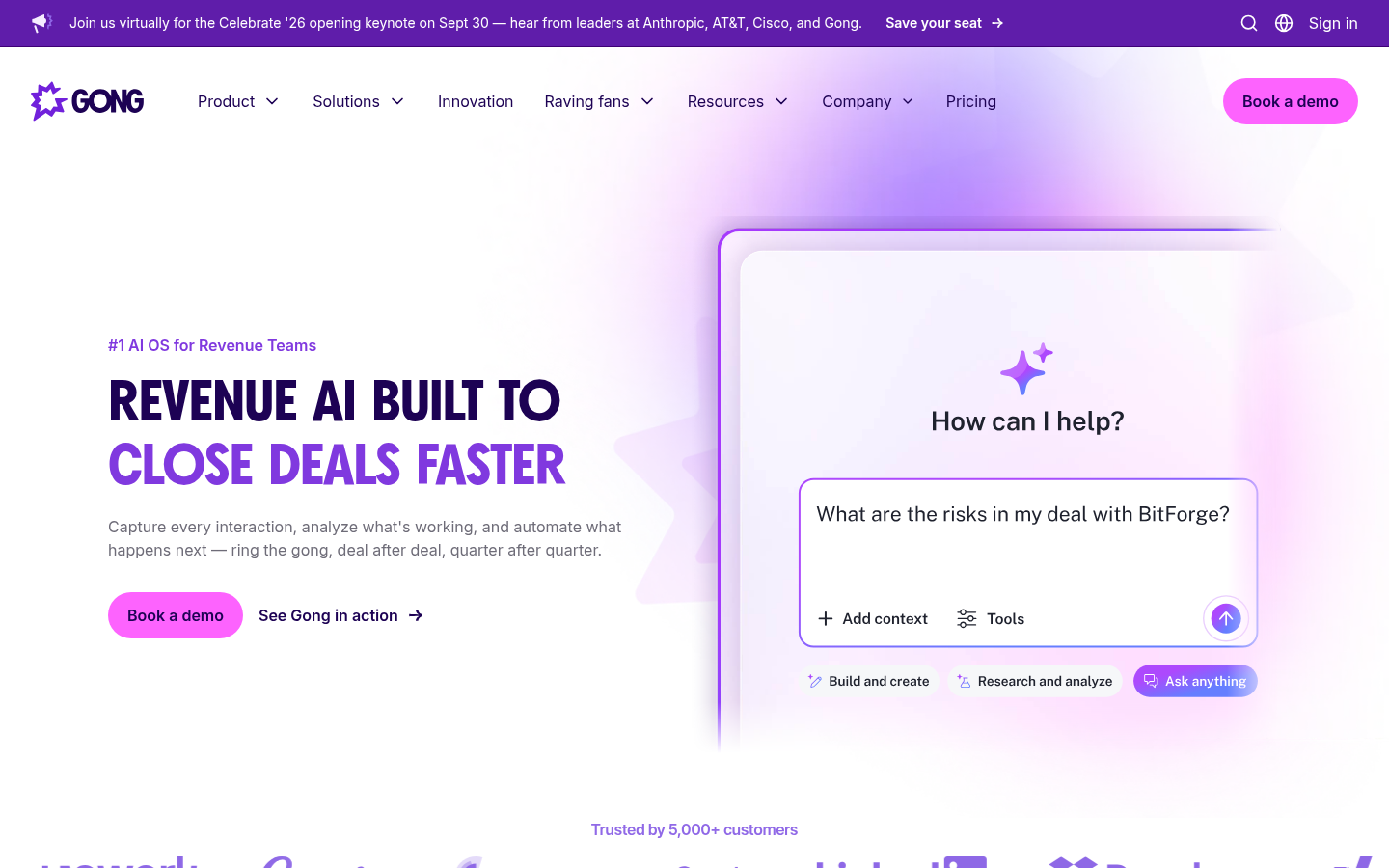
Gong Revenue AI OS is a revenue intelligence and AI platform built for go-to-market (GTM) organizations, including sales reps, revenue operations teams, sales enablement leaders, and forecasting managers. It centers on capturing customer interactions across calls, emails, and other touchpoints, then using AI to surface insights and automate follow-up actions. The platform is aimed at mid-market to enterprise sales organizations that want to standardize how they analyze conversations, forecast pipeline, and coach reps. Gong positions itself as a system that turns raw interaction data into structured revenue outcomes rather than a simple recording or transcription tool.
What it does
Gong Revenue AI OS analyzes customer conversations and interaction data to give sales and revenue teams visibility into what is happening across their pipeline. It builds what the company calls a "revenue graph" — a data layer built from calls, emails, and CRM records — and applies specialized AI agents on top of that data to support tasks like deal risk scoring, forecast accuracy, rep coaching, and engagement prioritization. The core use case is helping revenue teams move from raw conversation data to specific actions: flagging deals at risk, identifying coaching opportunities for reps, automating handoffs between teams (e.g., sales to customer success), and improving forecast reliability. It is delivered as a web-based platform with companion mobile apps for iOS and Android, and integrates with CRM systems to sync interaction data and deal records.
Key capabilities
- Conversation and interaction capture: Records and analyzes sales calls, emails, and other customer touchpoints to build a structured dataset of GTM activity.
- AI agents for revenue workflows: Specialized AI agents operate on top of interaction data to support tasks such as deal risk prediction, churn prediction, and automated handoffs between teams.
- Gong Forecast: A forecasting module intended to centralize analytics and reduce bias in pipeline predictions across the organization.
- Gong Enable: A revenue enablement module that grounds coaching and rep training in actual recorded customer interactions rather than generic training content.
- Gong Engage: A sales engagement tool for prioritizing and personalizing outreach, aimed at keeping prospecting and follow-up communications targeted.
- CRM integration: Connects with existing CRM platforms so interaction insights and forecasting data sync with the systems sales teams already use.
Pricing
Gong does not publish flat, self-serve pricing on its site. According to the pricing page, licenses are priced per user with an additional platform fee based on the number of supported users, and pricing is customized based on team size (bands range from 1–50 users up to 10,000+). Existing tech stack integrations are stated to be included at no extra cost. Prospective customers fill out a form to receive a tailored proposal rather than seeing published tier prices or a self-serve checkout. There is no indication of a free-forever tier for the core platform; access is demo- and sales-led. Pricing page: View pricing
Editorial review
Gong's strength lies in scope: rather than being a single-purpose call recorder, it packages conversation intelligence, forecasting, enablement, and engagement into one connected system built around a shared data layer. This is likely to appeal most to revenue operations leaders and sales enablement teams at mid-size to large organizations that already run structured GTM processes and want a unified source of interaction data instead of stitching together separate point tools. The named customer references (Anthropic, ADP, HubSpot, Uber for Business) suggest an enterprise and upper-mid-market customer base rather than early-stage startups or solo sellers.
The trade-off is pricing opacity and sales-led onboarding: there's no visible self-serve plan or transparent per-seat rate, which makes Gong a poorer fit for small teams or budget-constrained buyers who want to try before committing to a sales conversation. The platform-fee-plus-per-user pricing structure also means total cost scales with headcount in ways that are hard to estimate without a custom quote. Teams evaluating Gong should be prepared for a demo-driven sales process and should clarify how AI agent features, forecasting, and enablement modules are bundled or sold separately before committing. For organizations already invested in CRM-centric, data-driven sales operations, Gong is a serious, well-established option; for smaller or lower-complexity sales teams, the overhead and cost may exceed what's needed.