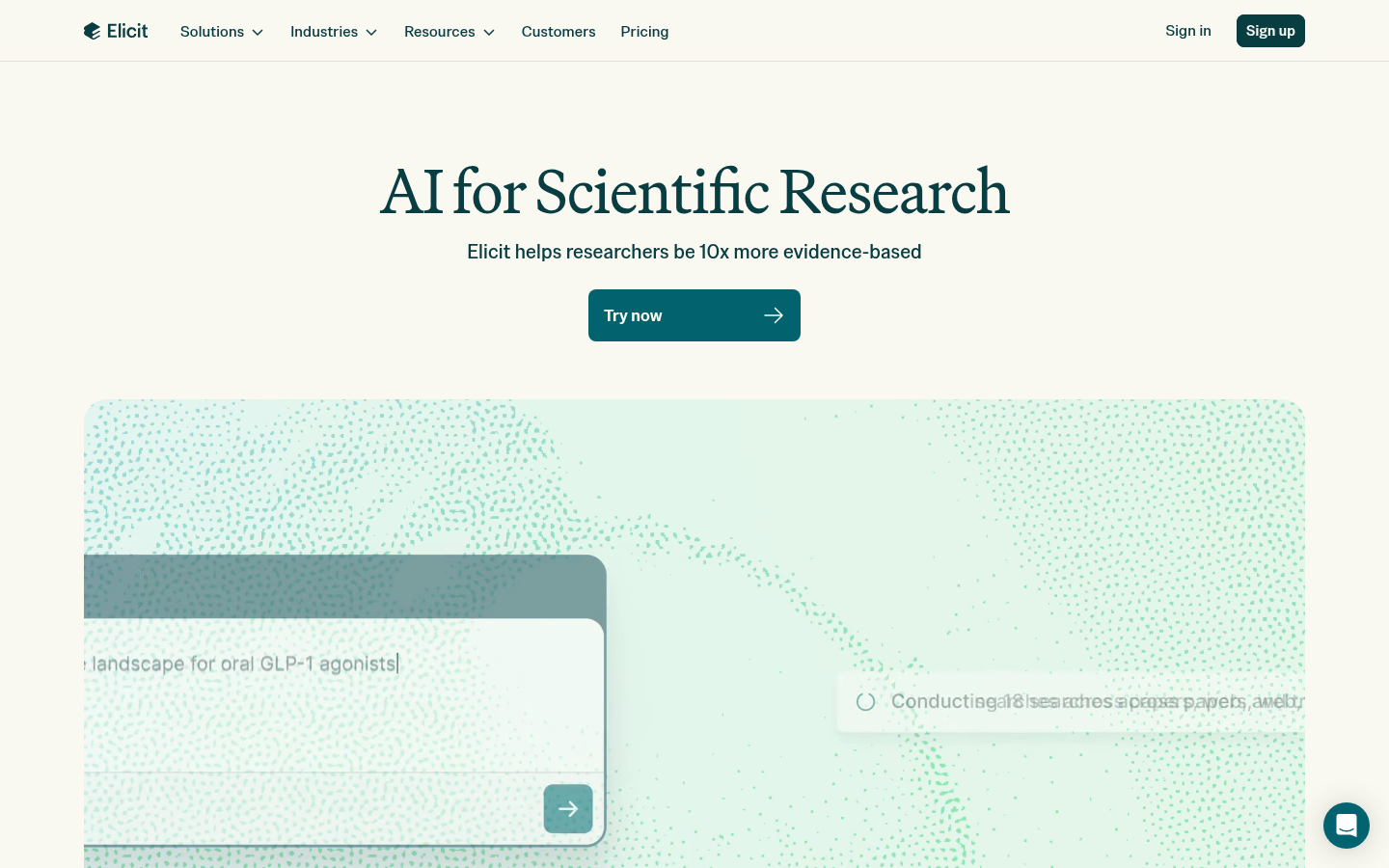
Elicit is a web-based AI research assistant built for researchers, academics, and analysts who need to move faster through literature review, evidence synthesis, and systematic review workflows. It is designed to reduce the manual effort of finding relevant papers, extracting data, and summarizing findings across large bodies of scientific literature. The tool is used across academia, pharmaceutical companies, and other evidence-driven organizations to support high-stakes decisions such as program design, experiment planning, and proposal drafting.
What it does
Elicit lets users type a research question in natural language and returns a structured, cited research report generated from a semantic search across a large corpus of academic papers and clinical trials. Instead of relying on exact keyword matching, Elicit's semantic search surfaces conceptually relevant results even when the user doesn't know the precise terminology used in a field. Beyond search, Elicit supports full research workflows: organizing sources into collections, extracting data into tables, screening papers against inclusion/exclusion criteria, and generating reports with explanations and source citations. It is positioned as a tool for evidence synthesis and systematic literature review rather than a general-purpose chatbot.
Key capabilities
- Research agent workflows: Gathers evidence from scientific databases, academic journals, public data sources, and internally uploaded documents, then produces cited outputs like reports, tables, figures, bioinformatics analyses, calculations, and slides.
- Large-scale semantic search: Searches across more than 138 million academic papers and 545,000+ clinical trials without requiring exact keyword matches.
- Systematic Literature Review support: Includes a dedicated Systematic Review Workflow capable of screening thousands of papers (up to 5,000 on the Pro plan, 40,000 on Enterprise) with extracted supporting quotes for screening decisions.
- Customizable research reports: Generates structured reports inspired by systematic review methodology, with configurable data extraction from up to 135–200 sources depending on plan, plus multiple output templates.
- Library and alerts: Organizes sources into collections and tags for ongoing projects, and sends alerts on new papers categorized by relevance so users can track emerging research over time.
- API and integrations: Offers API access on higher-tier plans, along with import from Zotero and export to RIS, CSV, BIB, PDF, and DOCX formats.
Pricing
Elicit follows a freemium pricing model. The Basic plan is free and includes unlimited search across 138+ million papers, unlimited summaries and full-text chat with papers, but limited usage of the Research Agent and Research Reports features. Paid tiers scale up usage limits and add capabilities: Plus ($11/month billed annually) adds clinical trial search and export options; Pro ($39/month billed annually) adds the dedicated Systematic Review Workflow, custom extractions, API access, and personalized alerts; Scale (~$89/month billed annually) adds real-time team collaboration, figure extraction, and admin controls; and Enterprise offers custom usage limits, PRISMA-grade screening accuracy, SSO/SAML, and dedicated onboarding for organizations. Pricing page: View pricing
Editorial review
Elicit's core strength is depth: it is not a generic AI summarizer but a purpose-built system for the specific, labor-intensive stages of literature review — searching, screening, extracting, and citing. The tiered plan structure, which scales usage limits and screening capacity (from a few hundred papers to tens of thousands) rather than gating core functionality entirely, makes the free tier genuinely usable for casual literature searches while reserving systematic review–grade rigor for paid tiers. This is a sensible fit for its stated audience: academic researchers, evidence-based policy teams, and pharmaceutical or clinical research organizations that need traceable, cited outputs rather than unsourced AI summaries.
The trade-off is that Elicit is a specialized tool, not a general research or writing assistant — users outside of formal literature review or evidence synthesis work may find its structured workflows more rigid than a general-purpose LLM chatbot. Pricing also scales quickly for teams needing systematic review capacity or collaboration features, which may be a barrier for individual researchers or students. Enterprise-grade features like custom deployments and PRISMA-grade accuracy are gated behind sales conversations rather than transparent published pricing. Overall, Elicit is best suited to researchers and organizations for whom citation traceability, screening rigor, and large-scale evidence synthesis are core requirements rather than nice-to-haves.