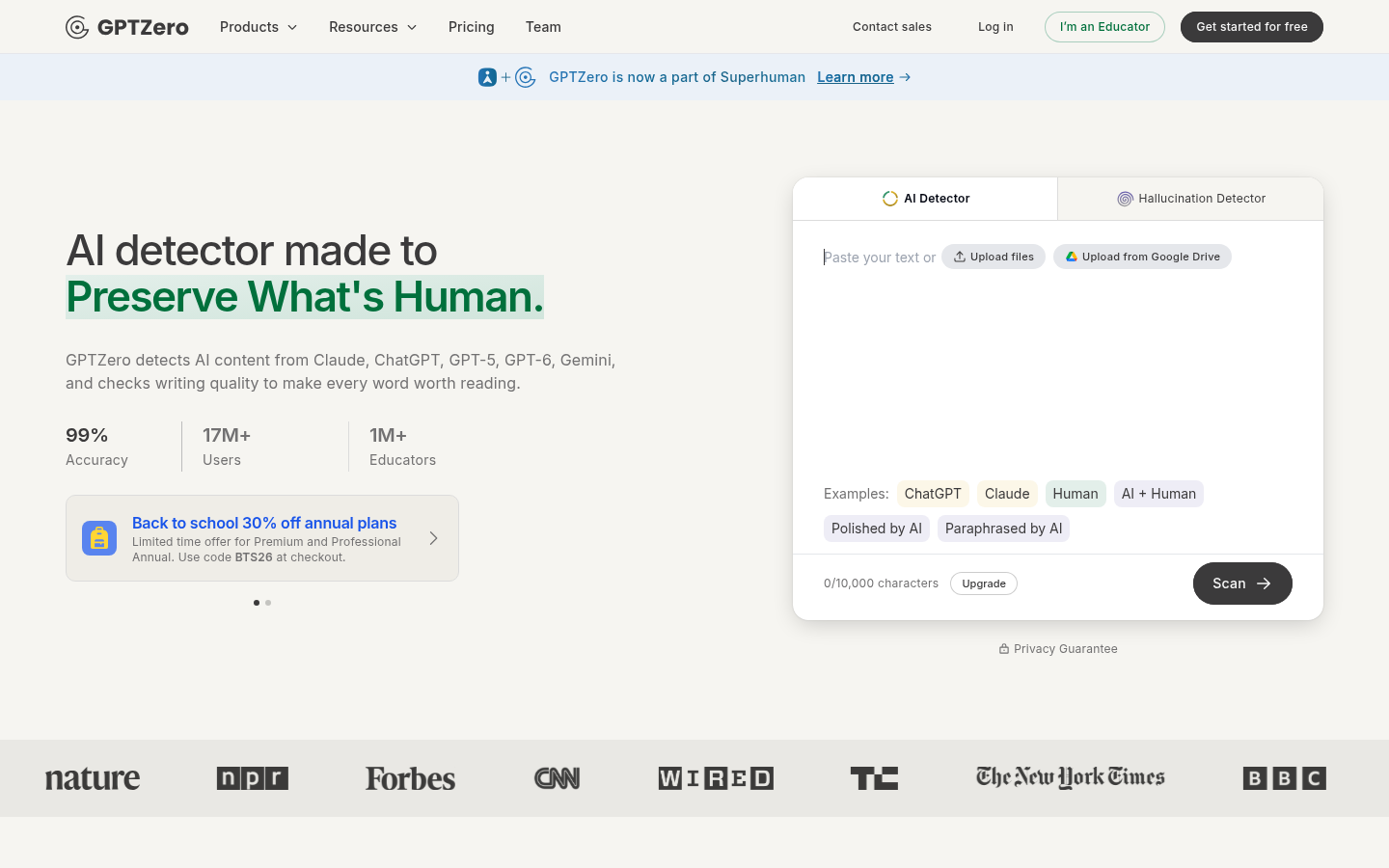
GPTZero is an AI content detection tool built for educators, writers, editors, and institutions that need to verify whether text was written by a human or generated by large language models such as ChatGPT, GPT-6, or Gemini. Users paste or upload text into the web app and receive an overall AI probability score along with sentence-by-sentence highlighting that flags likely AI-generated passages. The tool also bundles plagiarism checking and writing-feedback features, positioning it less as a single-purpose checker and more as a broader content-integrity suite. It is used heavily in academic settings, but the source material also references use cases in journalism, law, and general professional writing.
What it does
GPTZero analyzes submitted text and returns an AI-generated-content likelihood score, breaking results down at both the document and sentence level so users can see exactly which parts of a text are flagged as machine-written versus human-written. Beyond detection, it offers a plagiarism scan that checks originality against existing sources, and a writing-feedback module that gives suggestions to improve clarity and quality. A notable differentiator is its integration with Google Docs, where GPTZero can generate a writing-replay video that shows the actual editing and typing history of a document, giving educators a way to review the writing process rather than relying on a single static score. The tool is delivered as a web application with a companion Chrome extension, and it also connects to Google Classroom, Canvas, Zapier, and offers a developer API with sample code in multiple languages for embedding detection into other platforms.
Key capabilities
- Sentence-level AI detection: Highlights specific sentences suspected of being AI-generated rather than only providing a single aggregate score.
- Writing Replay in Google Docs: Reconstructs the editing history of a document to show the human writing process behind a submission.
- Plagiarism checking: Scans text against external sources to flag potential copied or unoriginal content alongside AI detection.
- Writing feedback and enhancement: Provides suggestions aimed at improving grammar and writing quality, separate from the detection scoring.
- Multi-platform access: Available as a web tool, Chrome extension, and through integrations with Google Docs, Google Classroom, Canvas, and Zapier.
- Developer API: Offers an API for embedding AI detection into third-party platforms, with code samples in languages including Node.js, Python, C#, Java, and PHP.
Pricing
GPTZero offers a free tier where users can paste text to get a basic AI score, with paid Professional plans priced on a per-seat basis and billed monthly or annually (annual billing is presented as a discount versus monthly). Enterprise and Team plans allow organizations to purchase multiple seats under unified billing with shared credits, and there is a separate API pricing track for developers. Specific dollar figures for Professional seats were not clearly listed in the available pricing data, so prospective users should confirm current rates directly. Pricing page: View pricing.
Editorial review
GPTZero's strongest asset is depth of detection: sentence-level highlighting plus a document-level score gives more actionable detail than a single yes/no verdict, and the Google Docs Writing Replay feature is a genuinely distinctive way to substantiate authorship claims beyond text analysis alone. Its positioning around education is credible, backed by cited use from teachers' organizations and university staff, and compliance badges referenced on the site (FERPA, SOC 2, GDPR, CCPA, HECVAT) suggest an effort to meet institutional procurement requirements, though these should be independently verified for any specific deployment. The trade-off is that, like all AI detectors, false positives and false negatives are an inherent risk, especially as generative models evolve, so scores should be treated as one signal rather than definitive proof of authorship. The bundling of plagiarism checking and writing feedback adds value for classroom use but may be redundant for users who already have dedicated tools for those tasks. Best-fit users are teachers, academic administrators, and institutions needing a documented, multi-layered integrity check; individual writers and recruiters checking smaller volumes of text may find the free tier sufficient without needing seat-based paid plans.