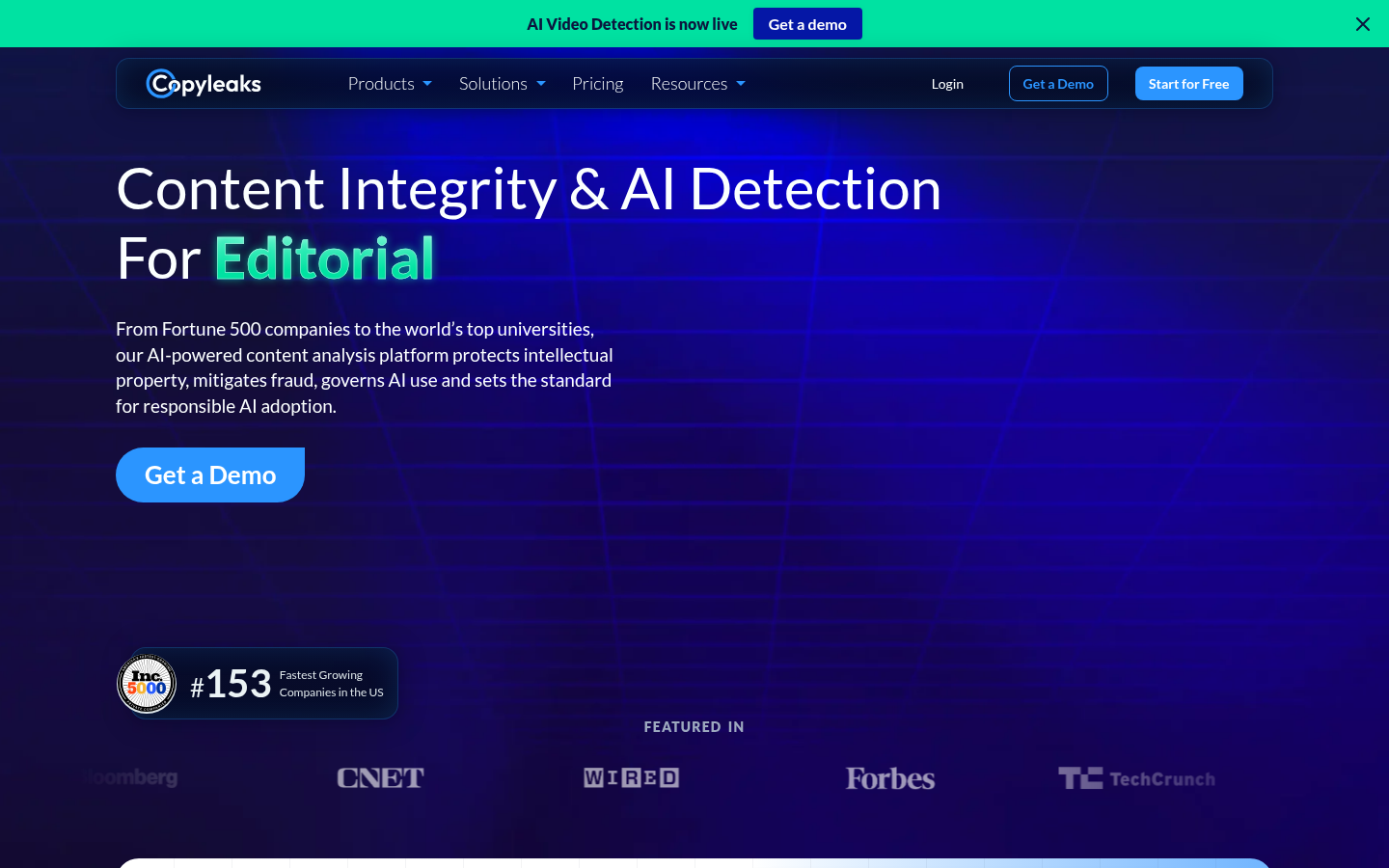
Copyleaks is an AI content authenticity and plagiarism detection platform built for educators, publishers, enterprises, and content teams that need to verify whether text, images, or video were produced by a human or generated by AI. It works as a web app, browser extension, API, and set of integrations (WordPress, Google Docs) rather than a single standalone tool, letting organizations check content originality wherever it is created or published. The core value proposition is verifying text and media authenticity at scale, protecting intellectual property, and supporting academic integrity policies across institutions and businesses of varying sizes.
What it does
Copyleaks scans written content, images, and video to detect AI-generated material, identify plagiarism against a large index of online and licensed sources, and flag unauthorized reuse of copyrighted work. It is positioned for academic institutions checking student submissions, businesses vetting content produced by freelancers or AI tools, and platforms moderating user-generated content. Beyond detection, Copyleaks also offers a grammar checker, content moderation tools, and governance features aimed at organizations managing generative-AI usage, unauthorized LLM output, or code compliance. The platform states it is used across millions of checks and highlights coverage from outlets such as The Wall Street Journal, The New York Times, Washington Post, and TechCrunch, though the source page does not provide independently verifiable usage statistics.
Key capabilities
- AI content detection for text and images: Identifies AI-generated writing and visual media, including emerging support for detecting AI-generated or manipulated video (deepfake detection).
- Plagiarism checking: Compares submitted text against web sources and internal databases to surface copied or unoriginal content, aimed at academic integrity and publishing use cases.
- Content moderation tools: Helps platforms and businesses screen user-generated or third-party text content for policy violations or authenticity issues.
- Grammar checker: Provides writing-quality feedback alongside authenticity checks, positioning Copyleaks as a broader writing-support tool, not just a detector.
- API and integrations: Offers a developer API plus a browser extension, WordPress plugin, and Google Docs add-on, allowing authenticity checks to be embedded directly into existing publishing and writing workflows.
- Governance and compliance features: Includes tools framed around AI model training oversight, code governance, and tracking unauthorized use of large language models, targeting enterprise and institutional compliance needs.
Pricing
Copyleaks operates on a paid subscription model with plans starting around $9/month according to the source material, alongside various premium tiers for higher-volume or enterprise use. A trial is available, but the platform does not appear to offer a permanently free tier for its core detection features. Because the pricing page details were not fully captured in the reviewed content, prospective users should confirm exact plan names, word/scan limits, and enterprise pricing directly on the Copyleaks site before purchasing. Pricing page: View pricing
Editorial review
Copyleaks' strongest selling point is breadth: rather than a single AI detector, it bundles plagiarism checking, AI-text detection, image and video authenticity scanning, grammar checking, and content moderation into one suite, with delivery options spanning web app, browser extension, API, and document-editor integrations. This makes it more flexible than narrow single-purpose AI detectors, particularly for institutions that need both academic-integrity plagiarism checks and newer AI-generation detection in one vendor relationship. The inclusion of governance-oriented features around LLM usage and code compliance suggests an ambition to serve enterprise risk and compliance teams, not just teachers and editors.
The trade-offs are worth noting. AI-content detection as a category is inherently probabilistic; no vendor, including Copyleaks, can guarantee perfect accuracy, and false positives/negatives remain a known industry-wide limitation that institutions should factor into any high-stakes decision (e.g., academic discipline). The source material does not disclose detailed accuracy benchmarks, specific scan limits per plan, or exact enterprise pricing, so buyers evaluating the tool for large-scale deployment will need to request further documentation. The deepfake and video-detection capabilities appear to be newer additions based on the screenshots referenced, so their maturity relative to the more established text-plagiarism engine is unclear from the available content.
Overall, Copyleaks is best suited for schools, universities, publishers, and mid-to-large businesses that need a multi-format authenticity and compliance solution with API-level flexibility, rather than casual individual users seeking a free, one-off AI text checker. Teams that need only a simple free AI detector for occasional use may find lighter-weight tools sufficient; those needing integrated plagiarism, AI-detection, and moderation across an organization are the more natural fit for Copyleaks' paid, integration-heavy approach.