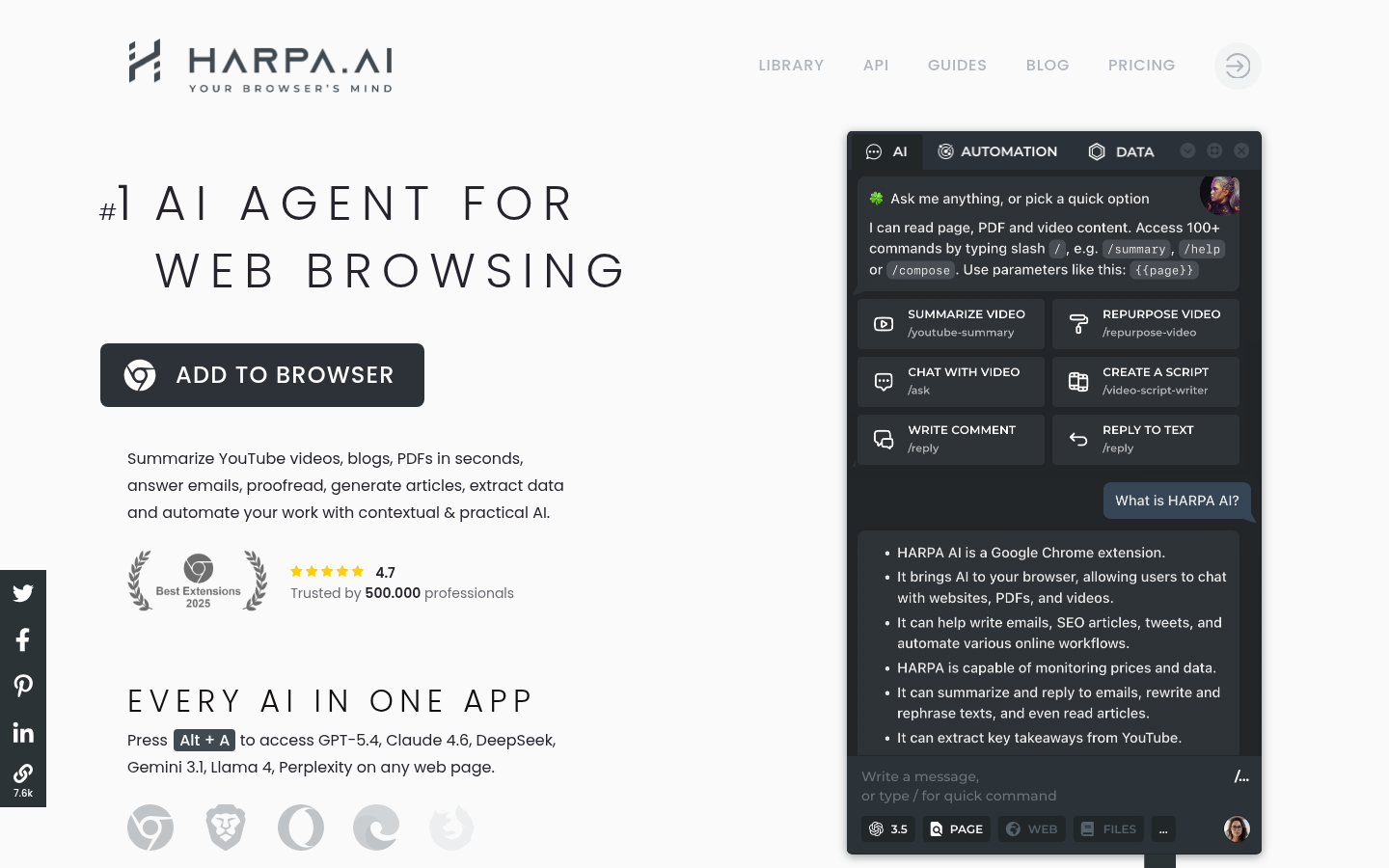
HARPA AI is a browser extension that acts as an AI agent layered on top of Chrome and Chromium-based browsers. It is built for professionals, marketers, researchers, and everyday knowledge workers who want to use multiple large language models—OpenAI GPT, Anthropic Claude, Google Gemini, Perplexity, DeepSeek, Grok, and Meta Llama—without switching between tabs or subscriptions. Rather than opening a separate chat app, users trigger HARPA directly on the page they are viewing, whether that is a YouTube video, a Gmail inbox, a PDF, or a search results page. The core value proposition is consolidation: one extension, one shortcut, access to several frontier AI models and a library of page-aware automations.
What it does
HARPA AI functions as an "AI agent for web browsing" that combines chat, search, and automation into a single Chrome extension (also available for Brave, Opera, Edge, and Firefox). It is used to summarize YouTube videos and jump to specific timestamps, draft and categorize Gmail replies, generate long-form articles and SEO content, extract structured data from web pages, monitor pages or prices for changes, and get cited, hallucination-free answers alongside standard search results. Users invoke it with a keyboard shortcut (Alt+A) or inline "//" commands on any webpage, making it a practical tool for research, content production, and repetitive browser-based busywork rather than a standalone chatbot website.
Key capabilities
- Multi-model access in one place: Connects to GPT, Claude, Gemini, DeepSeek, Perplexity, Grok, and Llama through either web session connections or bring-your-own API keys, avoiding the need for separate paid subscriptions to each provider.
- YouTube summarizer: Extracts key takeaways from long videos, allows users to jump to relevant timestamps, and supports repurposing video content into other formats.
- Gmail assistant: Categorizes incoming emails, summarizes long threads, and drafts contextual replies matched to the user's tone of voice.
- Style-matching writer: Generates emails, tweets, LinkedIn posts, cover letters, and long-form SEO articles (reportedly up to tens of thousands of words) while attempting to mimic the user's own writing style.
- Page monitoring and answer engine: Sets up periodic checks on web pages for changes and returns AI answers with source citations alongside Google Search results.
- Ready-made prompt library: Provides over 100 page-aware automation commands covering marketing, SEO, e-commerce, recruiting, coding fixes, and language learning.
Pricing
HARPA AI uses a freemium-style structure with a free tier ("DEMO plan") and paid individual/team plans billed monthly or annually, plus a one-time lifetime option for single users. Paid tiers are differentiated by "Megatoken" balances (an annual token allowance rather than fixed query counts), access to cloud models like GPT-5.4, Claude Sonnet 4.6, Gemini 3.1 Pro, DeepSeek V3, Perplexity Pro, Grok 4.1, and Llama 4, plus features such as scheduled commands, advanced automation, and multi-device chat history that are reserved for higher tiers. Free web-session connections to ChatGPT, Claude, and Gemini are available on all plans, and users can alternatively supply their own API keys. Pricing page: View pricing
Editorial review
HARPA AI's clearest strength is consolidation: instead of paying separately for ChatGPT Plus, Claude Pro, and Perplexity Pro, users get a single extension that can connect to all of them, either via free web sessions or API keys, which is a genuine cost argument for people already juggling multiple AI subscriptions. The page-aware command library and specific workflows—Gmail triage, YouTube summarization, page monitoring—are more concrete and immediately useful than generic "chat with AI" positioning, and they target real browser-based friction points for marketers, researchers, and support/ops staff.
The trade-offs are worth noting. As a Chrome extension (with Brave, Opera, Edge, and Firefox support), HARPA depends on browser permissions and, for some features, live web sessions with third-party AI providers, which means functionality can be affected by changes on those providers' sides. The "Megatoken" pricing unit is a HARPA-specific abstraction rather than a simple per-query or per-seat price, so buyers should check the pricing page directly to understand real-world usage limits before committing to an annual or lifetime plan. Claims about privacy (no conversation logging, GDPR compliance, local model support via Llama) are stated on the site but not independently verifiable from this material. Overall, HARPA AI looks best suited to individual power users and small teams who already rely on multiple AI tools for browsing, writing, and research and want to cut subscription overlap rather than teams needing deep enterprise governance or admin controls.