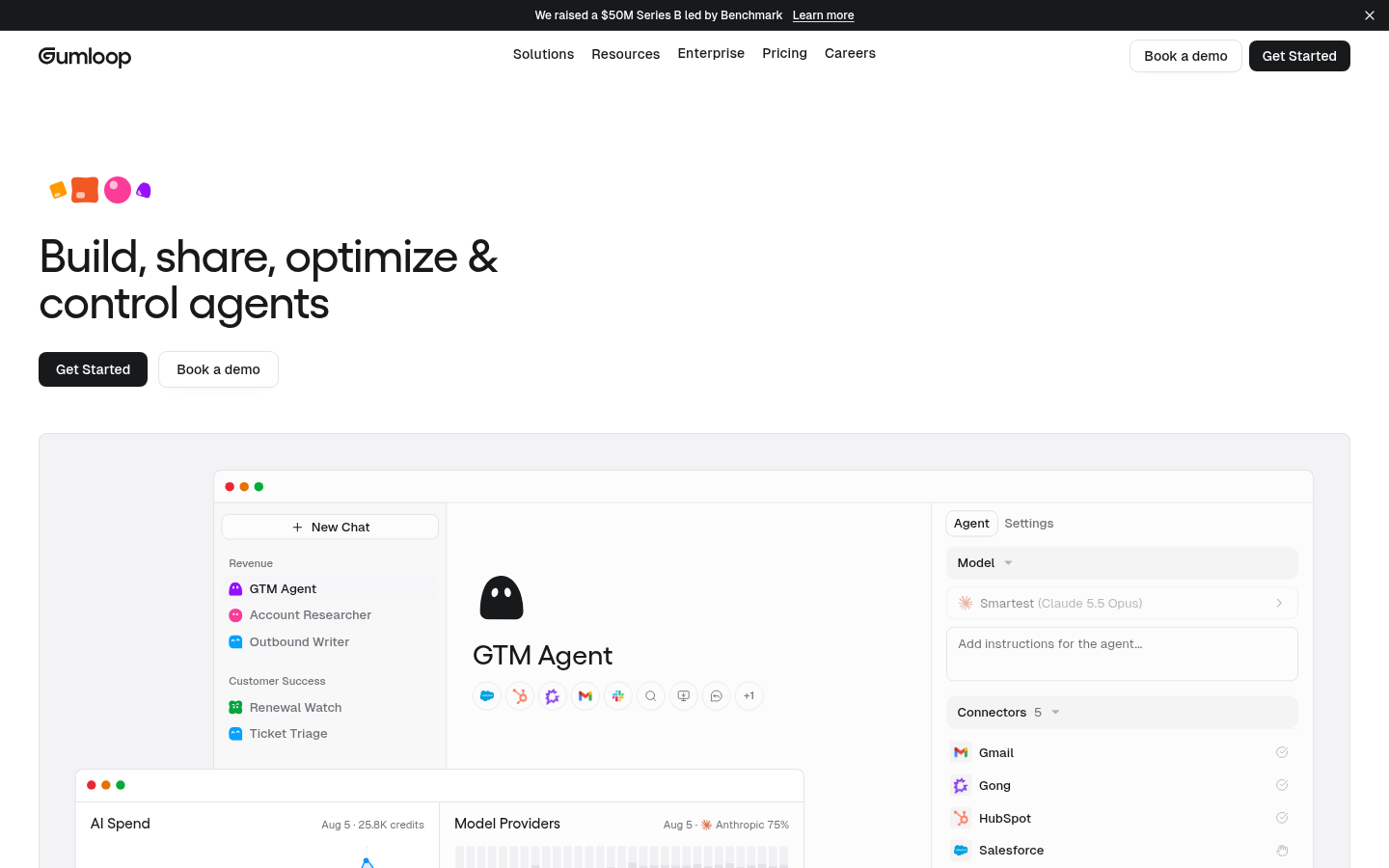
Gumloop is a web-based AI agent building platform aimed at businesses and teams that want to automate repetitive work without relying solely on engineering resources. It targets operations, sales, support, and IT teams that need to connect AI models to everyday business tools like Salesforce, HubSpot, Gmail, Slack, Notion, and Google Workspace. The core value proposition is collaborative agent-building: multiple people at a company can construct and edit AI workflows together, while IT retains centralized control over data access and permissions. This positions Gumloop less as a single-user automation script tool and more as a shared, governed workspace for building production AI agents.
What it does
Gumloop functions as a no-code/low-code workflow builder specifically for AI agents used in day-to-day business operations. Rather than requiring a developer to hand-code integrations between a CRM, email, and an LLM, Gumloop provides a visual canvas where non-technical staff can assemble multi-step automations that pull data from tools like Salesforce, Gong, Apollo, or Google Sheets, process it with an AI model, and push results back into Slack, Gmail, Notion, or Jira. The "multiplayer" framing suggests real-time or shared collaboration on building these agents, similar to how collaborative document editors work, but applied to workflow automation. It is built for teams where several departments — sales, revenue operations, customer support, IT — each need custom automations without waiting on a central engineering queue.
Key capabilities
- Multi-model support: Agents can be built using different AI models rather than being locked to a single LLM provider, giving teams flexibility to match models to task requirements.
- Broad integration catalog: Native connections to sales and CRM tools (Salesforce, HubSpot, Apollo, Gong), productivity and communication tools (Gmail, Slack, Google Drive, Google Sheets, Google Calendar), and dev/PM tools (GitHub, Jira, Linear, Notion).
- Shared, collaborative building: Multiple users within an organization can contribute to building and maintaining the same agent workflows, reducing single-owner bottlenecks common in traditional automation tools.
- Centralized IT governance: Access controls are managed by IT even as agent-building is distributed across teams, addressing a common tension between self-serve automation and enterprise security requirements.
- Cross-functional use cases: The integration set spans sales enablement (Salesforce, Gong, Apollo), support/communication (Gmail, Slack), and knowledge/project management (Notion, Jira, Linear, GitHub), indicating the tool is designed for horizontal use across a company rather than one specific department.
Pricing
Gumloop offers a free tier alongside premium paid options, consistent with a freemium model. Specific plan names, feature limits, or price points are not confirmed in the available source material, so exact tier details should be verified directly on the product's pricing page before making a purchasing decision.
Editorial review
Gumloop's strongest differentiator is its framing around collaborative, multi-user agent building combined with centralized IT oversight — a combination that addresses a real pain point in mid-size and larger organizations where shadow automation tools proliferate without governance. The breadth of integrations shown (spanning CRM, sales intelligence, communication, and dev/PM tools) suggests it is designed to serve as a general-purpose automation layer rather than a niche point solution, which should appeal to operations and RevOps teams juggling multiple SaaS tools.
That said, the publicly available material is light on hard specifics: there is no confirmed pricing structure, no detailed breakdown of which AI models are supported out of the box, and no clear description of the underlying workflow builder's technical depth (e.g., branching logic, error handling, version control for agents). Teams evaluating Gumloop for production use should test the platform directly to confirm model support, integration depth, and how access controls are actually configured in practice, since "IT controls access" is a claim that needs hands-on verification against an organization's specific compliance requirements.
Overall, Gumloop looks best suited for mid-market to enterprise teams that already use tools like Salesforce, Slack, and Notion and want a shared space for non-engineers to build AI-powered automations, rather than solo builders or highly technical teams who might prefer code-first automation frameworks with more granular control.