
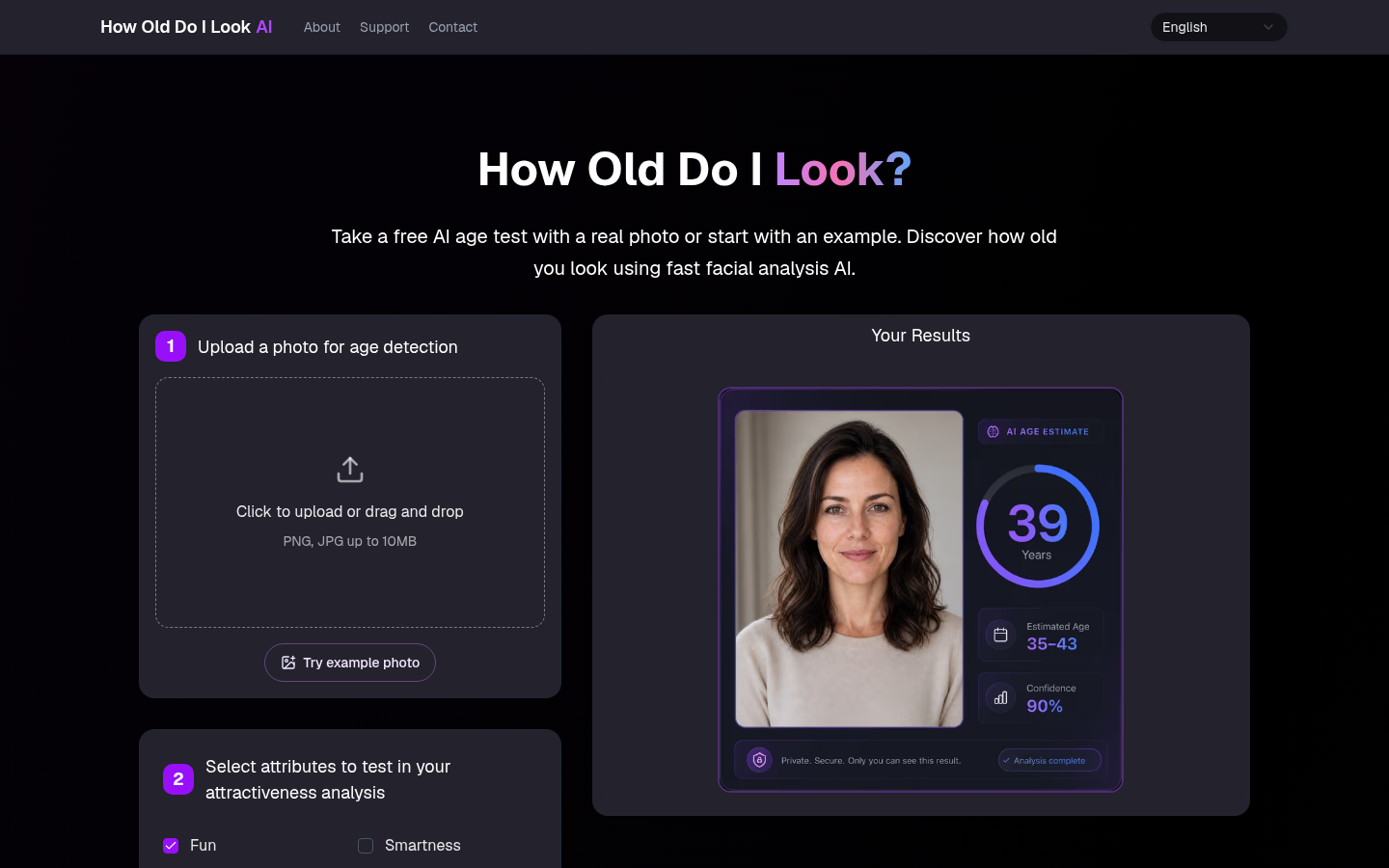

How Old Do I Look Test is a free, web-based AI age-detection tool designed for individuals curious about how their appearance is perceived. Users can upload a photo or start from an example, and in seconds receive an apparent age estimate, a face score, and trait-based impressions generated by AI analysis. The workflow is browser-based, requires no signup, and emphasizes privacy by not storing or sharing the uploaded image after analysis. The tool targets people who want quick, entertaining feedback on facial age appearance and related impressions.
What it does
How Old Do I Look Test answers the question, "How old do I look?" by applying artificial intelligence to facial imagery to estimate apparent age and provide accompanying impressions. The product is positioned as a fast, accessible tool for individuals seeking a light, non-technical evaluation of facial age, rather than a medical or forensic solution. It supports users who want to compare how age appearance changes across photos and experiments with different lighting, angles, or expressions. The core value lies in delivering an instant, browser-run result without account setup or software installation.
Key capabilities
- AI-driven age estimation from a user-uploaded facial image
- Provided confidence score to accompany the estimated age
- Front-facing, well-lit photos yield more reliable results
- Instant, in-browser processing with no sign-up required
- Privacy-focused: the tool does not store or share the photo after analysis
- Appearance impressions (trait-based outputs) such as attractiveness, trustworthiness, and approachability
Pricing
The tool is offered as Free to use with no paid tier required to access the core features. No trials or premium plans are advertised, and the service advertises free, immediate access from a web browser.
Editorial review
How Old Do I Look Test stands out as a straightforward, low-friction entertainment tool for individuals curious about perceived age. Its primary strengths are immediacy, ease of use, and a privacy-conscious approach that asserts photos are not stored or shared after processing. The absence of required sign-up lowers barriers to entry, making it suitable for casual experimentation, social media quick checks, or classroom demonstrations around AI-driven appearance analysis.
However, users should recognize the limitations inherent to appearance-based age estimation. Results can vary significantly based on lighting, camera angle, expression, makeup, and image sharpness. The model’s outputs are entertainment-oriented and should not be interpreted as precise or scientifically validated age measurements. The page does not disclose technical details about model architecture, datasets, or accuracy metrics, which may be important for users seeking rigorous evaluation. Additionally, the availability of trait-based impressions adds a subjective dimension that may not be appropriate for all audiences or contexts. Overall, the tool is best suited for curiosity-driven use, casual comparisons, and quick visual analyses rather than authoritative age assessment.


