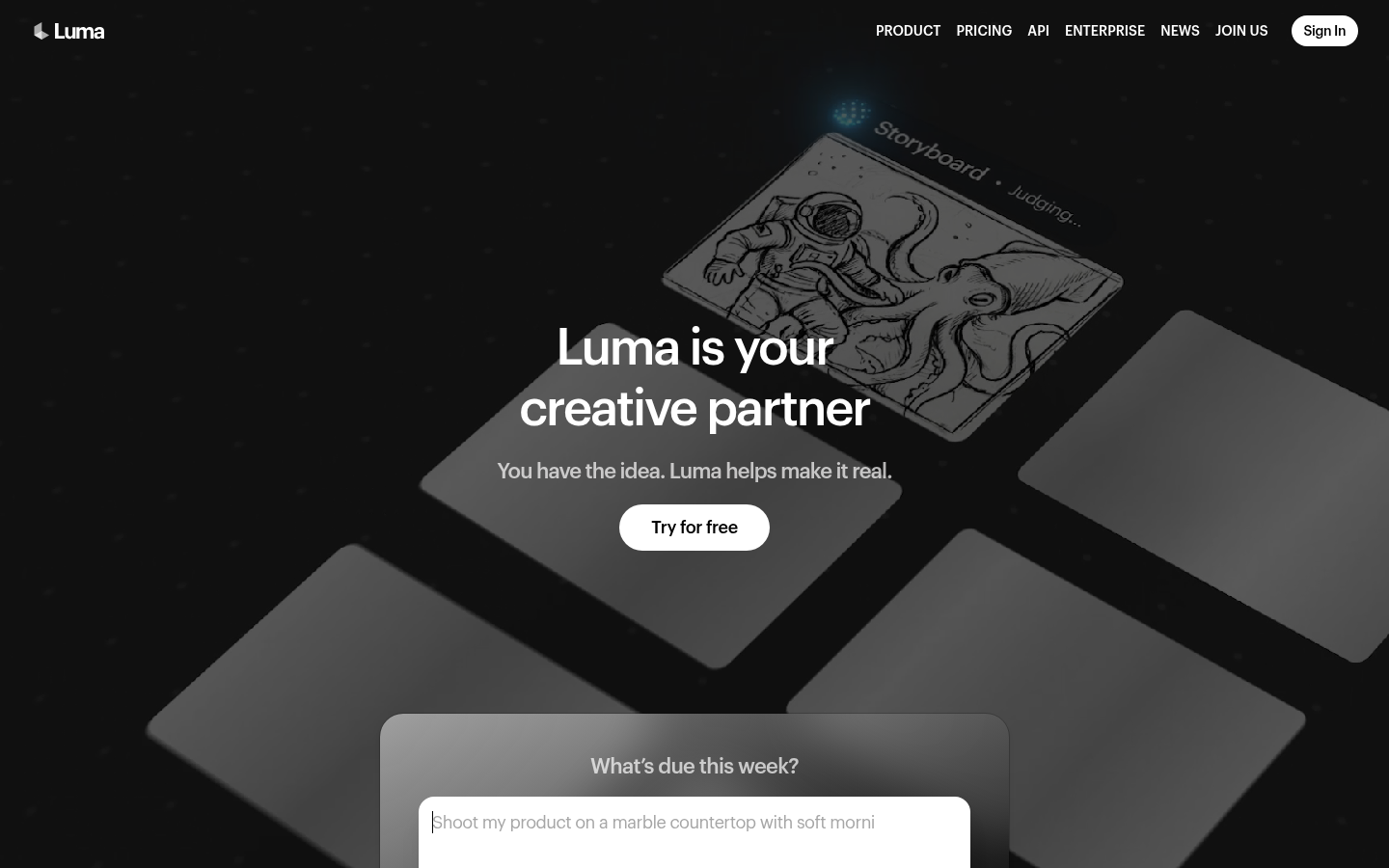
Luma AI is a creative AI platform built for brands, agencies, and creative teams that need to generate video and image content quickly while keeping visual identity consistent across large volumes of output. It centers on two proprietary model families, Ray (video generation) and Uni (image generation and brand-aware visual synthesis), combined with creative agents designed to handle multi-step workflows rather than single prompts. The platform targets in-house marketing teams, ad agencies, and production studios that need to move from concept to finished asset without traditional shoots. Luma frames its value around speed and control: producing many creative directions and variants in a single work session while maintaining brand consistency across all of them. It is delivered as a web application with companion mobile apps for iOS and Android.
What it does
Luma AI generates video and images from text or image prompts and extends that generation into structured, repeatable creative workflows. Instead of only producing one-off clips or images, the platform positions its "Luma Agents" as tools that research, generate, and refine content across video, image, audio, and text within a single project, aiming to hold brand style steady from the first draft to the final cut. Core use cases highlighted on the site include producing product hero shots, generating paid social ad variants, and cutting video teasers—tasks common to performance marketing and agency production pipelines. The platform also exposes an API and enterprise tier, indicating it is used both by individual creators inside a web app and by companies embedding Luma's generation models into their own tools or production systems.
Key capabilities
- Ray video model: A video generation model line (with the newest version referred to as Ray3.2 on the site) that supports text-to-video, image-to-video, video-to-video, and reframe operations across draft, 540p, 720p, and 1080p resolutions, with SDR and HDR output options.
- Uni image model: Described as "brand intelligence at the model level," Uni generates images while carrying forward style references, character references, and visual grounding, aimed at keeping generated assets on-brand.
- Creative agents for end-to-end workflows: Agents handle multi-step creative tasks—generating multiple directions, producing dozens of variants, and refining outputs—rather than single-shot prompt responses.
- Skills for repeatable workflows: A "Skills" feature lets users build a creative workflow once and reuse it, targeting teams that need consistent, repeatable output rather than one-off generations.
- API and enterprise access: Luma exposes its models via API alongside a dedicated Enterprise offering with custom fine-tuning, indicating support for developers and larger organizations building on top of the platform.
- Cross-platform access: Available through a web app plus iOS and Android apps, letting creative work continue outside a desktop environment.
Pricing
Luma AI uses a paid subscription structure with individual plans starting at Plus ($30/month or $300 billed yearly, 10,000 credits), scaling up to Pro ($90/month, 40,000 credits, 4x Luma Agents usage) and Ultra ($300/month, 150,000 credits, 15x Luma Agents usage). Business-tier Team and Enterprise plans are available on a contact-sales basis, adding team management, shared credits, SSO, and (for Enterprise) custom fine-tuning. Video and image generation costs also vary by model (Ray3.2, Ray3.14, Seedance 2.0/2.5) and output resolution, consumed via the credit system rather than flat per-asset pricing. No permanently free tier is confirmed in the available pricing data, though a free trial is referenced elsewhere on the site. Pricing page: View pricing.
Editorial review
Luma AI's strongest differentiator is that it builds its own underlying models (Ray and Uni) rather than wrapping third-party APIs, which shows up in feature depth like frame-level video control, continuity across cuts, and brand-reference-aware image generation. The credit-based pricing tied to resolution and model choice gives cost transparency but also means costs can escalate quickly for 1080p or HDR-heavy workloads, which agencies should model carefully before committing to a plan. The Skills feature and Luma Agents suggest a genuine push toward workflow automation rather than isolated content generation, which differentiates it from simpler single-prompt generators, but the practical reliability of "end-to-end" agent workflows isn't independently verifiable from the site content alone. Best-fit users are marketing teams, agencies, and production studios generating high volumes of on-brand video and image variants for paid social and product marketing; solo creators or hobbyists may find the entry-level pricing steep compared to consumer-oriented generators. The lack of a clearly stated permanent free tier is a limitation worth noting for budget-conscious users.