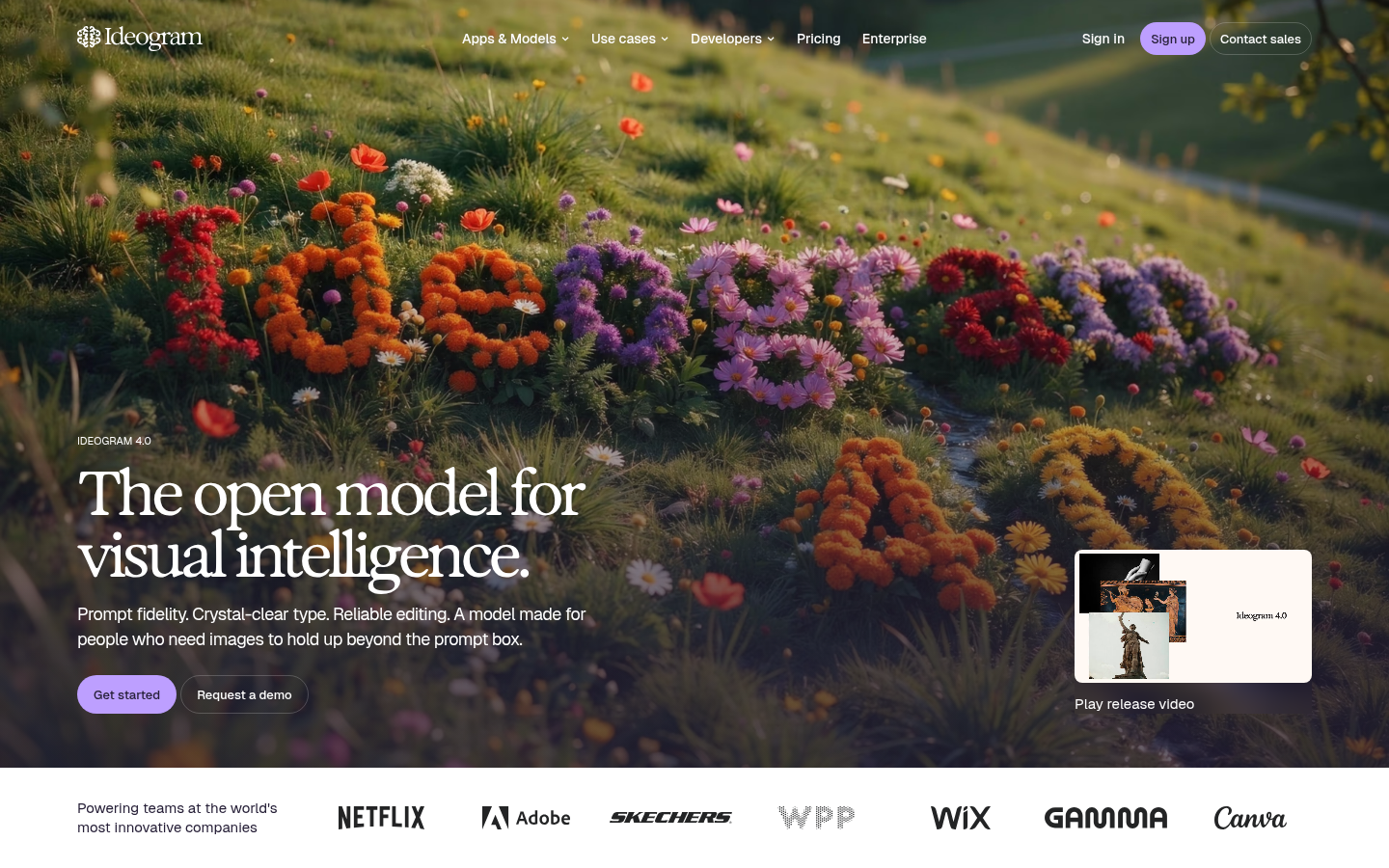
Ideogram is an AI image and video generation platform aimed at designers, marketers, developers, and creative professionals who need production-ready visuals without juggling multiple AI tools. Instead of forcing users to choose a single model, Ideogram bundles purpose-built AI apps with API access to several major image and video generation models, alongside its own proprietary Ideogram 4.0 model. The platform is used by teams at companies like Netflix, Adobe, Skechers, WPP, Wix, Gamma, and Canva for tasks ranging from marketing creative to illustrated book covers and stylized character art. Its core value proposition is consolidation: one account and one API surface to reach multiple generation engines instead of separate subscriptions and integrations.
What it does
Ideogram functions as a web-based hub for AI-generated visual content. Users can generate images, posters, book covers, character illustrations, and video clips by typing text prompts, and the platform routes requests across different underlying models depending on the task. This makes it useful for practical use cases such as vintage-style travel posters, anime-style scene illustrations, fantasy landscapes, fashion portraits, stickers, and sci-fi concept art — all visible as example outputs on the site. Beyond the consumer-facing apps, Ideogram exposes an API so developers can integrate image and video generation directly into their own products, which is why it appeals to both individual creatives and engineering teams building AI-powered features.
Key capabilities
- Multi-model access through one API: Instead of integrating separately with each provider, developers can reach several major image and video generation models via a single Ideogram API endpoint.
- Proprietary Ideogram 4.0 model: The platform's own generation model, positioned as a foundation others can build on, alongside third-party models available through the same interface.
- Purpose-built AI apps: Rather than a single generic prompt box, Ideogram offers task-specific apps tailored to particular creative outputs (posters, illustrations, character art, etc.), reducing prompt-engineering overhead for non-technical users.
- Rich style range: Example outputs span vintage poster design, anime illustration, fantasy and sci-fi concept art, fashion photography-style portraits, book cover design, and sticker/character art, indicating broad stylistic flexibility.
- Enterprise and brand adoption: Companies including Netflix, Adobe, Skechers, WPP, Wix, Gamma, and Canva are referenced as customers, suggesting the platform is used in professional creative and marketing pipelines, not just hobbyist generation.
- Web and mobile access: The product is accessible via a web app, with mobile access also supported for on-the-go generation and review.
Pricing
Ideogram operates on a freemium model: the platform is free to use with premium, paid options available for expanded access or capabilities. A trial of premium features appears to be available. Specific plan names, credit limits, or price points are not confirmed in the available source material, so prospective users should check the live pricing page on the site for current tiers before committing to a paid plan.
Editorial review
Ideogram's main differentiator is consolidation rather than raw model quality: by putting multiple image and video generation models behind one app suite and one API, it reduces the integration and subscription overhead that comes with using several separate AI vendors. This is particularly relevant for development teams building AI features into products, since a single API contract can replace multiple vendor integrations. For creative professionals, the purpose-built apps (posters, book covers, character art, etc.) lower the barrier compared to generic prompt-based tools, since the interface is tailored to specific output types rather than a blank canvas.
The trade-off is that specific technical details — model names beyond "Ideogram 4.0," exact pricing tiers, resolution/output limits, and licensing terms for generated content — are not fully detailed in the available material, which makes it hard to assess how it compares feature-for-feature against dedicated competitors in image generation or video generation. The presence of recognizable enterprise customers (Netflix, Adobe, Canva, Wix) is a credible trust signal for production use, but buyers evaluating the platform for commercial work should verify licensing and usage rights directly before scaling deployment. Overall, Ideogram looks best suited for teams that want one platform and API to cover multiple AI visual generation needs, rather than users seeking the single best-in-class model for one narrow style.