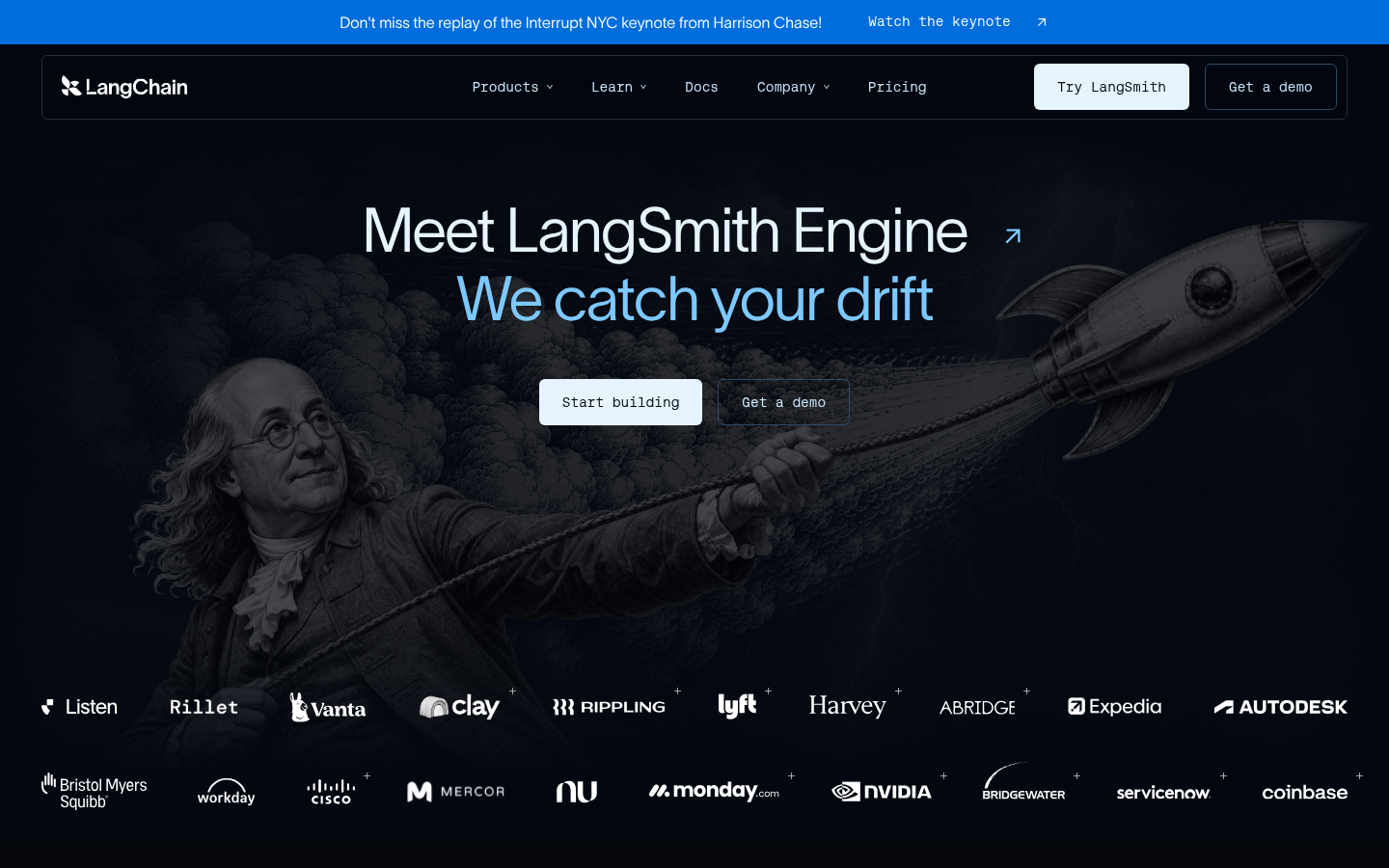
LangChain is an open agent engineering platform aimed at engineering teams building applications and autonomous agents powered by large language models. It targets developers, data scientists, and organizations that need to move LLM prototypes into production while retaining control over how those agents are built, monitored, and governed. The platform's core value proposition is letting companies "own their intelligence" rather than relying entirely on closed, opaque agent infrastructure — combining an open-source framework with commercial tooling for observability, deployment, and evaluation. LangChain is positioned as infrastructure for the full agent lifecycle, from prototyping to production-grade operation at scale.
What it does
LangChain provides a framework and toolset for building applications and agents on top of large language models. It gives developers a flexible way to connect LLMs to external data sources, APIs, and tools, chaining together prompts, retrieval steps, and decision logic into working agents. Beyond the open-source library, LangChain's broader platform (including components referred to as LangSmith Engine, LangSmith LLM Gateway, and LangSmith Fleet in its marketing materials) extends this into observability, debugging, and fleet-level management of deployed agents. The company describes itself as trusted by thousands of organizations, with enterprise logos such as Rippling, Lyft, Harvey, Expedia, Autodesk, Workday, Cisco, ServiceNow, Coinbase, Nvidia, and Bridgewater appearing on its site, suggesting adoption across sectors like fintech, legal tech, travel, and infrastructure software.
Key capabilities
- LLM application framework: Core open-source library for chaining prompts, retrieval, memory, and tool calls into working LLM applications and agents.
- Multi-source data and API connectivity: Flexible infrastructure for connecting agents to external data sources, databases, and third-party APIs.
- Agent observability and gateway tooling: Named platform components (LangSmith Engine, LangSmith LLM Gateway, LangSmith Fleet) suggest capabilities around monitoring, routing LLM traffic, and managing fleets of deployed agents.
- Sandboxed execution environments: Referenced "sandboxes" functionality points to isolated environments for testing or running agent workflows safely.
- Multi-language and multi-platform support: Framework support extends across programming languages, letting teams integrate LangChain into existing engineering stacks.
- Enterprise-scale deployment claims: Marketing materials cite adoption by large enterprises across finance, legal, logistics, and technology, indicating focus on production-grade, governed agent deployment rather than only hobbyist prototyping.
Pricing
LangChain's core framework is open source, consistent with its long-standing developer-tool roots, and the site frames the platform as enabling companies to "own" their intelligence stack rather than paying purely for a closed SaaS product. The homepage content does not surface a detailed public pricing table, specific plan tiers, or per-seat costs, so paid components (such as the LangSmith observability and gateway tooling) likely follow a separate commercial pricing structure typical of enterprise infrastructure vendors. No specific dollar figures, plan names, or trial terms are confirmed in the available source material, so prospective users should confirm current plan details directly on LangChain's site before budgeting.
Editorial review
LangChain's strength lies in its origin as one of the most widely adopted open-source frameworks for LLM application development, giving it a large existing developer base and ecosystem of integrations. The expansion into named platform products (engine, gateway, fleet management, sandboxes) signals a shift from a pure library toward a fuller agent operations stack, competing with observability and orchestration vendors rather than just other frameworks. This is likely appealing to engineering teams that already have LangChain in their stack and want tighter production controls without switching frameworks.
The trade-off is that the homepage leans heavily on logo-drop credibility (Nvidia, ServiceNow, Coinbase, and similar enterprise names) and open-ended language like "own your intelligence" without exposing granular product documentation, architecture diagrams, or transparent pricing in the reviewed material. Teams evaluating LangChain for production agent systems will need to dig into technical docs to assess how the newer commercial layers (gateway, fleet, sandboxes) differ from, or build on, the open-source core. Best-fit users are engineering-led organizations already comfortable with LLM tooling who want a single vendor spanning framework, observability, and governance; teams wanting a fully no-code or turnkey agent builder may find the developer-first orientation less suited to their needs.