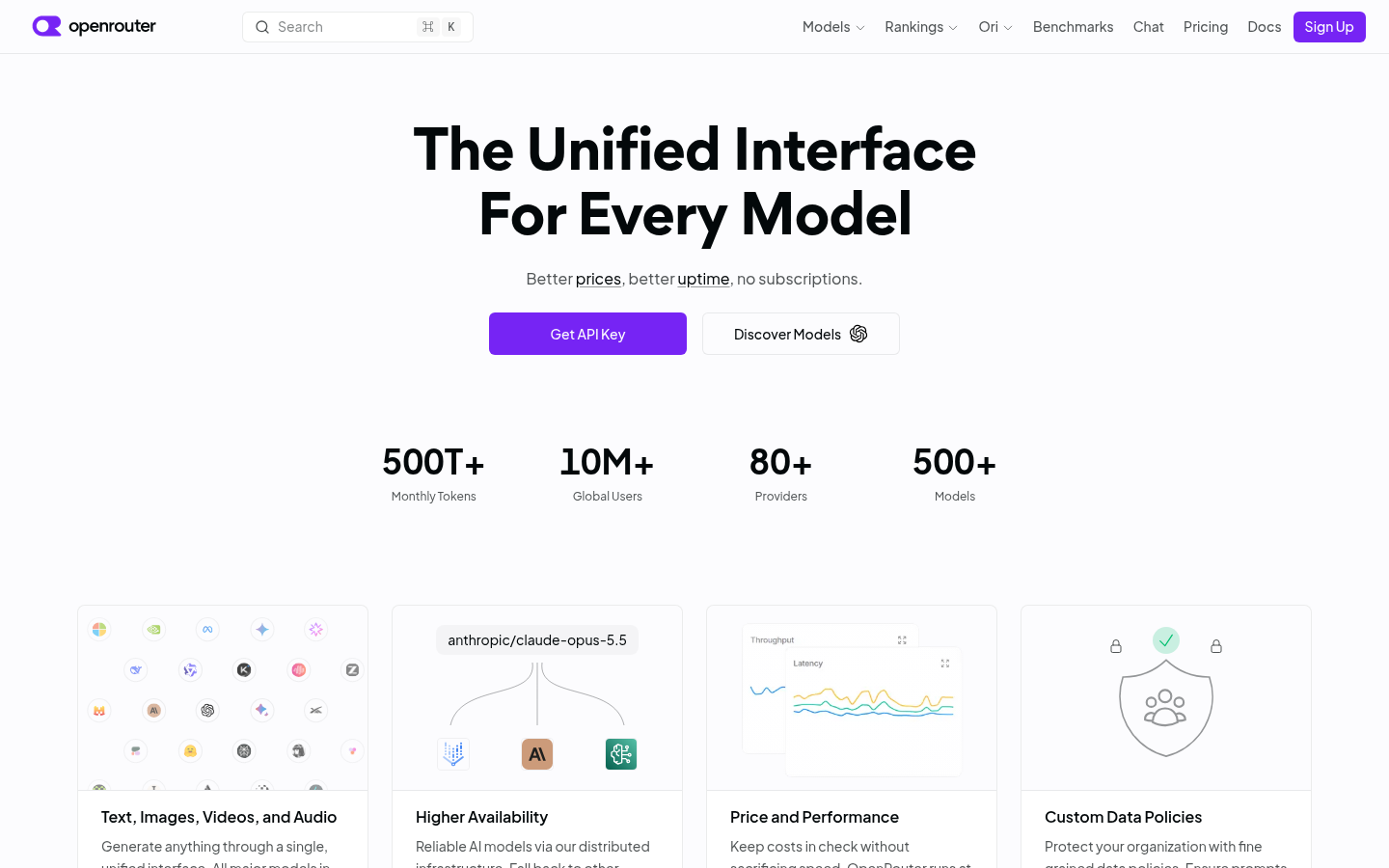
OpenRouter is a unified API gateway and web interface for accessing large language models and other generative AI models from dozens of providers through a single, OpenAI-compatible endpoint. It targets developers, data scientists, and teams building AI-powered applications who want to avoid integrating separately with OpenAI, Anthropic, Google, Meta, Mistral, DeepSeek, Qwen, and other model providers. The core workflow is straightforward: create an account, generate an API key, and route requests to any supported model by changing a single parameter rather than rewriting integration code. OpenRouter positions itself around price and performance transparency, automatic failover across providers, and fine-grained control over where prompt data is allowed to go.
What it does
OpenRouter functions as "the unified interface for every model," letting developers query text, image, video, and audio generation models from over 80 providers through one OpenAI-compatible API. Instead of managing separate SDKs, billing accounts, and rate limits for each AI provider, users send requests to OpenRouter's endpoint and specify which model to use—switching between models like Claude, GPT, Gemini, or open-weight alternatives such as DeepSeek and Qwen with minimal code changes. The platform is built for use cases like model comparison, cost optimization across prompts, building AI agents and apps that need resilient access to inference, and benchmarking model performance and pricing side by side. It serves both individual developers experimenting with prompts and organizations running production workloads that need reliability guarantees.
Key capabilities
- Model routing across 500+ models and 80+ providers: Send a single API call and access models from OpenAI, Anthropic, Google, Meta, Mistral, DeepSeek, Qwen, xAI, Cohere, Perplexity, and other providers without separate integrations.
- Automatic failover for higher availability: Requests can fall back to alternative providers if a primary provider experiences downtime, reducing single-point-of-failure risk for production applications.
- Price and performance visualization: Built-in graphs and model comparison pages (including a models directory sortable by price) help users evaluate cost, latency, context length, and benchmark results before committing to a model.
- Custom data policies: Organizations can configure fine-grained rules restricting which models and providers are allowed to process prompts, aimed at compliance and data governance requirements.
- OpenAI-compatible API: Existing code written for OpenAI's API can typically point to OpenRouter with minimal modification, lowering migration friction.
- Model and app discovery: The site surfaces featured models, trending token usage, weekly trend data, and featured agents/apps (such as coding assistants and autonomous agents) built on top of OpenRouter.
Pricing
OpenRouter uses a pay-as-you-go, credit-based pricing structure rather than a traditional subscription: users add credits to their account and consumption is deducted per request based on the model used. The pricing page confirms multiple plan tiers—Free, Standard, Business, and Enterprise—alongside a stated policy of "pay only for what you use" across the 500+ available models. Exact per-model rates vary by provider and are listed on the models comparison page, which can be sorted from lowest to highest price. No credit card or subscription commitment is described for basic usage. Pricing page: View pricing
Editorial review
OpenRouter's core value proposition—one API key, hundreds of models, and built-in failover—addresses a real pain point for teams tired of maintaining separate integrations and billing relationships with each AI lab. The price/performance comparison tooling and sortable model directory are genuinely useful for developers deciding between, say, a cheaper open-weight model and a premium frontier model for a given task. The custom data policy feature is a meaningful differentiator for teams with compliance constraints who need assurance that prompts won't be routed to untrusted providers.
The trade-off is that OpenRouter sits as a middleman layer, which introduces a dependency: outages or policy changes at OpenRouter itself become a new failure point, even as it protects against individual provider outages. Latency-sensitive applications should also verify that routing overhead doesn't offset the benefits of edge-based inference claims. Because the platform aggregates third-party models rather than building its own, feature parity, rate limits, and fine-tuning options are ultimately bounded by what each upstream provider exposes through the API.
Best-fit users are developers and product teams building LLM-powered applications, agents, or coding tools who want provider flexibility without vendor lock-in, plus organizations that need to compare model costs at scale or enforce data-handling rules. It is less relevant for non-technical users seeking a polished consumer chatbot experience, since the primary interface is developer-oriented (API keys, SDKs, and a models dashboard), though a chat interface is also available. Teams already fully committed to a single provider's ecosystem (e.g., deeply integrated with OpenAI's function-calling or Anthropic-specific features) may find less incremental value unless multi-model flexibility or failover is a priority.