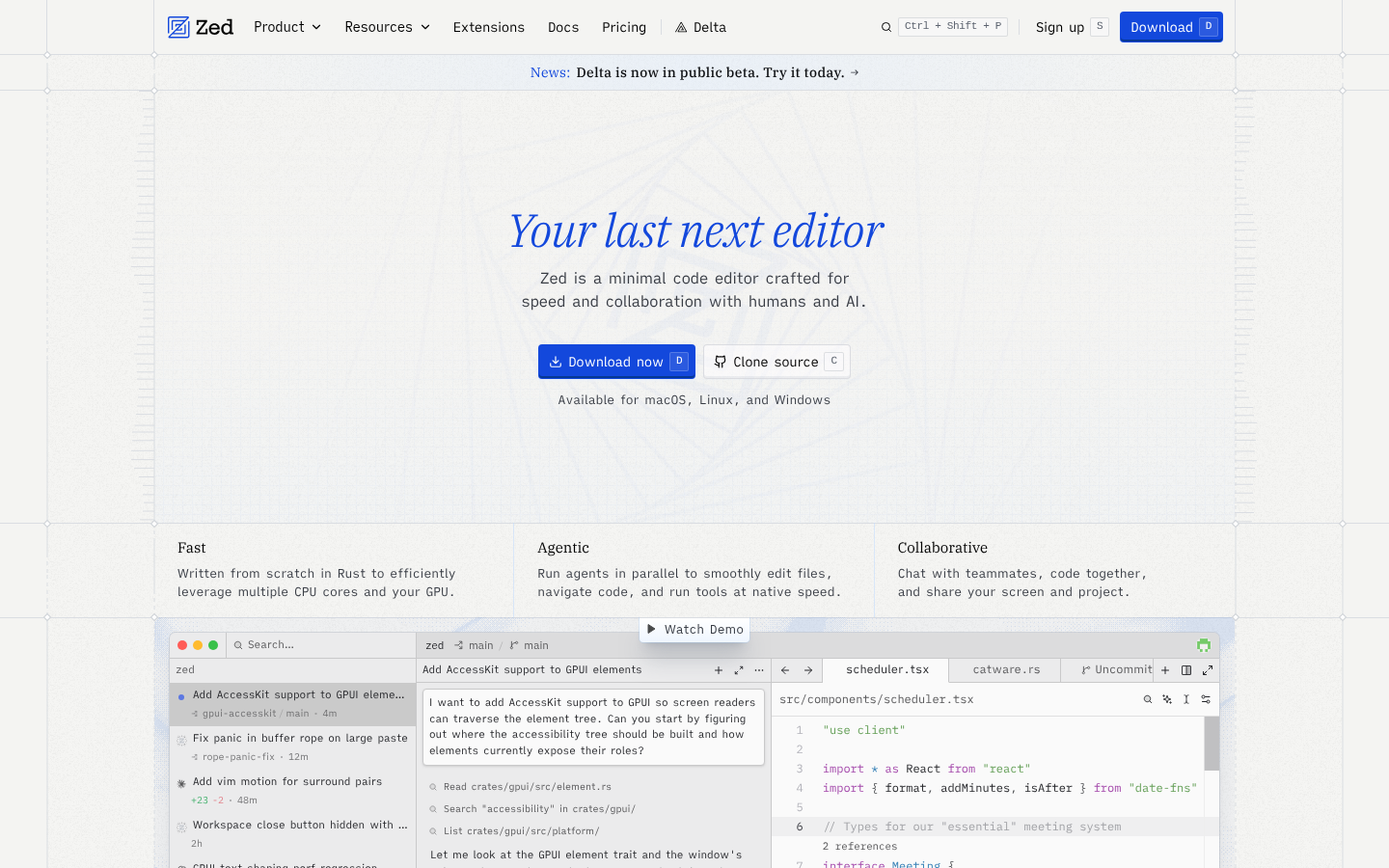
Zed is a code editor built for developers and engineering teams who want native performance, multiplayer collaboration, and AI-assisted coding without leaving a single application. It comes from the creators of Atom and Tree-sitter and is written from scratch in Rust to take advantage of multiple CPU cores and the GPU. The editor targets individual developers, pairs, and organizations that need centralized controls over AI usage across a team. Its core workflow blends manual editing with AI agents that can navigate code, edit files, and run tools directly inside the editor, alongside real-time pair programming with teammates. Zed is distributed as a standalone desktop application for macOS, Linux, and Windows.
What it does
Zed functions as a general-purpose, multi-language code editor with built-in agentic AI, an integrated terminal, and Git tooling, aimed at developers who want an editor that "just works" without heavy configuration. It supports version control workflows, debugging, and an extensions ecosystem for adding language and tooling support. A notable differentiator is Zed's ability to run multiple AI coding agents in parallel within the same workspace, letting developers delegate tasks like refactors, bug investigation, or file navigation to agents while continuing manual work elsewhere. The product also supports live, multiplayer sessions where teammates can code together, chat, and share screens and projects in real time, positioning it as both a personal daily-driver editor and a collaboration tool for distributed teams.
Key capabilities
- Native, multi-core performance: Built in Rust to leverage multiple CPU cores and the GPU rather than running as an Electron-based wrapper, aimed at reducing input latency and improving responsiveness on large codebases.
- Parallel AI agents: Runs multiple coding agents concurrently to edit files, navigate code, and execute tools, rather than limiting AI assistance to a single sequential chat thread.
- Real-time multiplayer collaboration: Enables pair programming with shared editing, chat, and project/screen sharing directly inside the editor.
- Integrated terminal and Git tooling: Combines a built-in terminal with Git workflow support so common command-line and version-control tasks stay inside the editor.
- Growing extensions ecosystem: Supports third-party extensions to add language support and additional editor functionality.
- Org-level AI governance (Business tier): Offers organization-wide AI model policies, data governance controls, unified spend visibility, and role-based access control for teams managing AI usage at scale.
Pricing
Zed uses a tiered freemium model. The Personal plan is free forever and includes a fixed allotment of accepted edit predictions, plus unlimited use when developers bring their own API keys or connect external agents such as Claude Agent or Codex CLI. The Pro plan is priced at $10 per month, includes unlimited edit predictions, and bundles a set amount of included token usage with usage-based billing beyond that allowance; a free trial is available for this tier. The Business plan is priced at $30 per seat, per month, and adds org-wide AI model policies, data governance controls, unified spend visibility, and role-based access controls; it does not bundle a fixed AI credit allotment, and organizations can use Zed-hosted AI at standard rates or bring their own provider keys. There is no minimum seat count for Business, and order-form contracts are available for organizations with 25 or more seats. Pricing page: View pricing
Editorial review
Zed's core strengths are clear from its architecture and feature set: a Rust-based, GPU-accelerated editor with native multiplayer collaboration is a genuinely different technical approach than most Electron-based competitors, and the ability to run several AI agents in parallel inside one workspace is a distinctive workflow rather than a marketing label. The tiered pricing structure is also transparent and reasonably conservative, with a genuinely free Personal tier for developers who don't need bundled AI, a mid-priced Pro tier for individuals wanting hosted models, and a Business tier focused specifically on governance and billing controls rather than duplicating Pro features.
The trade-offs are around ecosystem maturity: the extensions marketplace is described as "growing" rather than established, meaning some workflows common in older editors like VS Code may have fewer or newer plugin equivalents. Teams already invested in a specific AI vendor's contract will want to verify Zed's bring-your-own-key support meets procurement requirements, since Business seats don't include bundled AI credits by default. Zed appears best suited to individual developers and small-to-midsize engineering teams who value editor performance and want AI agents and pair programming built into the core product rather than added on through extensions, and to organizations that need centralized oversight of AI tool usage across many seats.