
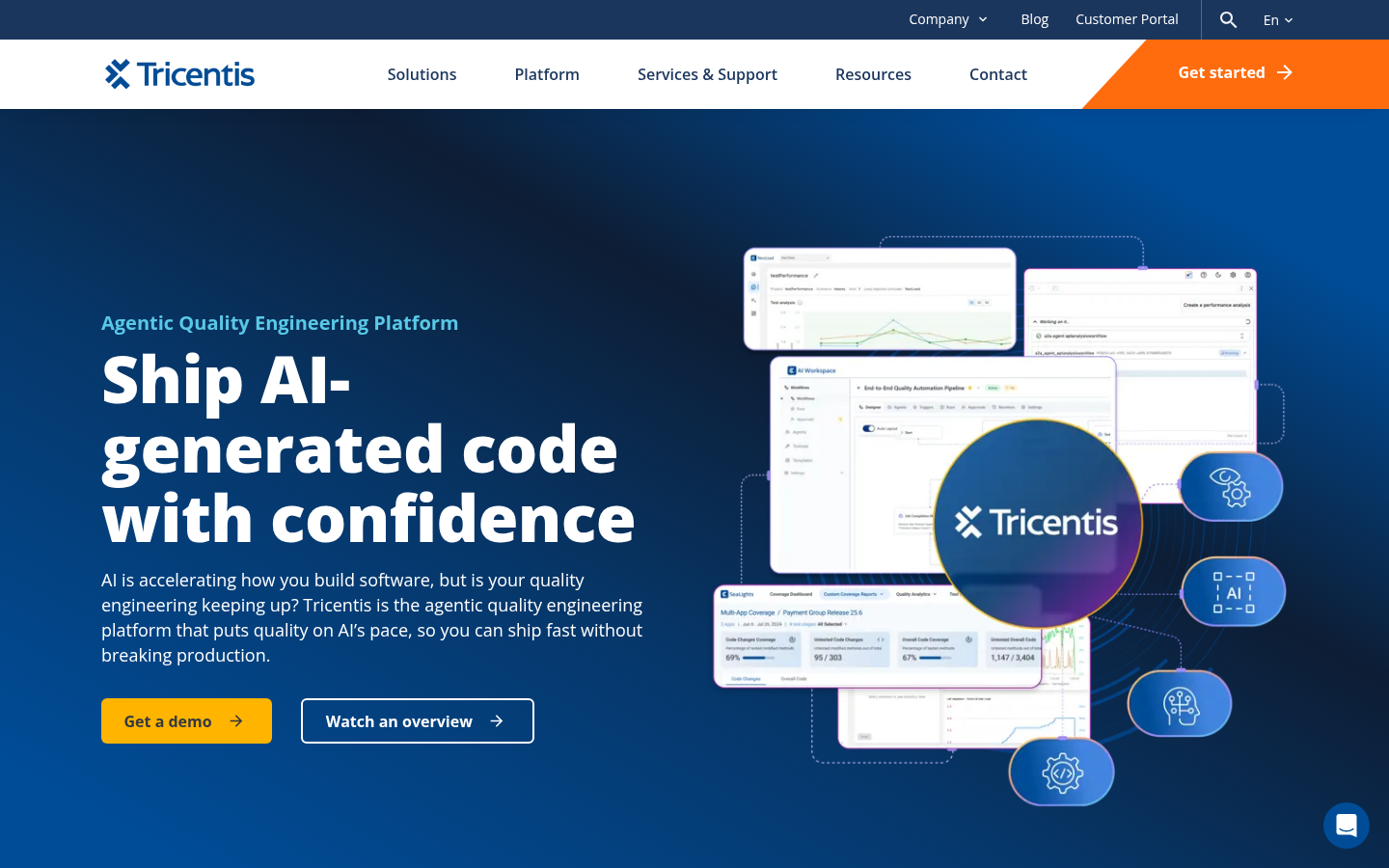
Tricentis' Agentic Quality Engineering Platform is a software testing and quality assurance platform built for QA professionals, software developers, and IT teams that need to keep pace with AI-generated code. As AI coding assistants accelerate development, testing has become the bottleneck; this platform addresses that gap by deploying specialized AI agents, coordinated through a governed control plane called AI Workspace, to test, validate, and help release software faster without sacrificing confidence in what ships.
What it does
The platform positions itself as an answer to a specific modern problem: AI writes code faster than teams can manually test it. Tricentis' Agentic Quality Engineering Platform unifies multiple purpose-built AI agents under a single governed control plane so that test creation, test automation, and release validation happen continuously rather than as a manual bottleneck at the end of a sprint. It is aimed at enterprise quality engineering teams, DevOps and CI/CD pipelines, and organizations running continuous delivery who need automated, AI-driven testing that scales alongside AI-assisted development. Rather than replacing existing QA processes wholesale, it is designed to sit inside the software delivery lifecycle, connecting test design, execution, and reporting into one coordinated workflow.
Key capabilities
- AI-driven test automation: Automated generation and execution of tests intended to keep pace with the speed of AI-generated application code.
- Agentic test creation: Specialized AI agents handle discrete testing tasks (such as generating test cases) rather than relying on a single monolithic automation engine.
- Governed AI Workspace control plane: A centralized layer that coordinates and governs the behavior of AI agents across the testing lifecycle, aimed at giving teams oversight and control rather than unmanaged automation.
- Integrated testing capabilities: Testing functions are integrated across the platform rather than operating as disconnected point tools, supporting a more unified quality engineering workflow.
- Continuous testing pipelines: Support for ongoing, pipeline-based testing intended to align with continuous integration and continuous delivery practices.
- Performance testing modules: Dedicated functionality for evaluating application performance alongside functional test coverage.
Pricing
Public marketing material frames the platform around a freemium-style structure, with a free entry point and premium options for teams that need expanded capability, though the source material does not list specific plan names, seat limits, or feature breakdowns by tier. Organizations evaluating the platform should expect to engage directly with Tricentis for detailed enterprise pricing, as is typical for quality engineering and test automation platforms sold to larger IT and QA organizations.
Editorial review
Tricentis is an established name in enterprise software testing, and this Agentic Quality Engineering Platform reflects a broader industry shift toward using AI not just to write code but to validate it. The core value proposition—governed AI agents handling test creation and execution so quality checks don't lag behind AI-assisted development—is a credible and increasingly relevant pitch for enterprises adopting AI coding tools at scale. The emphasis on a governed control plane (AI Workspace) rather than a loose collection of automation scripts suggests an intent to address enterprise concerns around auditability and control of AI-driven processes, which is a reasonable differentiator in a market where many AI testing tools lack oversight mechanisms.
That said, the available material is heavy on positioning language and light on granular detail: there are no concrete pricing tiers, no named integrations with specific CI/CD tools or version control systems, and no independently verifiable performance benchmarks in the source content. Teams evaluating this platform should treat marketing claims about "AI speed" testing as directional rather than quantified, and should request a demo or trial to assess how the agentic workflows perform against their own codebases and existing test suites. Best-fit users appear to be mid-to-large enterprise QA and DevOps teams already using or considering AI coding assistants, who need a testing layer that can scale with faster code output, rather than small teams or individual developers looking for a lightweight, self-serve testing tool.



