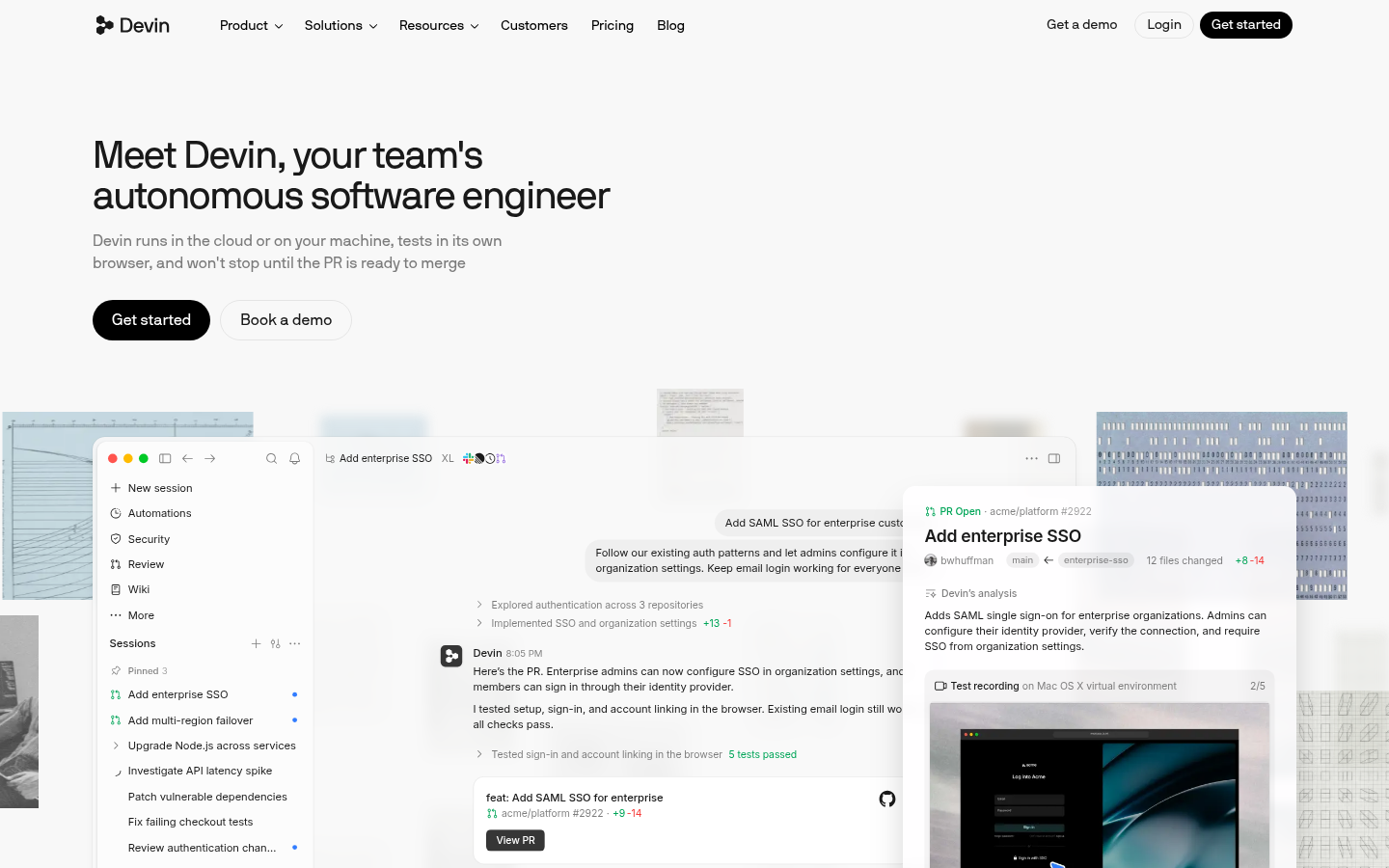
Devin is an autonomous AI coding agent built by Cognition, aimed at software developers and engineering teams that need help clearing backlogs of real engineering work rather than just autocompleting lines of code. Instead of suggesting snippets inside an editor, Devin takes a task description, works through a codebase across multiple repositories, writes and tests code in its own isolated environment, and opens a pull request ready for human review. It runs as cloud agents that can work in parallel, or locally via a desktop app and CLI, making it suited to teams that want to offload well-defined engineering tickets like SSO implementations, dependency upgrades, bug fixes, or test coverage expansion.
What it does
Devin functions as an AI software engineer that takes a task — a feature request, bug report, or security patch — and carries it through the full development lifecycle: exploring the relevant repositories, writing code, running tests in its own browser and virtual environment, and submitting a pull request with a written summary of its analysis and test results. It is designed for "problem to merged PR" workflows rather than single-line suggestions, and it integrates with tools engineering teams already use, including GitHub, GitLab, Bitbucket, Slack, Microsoft Teams, Linear, and Jira. Sessions can be tracked and reviewed individually, with Devin documenting what it explored, what it changed, and what it verified before handing work back to a human reviewer.
Key capabilities
- Autonomous PR workflow: Devin explores a codebase, implements a fix or feature, writes and runs tests in an isolated virtual environment, and opens a pull request with a written explanation of its changes.
- Parallel cloud agents: Multiple Devin sessions can run concurrently, letting teams delegate several tickets — security patches, latency investigations, dependency upgrades — at the same time.
- Devin Review: An automated code review mode that analyzes diffs, flags bugs, and categorizes changes on pull requests.
- DeepWiki and documentation: Devin can generate and maintain architecture documentation for a service or repository, reducing manual onboarding and knowledge-sharing overhead.
- Multi-model routing (Fusion mode): Devin pairs different underlying models (including its own SWE-2 model alongside frontier models) for different sub-tasks — planning, coding, testing, computer use — to balance cost and capability.
- Enterprise controls: SAML/OIDC SSO, centralized admin dashboards, dedicated deployment options, and support for major git providers are available on higher-tier plans.
Pricing
Devin uses a freemium structure with five published tiers. A Free plan offers limited quota and model availability with unlimited inline edits and Tab completions. The Pro plan is $20/month and adds increased quotas, access to frontier models (OpenAI, Claude, Gemini, and others) alongside open-source models, and cloud agent access. A Max plan at $200/month raises quotas further. Team plans start at $80/month plus $40/month per full developer seat, adding multi-user collaboration, centralized billing, and an admin dashboard, with a cap of up to 200 users. An Enterprise tier is quote-based and adds SSO, dedicated account management, and dedicated deployment. Cognition has also stated that recent model and harness updates reduced usage costs by roughly 15-40% depending on mode, and up to 70% cheaper in Devin Review. Pricing page: View pricing
Editorial review
Devin's core pitch — a coding agent that hands back a tested, documented pull request rather than a code suggestion — sets it apart from inline AI coding assistants and puts it closer to an outsourced junior engineer than a productivity plugin. The parallel cloud agent model and integrations with Slack, Linear, Jira, and major git providers suggest a genuine attempt to fit into existing team workflows rather than requiring a new interface. Enterprise customers referenced on the site (including large organizations) and enterprise-grade controls like SAML/OIDC SSO indicate the product is being positioned for serious engineering organizations, not just solo developers.
The trade-offs are the ones inherent to any autonomous coding agent: task quality depends heavily on how well-scoped the ticket is, and human review of every PR remains necessary, which the product itself acknowledges by centering its workflow around review rather than auto-merge. Pricing is not trivial — Team and Enterprise costs scale with seats, and even the Pro tier is metered against model usage, so cost predictability requires some evaluation. The product is best suited to engineering teams with a backlog of well-defined, medium-complexity tasks (dependency upgrades, test coverage, documentation, security patches) rather than teams looking for a full replacement for senior engineering judgment. Developers evaluating Devin should test it against their own repositories and CI setup before committing to a paid seat, since real-world performance on messy, legacy, or highly domain-specific codebases will vary from the polished examples shown in marketing material.