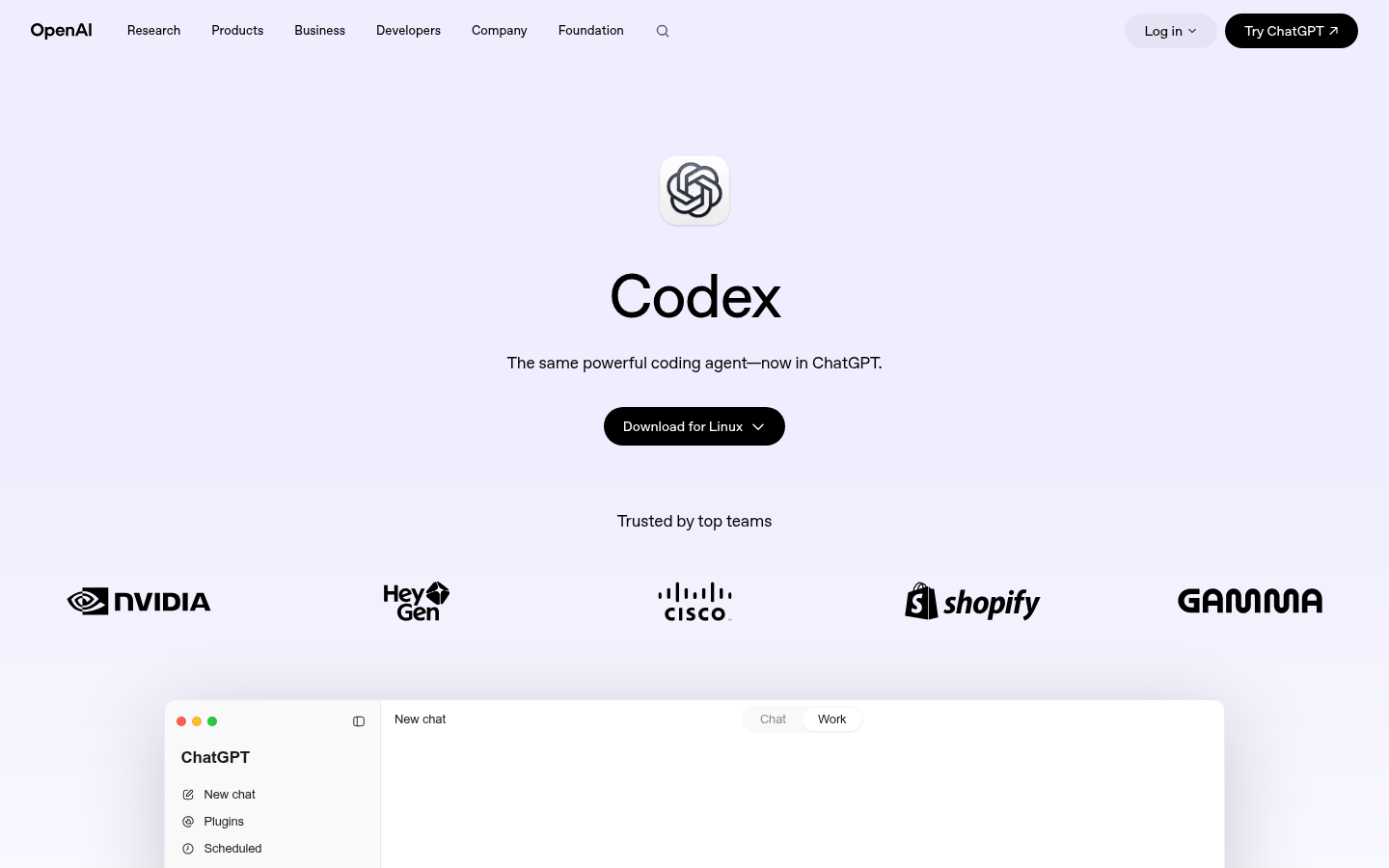
Codex is an AI coding agent from OpenAI built for software developers and engineering teams who want to offload substantial chunks of real engineering work, not just autocomplete suggestions. It runs across multiple surfaces—the terminal, code editor, ChatGPT, and web—so developers can delegate tasks from wherever they already work. The core workflow centers on multi-agent collaboration: several Codex agents can work in parallel on different parts of a codebase, handling planning, feature building, refactors, code review, and release tasks. It is positioned as a coding partner rather than a simple completion tool, aimed at accelerating end-to-end engineering workflows instead of isolated snippets.
What it does
Codex functions as an AI coding assistant and autonomous coding agent that connects to a developer's existing codebase and development context. It is designed to handle tasks across the full software lifecycle: drafting implementation plans, writing and modifying code, running and fixing tests, reviewing pull requests, and preparing releases. Rather than operating as a single chat window, Codex is built into multiple product surfaces—an app experience inside ChatGPT, a code editor integration, and a command-line terminal interface—so teams can trigger and monitor agent tasks from whichever environment fits a given workflow. Background, always-on task execution is also part of the design, letting agents continue working on assigned engineering tasks while a developer is away, with results surfaced later for review.
Key capabilities
- Multi-agent parallel execution: Multiple Codex agents can work simultaneously on different tasks within the same project, such as building a feature while another agent handles a refactor.
- Cross-surface availability: Codex is accessible through a terminal interface, a code editor experience, and an integrated app inside ChatGPT, allowing developers to choose the interface that matches their workflow.
- Full engineering lifecycle support: Beyond code generation, Codex assists with planning, refactoring, pull request review, quality checks, and release preparation.
- Background task processing: Codex can run assigned tasks asynchronously, with an inbox-style panel surfacing completed work for review rather than requiring constant supervision.
- Codebase-aware context: The agent connects to development context and changed-file history, enabling review panels that show diffs and progress on in-flight tasks.
- Team-oriented workflows: The product is framed around supporting engineering teams and organizational development practices, not just individual coding sessions.
Pricing
Codex is offered under a freemium structure, with a free tier available alongside paid options for expanded usage. Specific plan names, usage limits, and paid tier pricing are not detailed in the available source material, so prospective users should check OpenAI's official Codex page for current plan specifics before committing to a paid tier.
Editorial review
Codex stands out for treating AI-assisted coding as an agentic, multi-surface workflow rather than a single autocomplete feature bolted onto an editor. The ability to run multiple agents in parallel and hand off background tasks is a meaningful differentiator for teams juggling refactors, feature work, and review cycles simultaneously, and the presence of dedicated terminal, editor, and ChatGPT-app surfaces suggests OpenAI is targeting varied developer habits rather than forcing a single interface.
That said, the source material is light on hard specifics: there's no detailed breakdown of supported languages, integration depth with version control systems, or exact limits between free and paid usage. Teams evaluating Codex for production use will want to pressure-test how well its code review and refactor suggestions hold up on large, real-world codebases, since marketing-style testimonials and screenshots don't substitute for benchmarked accuracy or latency data. The always-on background execution model is promising for reducing developer babysitting, but it also raises questions—unanswered here—about how errors, hallucinated changes, or unintended side effects are surfaced and rolled back.
Codex is best suited to developers and engineering teams already embedded in the OpenAI/ChatGPT ecosystem who want a single vendor handling both conversational AI and hands-on coding assistance. Teams with strict compliance, on-premises, or air-gapped requirements, or those needing deep IDE-specific plugin ecosystems, may want to compare Codex against dedicated coding-assistant tools with longer track records in enterprise codebases before standardizing on it.