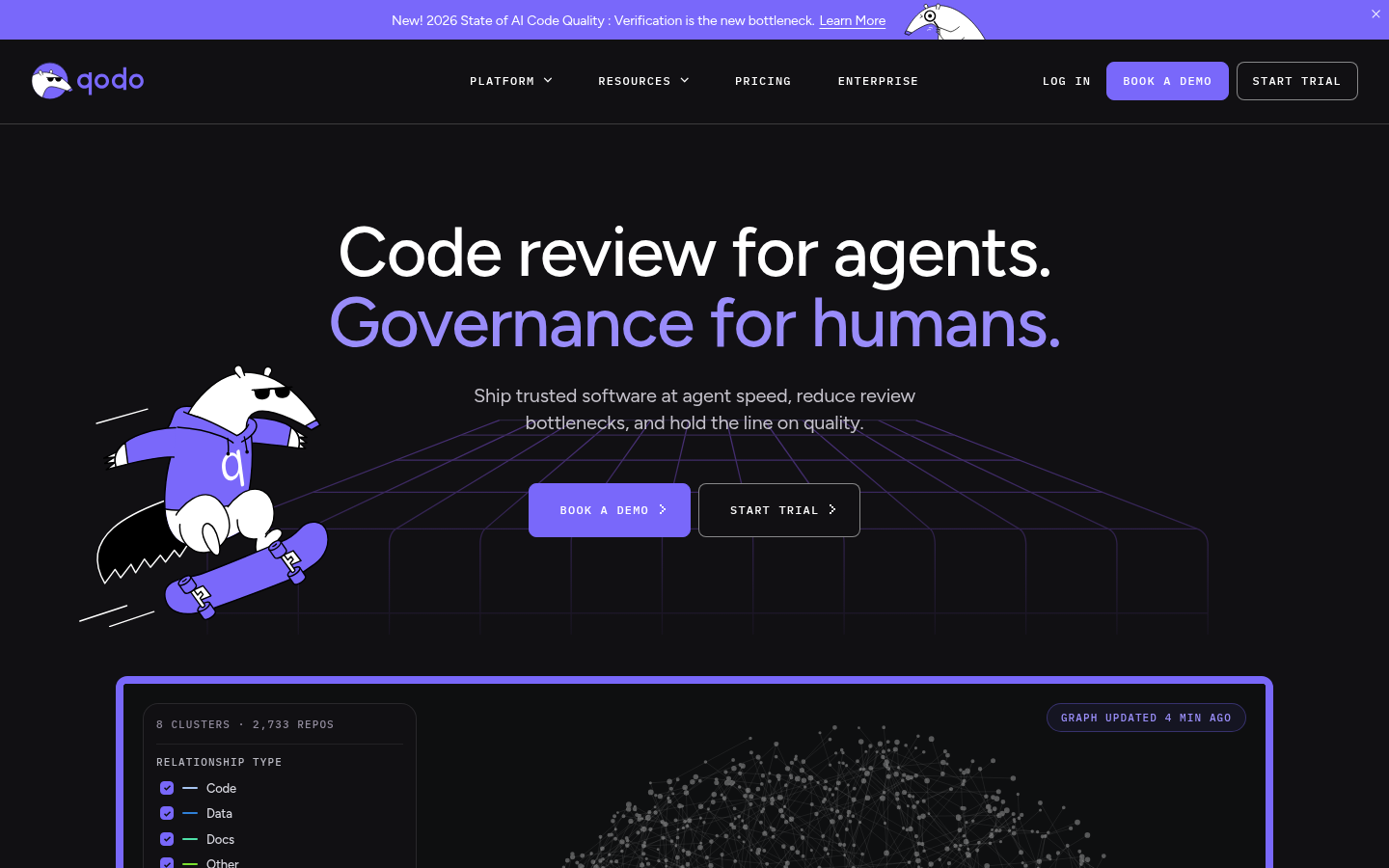
Qodo is an AI-powered code review and code quality platform built for software development teams shipping code faster with AI coding agents in the loop. It targets engineering teams, individual developers, and enterprises that need consistent review standards across large, distributed codebases. The core workflow centers on agentic review: specialized AI agents analyze pull requests with deep context of the entire codebase, flag bugs, rule violations, and requirement gaps, and surface fixes directly inside the developer's IDE or Git workflow. Qodo positions itself less as a single autocomplete tool and more as a "governance layer" that keeps code quality consistent whether changes are written by humans or AI agents.
What it does
Qodo functions as an agentic code review and integrity platform that plugs into existing Git providers and IDEs (including VS Code and JetBrains products such as IntelliJ, WebStorm, and CLion) to run automated, context-aware reviews on every code change. Rather than relying on generic linting, Qodo's review agents reason over full codebase context — dependency maps, architectural patterns, and PR history — to catch real bugs, security concerns, test gaps, and violations of team-specific coding standards before code merges. It also converts tribal knowledge (wikis, past PR decisions, coding conventions) into self-learning, machine-readable rules that both human reviewers and coding agents must follow, effectively creating a shared system of record for code quality decisions across an organization.
Key capabilities
- Context-aware PR review: Agents run automatically on every pull request, evaluating changes against the full repository context rather than just the diff, reducing false positives and review noise.
- Shift-left review skills: Review logic runs inside the developer's coding agent or IDE, surfacing rule violations and fixes earlier in the development lifecycle instead of only at PR time.
- Self-learning rules engine: Rules are inferred from a codebase's existing patterns, conventions, and architectural decisions, then enforced deterministically across the team without manual rule-writing.
- Dependency and software mapping: Visual dependency mapping helps teams and agents understand cross-service and cross-repo relationships before making changes.
- Governance and analytics dashboard: Tracks rule enforcement, violation trends, and resolution rates, giving engineering leaders visibility into code quality over time.
- Enterprise security controls: SOC2-oriented security posture, SSO/SAML, audit logs, bring-your-own-LLM-key (BYOK) support, and single-tenant or on-prem deployment options for regulated environments.
Pricing
Qodo follows a freemium-to-enterprise pricing structure. A free 14-day trial requires no credit card and includes unlimited reviews and credits. The Pro Team plan is listed starting at $30 (billed on a pooled, per-credit basis at $0.012/credit) with no annual commitment, supporting up to 30 users, agentic PR review, an unlimited rules system, Git and IDE integrations, and a dashboard. The Enterprise plan is custom-priced for organizations with 30+ users and adds SSO/SAML, audit logs, advanced self-learning, BYOK, and on-prem or single-tenant deployment. Pricing page: View pricing.
Editorial review
Qodo's strongest differentiator is its framing around AI-agent-era code review: rather than just generating code, it focuses on verifying and governing code regardless of whether a human or an AI agent wrote it, which is an increasingly relevant problem as coding agents produce more first-draft code. The self-learning rules system and cross-repo dependency mapping are notable for teams struggling to keep standards consistent across large, distributed codebases — a use case reinforced by its enterprise customer base (Nvidia, Intel, HiBob, monday.com are referenced on the site). The credit-based pricing model is reasonably transparent for the Pro Team tier, though the enterprise tier is fully custom and requires a sales conversation. Trade-offs to note: the platform is review- and governance-focused rather than a full autocomplete/code-generation assistant, so teams looking purely for inline code completion may need a complementary tool. Some claims around review precision and adoption scale are marketing-stated rather than independently verified. Best-fit users are engineering teams already running AI coding agents that need an independent, auditable review layer, plus enterprises with compliance requirements around SDLC governance, SSO, and on-prem deployment.