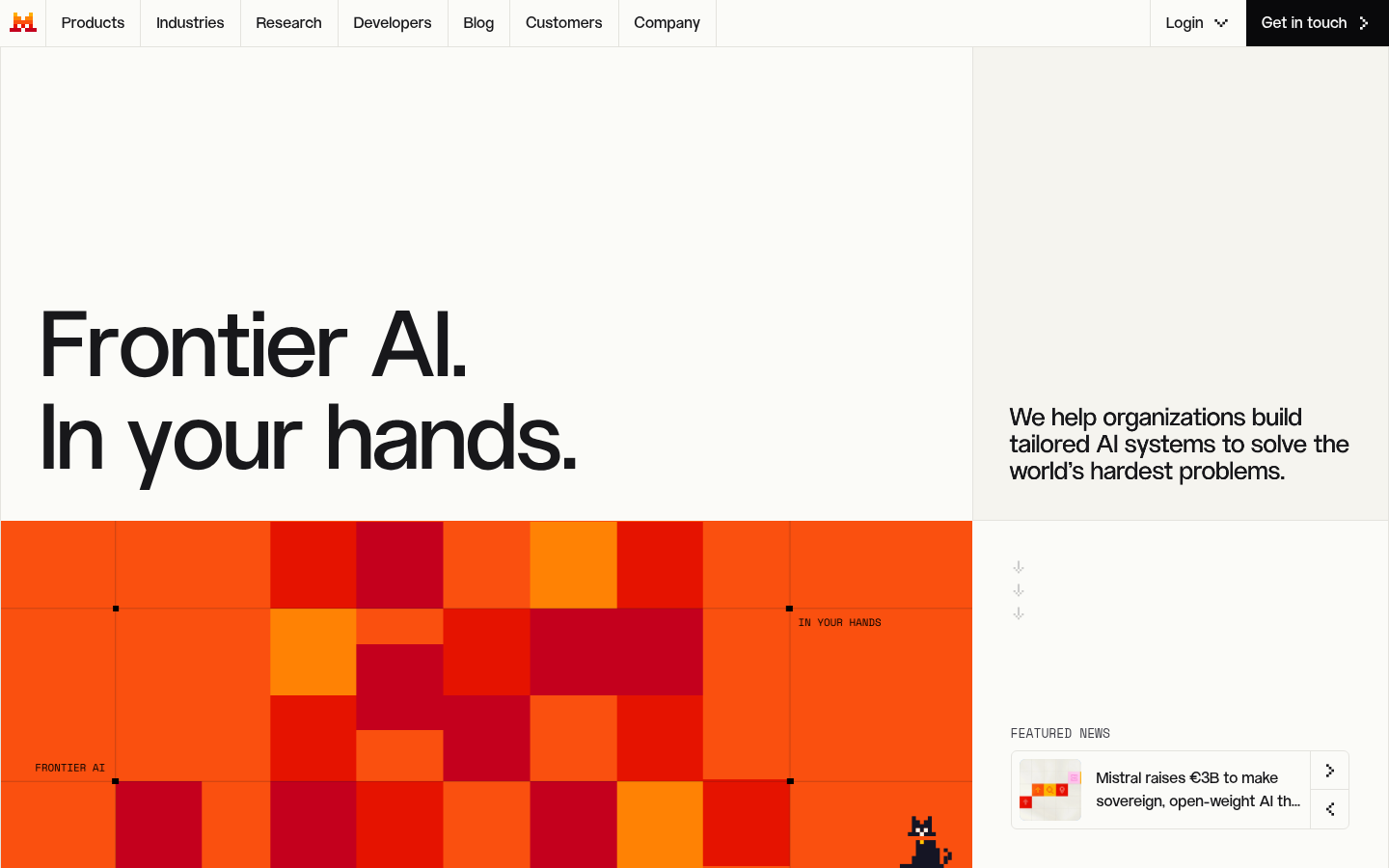
Mistral AI is a French AI company that develops frontier large language models (LLMs), a chat and coding assistant called Vibe, and an enterprise API platform for building AI assistants, autonomous agents, and multimodal applications. It targets developers, enterprises, and public-sector organizations that need customizable, fine-tunable, and in some cases open-weight AI models rather than a single closed consumer chatbot. Core use cases include document OCR and data extraction, coding automation via CLI and IDE plugins, agentic workflows with connectors, and regulated deployments requiring EU-based or private inference. The company positions itself around sovereign, open-weight AI infrastructure as an alternative to US-centric AI providers.
What it does
Mistral AI provides a suite of LLMs and multimodal models (including OCR, transcription, and coding-specialized models like Devstral) accessed through an API platform called Studio, plus a consumer/prosumer-facing assistant called Vibe available on web, CLI, and as IDE plugins for VS Code and JetBrains. Enterprises use Mistral to build custom AI assistants, autonomous agents, and document-processing pipelines, with named customers including HSBC, ASML, CMA CGM, the Austrian Academy of Sciences, and Stellantis referenced as case studies on the site. The platform emphasizes in-region (EU) inference and open-weight models as a differentiator for organizations with data sovereignty requirements.
Key capabilities
- Vibe assistant across interfaces: A chat-based AI agent usable in the browser, plus a terminal-native CLI and IDE plugins (VS Code, JetBrains) powered by the Devstral coding model for autonomous software engineering tasks.
- Document AI and OCR: A dedicated OCR model (OCR 4.1) marketed as a top-tier document extraction and understanding engine, priced separately from general chat/completion usage.
- Audio transcription: Voxtral Mini Transcribe model for batch audio-to-text conversion, billed per minute of audio input.
- Third-party and specialized models: Access to models like GLM 5.3 for long-context agentic and coding workflows alongside Mistral's own models, all through a unified API.
- Enterprise and regional controls: Options for regional (EU) inference endpoints, cached-token discounts for repeated prompts, batch processing at reduced rates, and priority inference tiers for latency-sensitive workloads.
- Custom enterprise deployments: Private deployments with custom models, custom agents, custom workflows, audit logs, SAML SSO, and white-labeling for large organizations.
Pricing
Mistral uses a freemium model. A Free plan gives access to Vibe on web and mobile with limited messages, web searches, and coding sessions, image generation, Studio model testing, a stated $10/month in API credits, and access to 100+ connectors. Paid tiers include a Pro plan (listed around $14.99/month, with a discounted student/education rate) offering expanded usage limits, more image generations, additional API credits, and chat/email support; a Team plan (around $24.99/user/month) adding secure collaborative workspaces, per-user storage, domain verification, and data export; and a custom-priced Enterprise plan with custom models, agents, workflows, audit logs, SAML SSO, and white-label options. Separately, API usage is billed per model: OCR is priced per 1,000 pages, Document AI per 1,000 pages, audio transcription per minute, and text models per million input/output tokens, with add-on pricing for regional inference, batch processing, and priority inference. Enterprise APIs with SLAs and premium support carry a stated premium over list pricing. Pricing page: View pricing
Editorial review
Mistral AI's strongest differentiator is its dual positioning as both an open-weight model provider and a full enterprise AI platform, which appeals to organizations wary of vendor lock-in or US-only data residency. The breadth of the API catalog—dedicated OCR, transcription, coding, and general-purpose text models with granular pricing controls like caching and batching—suggests a platform built for engineering teams optimizing cost and latency, not just casual chat users. The Vibe assistant's CLI and IDE integrations position it as a credible alternative to other AI coding agents for developers already in a terminal or IDE workflow.
The trade-off is complexity: the pricing structure spans consumer subscription tiers, per-model API rates, and enterprise contracts, which requires more evaluation effort than a single flat-rate competitor. Named enterprise customers (HSBC, ASML, CMA CGM, Stellantis) indicate real-world adoption in regulated and industrial sectors, but pricing details for Enterprise remain contact-sales only. Best-fit users are developers and enterprises needing customizable, self-hostable, or EU-region AI infrastructure, document processing at scale, or coding automation—less ideal for users simply wanting the cheapest single consumer chatbot subscription.