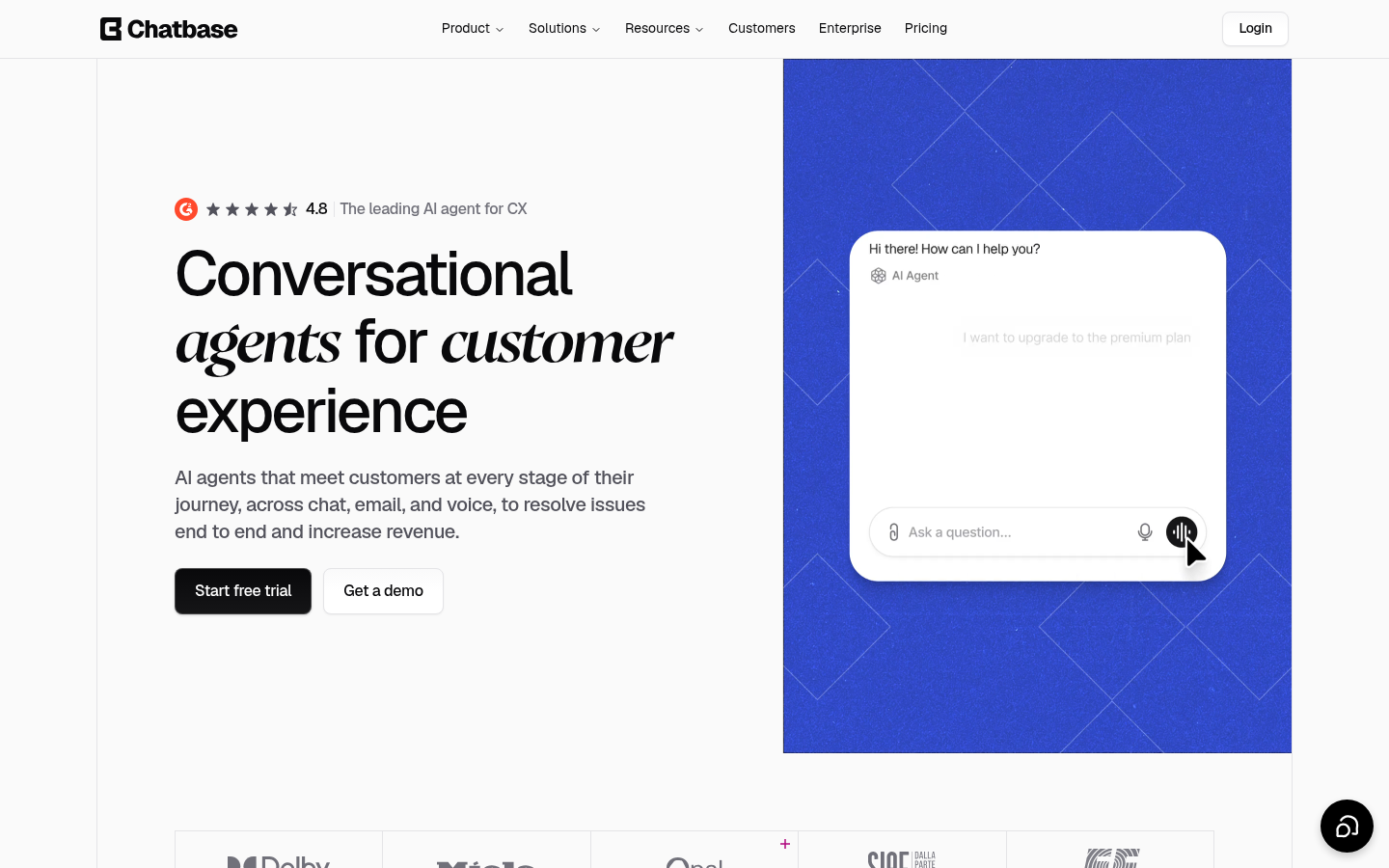
Chatbase is an AI customer experience platform for building and deploying conversational support agents that handle customer queries, automate service workflows, and reduce ticket volume. It targets businesses of varying sizes—from solo founders to enterprise support teams—that want to automate parts of their customer service, sales, and product guidance functions. The core workflow involves training an agent on company data, connecting it to backend systems like CRMs and order platforms, and publishing it across web widgets, Slack, WhatsApp, and Messenger. Chatbase positions itself around a full "agent lifecycle": build, deploy, and continuously optimize AI agents on a single platform rather than stitching together separate chatbot and analytics tools.
What it does
Chatbase lets businesses create AI agents that act as a first line of customer support, sales assistance, or product guidance, available around the clock. Users upload documents, help center content, or connect live data sources to train an agent on business-specific knowledge. The agent can then answer complex queries, take actions on external systems (such as updating a subscription, modifying an order, or checking a shipment status), and escalate to human agents when needed. This makes it relevant for support teams looking to cut ticket volume, e-commerce companies needing order-status automation, and SaaS companies wanting an AI-driven onboarding or product help experience. The platform is delivered as a web-based dashboard with agents deployable to a company's website, app, or messaging channels—there is no dedicated desktop client.
Key capabilities
- Multi-model AI backend: Supports multiple underlying AI models, including options from OpenAI, Anthropic, Google, and DeepSeek, letting teams choose the model that fits cost or performance needs.
- Real-time data sync: Connects to CRMs and order-management systems so agents can pull live customer or order data rather than relying only on static training documents.
- Agent actions on external systems: Agents can execute actions such as booking meetings, checking calendar availability, or modifying subscriptions, chaining multiple AI requests to complete a task.
- Omnichannel deployment: A single agent configuration can be published across a website widget, Slack, WhatsApp, and Messenger, avoiding the need to rebuild logic per channel.
- Customizable chat interface: Branding, tone, and interface elements can be adjusted to match a company's look and feel.
- Analytics and reporting: Usage and conversation data are tracked to help teams monitor resolution rates and identify gaps in agent knowledge.
Pricing
Chatbase uses a freemium-style structure with paid plans priced on a monthly subscription and billed via message credits, where each AI model request consumes credits that vary by model choice; credits renew monthly and auto-recharge options are available. Published plan tiers include a Hobby plan at $40/month, a Standard plan at $150/month, and a Pro plan at $500/month, with add-ons available to extend usage. Enterprise pricing is handled separately through a sales contact process. Because paid tiers dominate the published pricing structure and no explicit permanent free plan is confirmed in the source pricing data, prospective users should verify current entry-level costs directly. Pricing page: View pricing.
Editorial review
Chatbase's strongest asset is its focus on the full agent lifecycle rather than just chatbot creation—the emphasis on connecting to live CRM and order data, executing actions on external systems, and deploying identical logic across multiple channels differentiates it from simpler FAQ-bot builders. The multi-model support is a practical touch for teams wanting to control cost versus response quality trade-offs. The credit-based pricing model, however, adds complexity: costs scale with both the number of requests and the chosen model, and multi-step agent actions consume multiple credits per interaction, which can make budgeting less predictable for high-volume support operations. The published entry price point (Hobby at $40/month) positions Chatbase above hobbyist-tier chatbot tools and closer to small-business and mid-market support automation budgets. It is best suited for support, sales, and product teams at growing companies that already have structured knowledge bases or order/CRM systems to connect, rather than users wanting a purely free, no-integration chatbot. Enterprise buyers evaluating security and industry-specific deployment will need to engage sales directly, as detailed security and compliance specifics are not fully enumerated in the available public content.