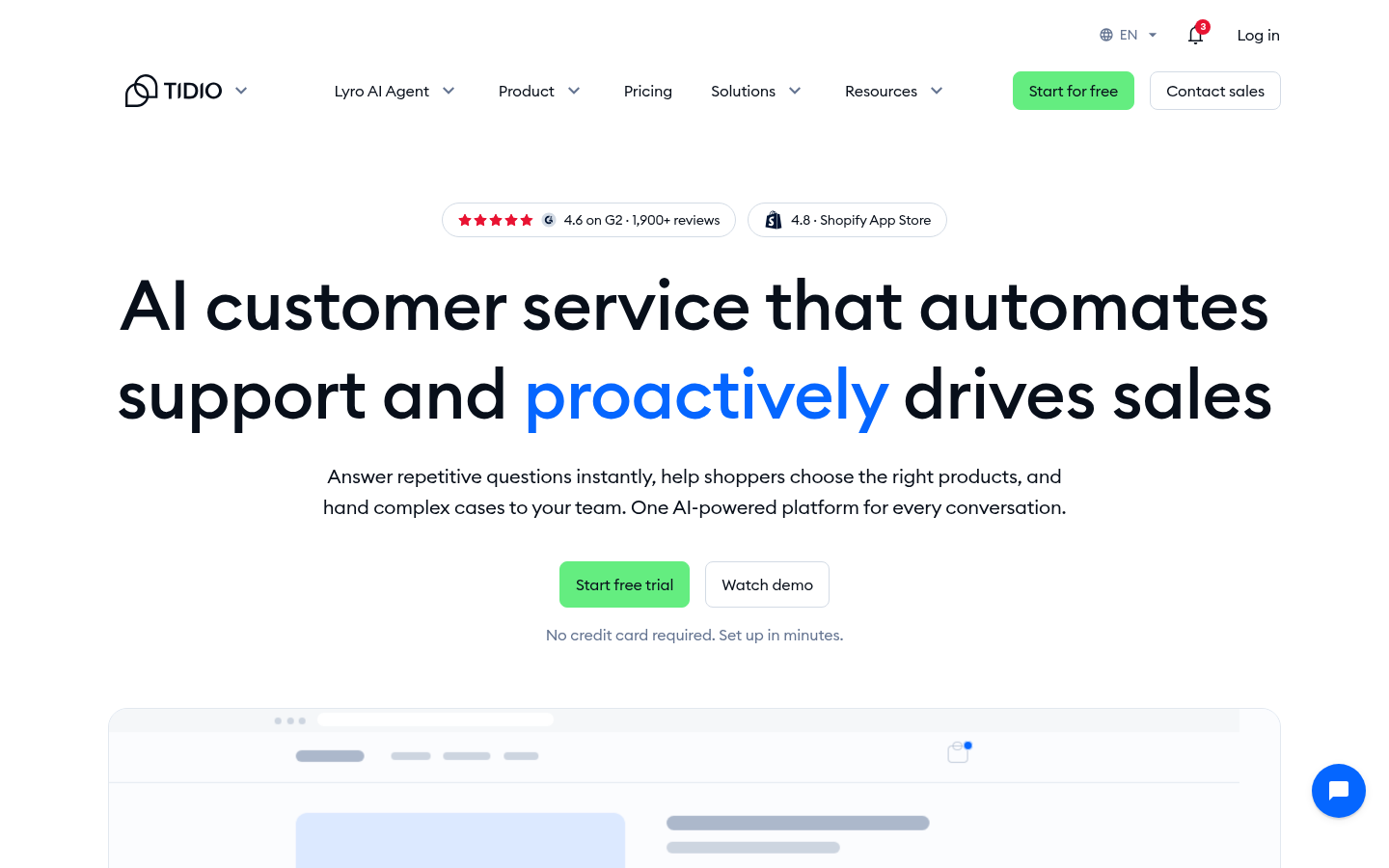
Tidio is a customer service platform built around an AI chat agent called Lyro, aimed at ecommerce businesses and support teams that want to automate conversations without losing revenue-generating opportunities. Instead of positioning itself purely as a help desk, Tidio frames every chat as a potential sale, lead, or booking, and gives teams tools to track what those conversations are worth. The core workflow combines a customizable website chat widget, a shared inbox for human agents, and an AI layer that can resolve routine questions or hand off to a person when needed. It is used by online stores, service businesses, and support teams that need to scale conversational support across a website and multiple channels without proportionally scaling headcount.
What it does
Tidio is an AI customer service and live chat software that lets businesses install a chat widget on their website, connect it to an AI agent (Lyro), and manage all conversations through a unified help desk inbox. It is designed for ecommerce stores and customer support teams that need to answer product questions, track orders, recommend items, and convert visitors into buyers or leads in real time. Lyro connects to a store's product catalog, order status, and tracking data so it can answer specific questions ("which range hood is quietest for a small kitchen?") and surface relevant product cards directly in the chat, rather than giving generic scripted responses. Conversations that Lyro cannot fully resolve are routed to human agents inside the same inbox, with AI-generated conversation summaries and suggested replies to speed up handling.
Key capabilities
- AI chat agent (Lyro): Resolves common customer questions automatically using store data such as product catalogs, order status, and tracking, and recommends products based on the shopper's stated needs.
- Unified help desk inbox: Combines live chat, email, and other channels into one inbox with AI-generated summaries and suggested replies for human agents.
- Customizable chat widget: Embeddable, brandable chat widget for websites that can trigger contextual prompts on product or checkout pages.
- Ecommerce integrations: Connects with platforms to pull live product and order data into conversations, supporting use cases like order tracking and returns handling.
- Analytics and revenue attribution: Reporting tools that let businesses see conversion outcomes—sales, leads, bookings—tied back to specific chat conversations.
- Workflow automation: Rule-based automated responses and workflows alongside the AI agent for routing, tagging, and triaging conversations.
Pricing
Tidio follows a freemium model: a free plan is available, with paid plans starting at a published entry price and a separate "Tidio Premium" tier offering custom limits, personalized branding, multi-department and multi-language support, and expert-assisted automation setup for larger organizations. Exact plan names, feature limits, and current prices are best confirmed on the vendor's pricing page rather than assumed, since tiered SaaS pricing changes over time. Pricing page: View pricing
Editorial review
Tidio's strongest differentiator is treating chat as a revenue channel rather than a pure support cost center: the emphasis on attributing sales, leads, and bookings to specific conversations, and on Lyro pulling live catalog and order data, sets it apart from chatbots that only handle FAQs. This makes it a reasonable fit for ecommerce brands and DTC stores that want AI to actively assist purchase decisions, not just deflect tickets. The combined AI-plus-human inbox model also suits support teams that don't want to fully automate away human oversight, since low-confidence conversations are escalated with context rather than dropped.
The trade-offs are typical of AI customer service tools: effectiveness depends heavily on how well the AI agent is connected to accurate, up-to-date product and order data, and the free tier will likely be limited compared to the AI-driven capabilities showcased on the marketing site. Buyers evaluating Tidio should look closely at the difference between the free/standard plans and the paid "Premium" tier, since features like multi-department support, custom branding, and expert-led automation setup appear to sit behind the higher tier. Security-conscious buyers may find the stated compliance signals (GDPR, CCPA, SOC 2 references) reassuring, but should verify current certifications directly. Overall, Tidio is best suited to small and mid-sized ecommerce and service businesses that want an AI-assisted chat layer with clear ties to sales outcomes, rather than enterprises needing deep, highly customized contact-center infrastructure.