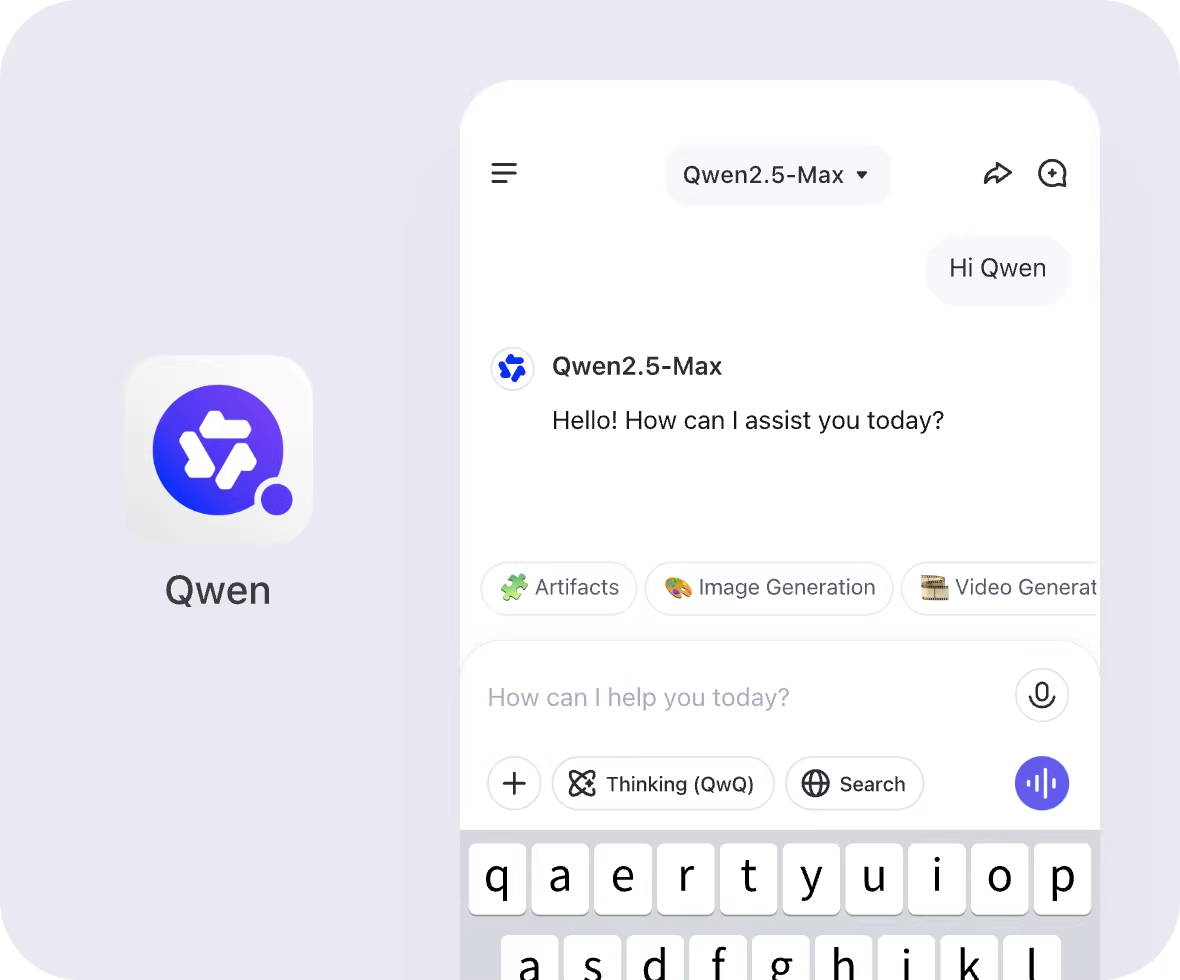
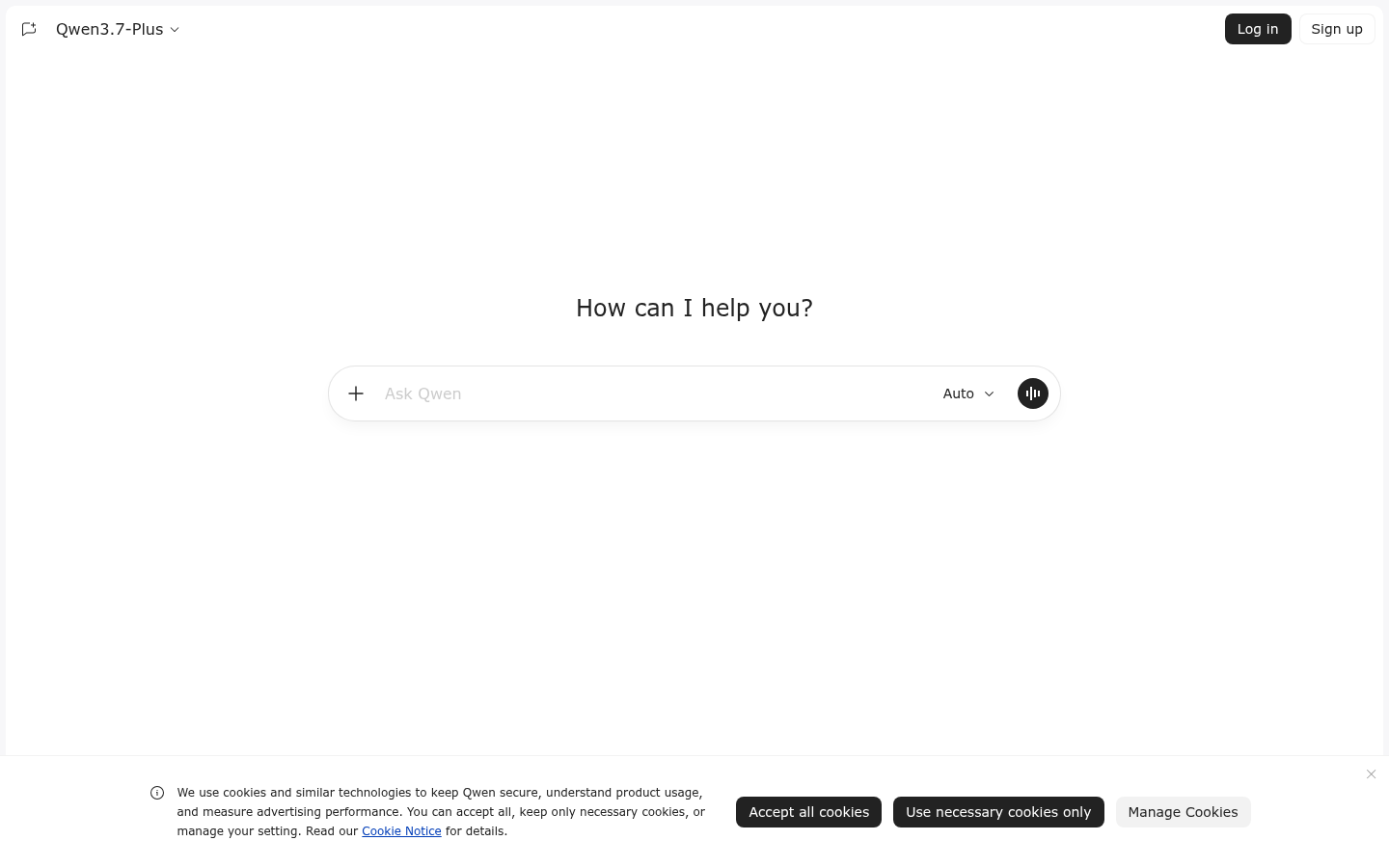
Qwen Chat is the official web platform from Alibaba providing unified access to the Qwen family of large language models, covering both open-source and proprietary variants. It targets everyday users who want a free AI assistant for conversation, research, and content creation, as well as developers who want to test Qwen's models before integrating them via API. The platform bundles chatbot conversation, document understanding, image and video comprehension, image generation and editing, and coding assistance into a single interface. Instead of installing multiple tools, users can switch between reasoning models, vision-language models, and generation models from one account. It positions itself as a direct, no-cost way to try Alibaba's Qwen 2.5, Qwen 3, QwQ, and QVQ model lineup without setting up local infrastructure.
What it does
Qwen Chat is a browser-based AI assistant that gives users direct access to Alibaba's Qwen model series, including general chat models, reasoning-focused models (QwQ), and vision-language models (QVQ, Qwen-VL). It is built for people who need a capable, free alternative to mainstream chatbots for tasks like summarizing PDFs, translating documents, generating and editing images, analyzing photos or videos, writing and debugging code, and holding voice or video conversations with an AI. Developers use it as a testing ground for Qwen models before committing to the Qwen API, while non-technical users treat it as a general-purpose chat and productivity assistant. The interface also supports "artifacts," letting users generate interactive outputs such as web pages, UI mockups, or visual components directly from a prompt.
Key capabilities
- Multi-model chat access: Switch between Qwen's general chat models, the QwQ reasoning model, and the QVQ vision-reasoning model within one conversation interface.
- Document and PDF processing: Upload and summarize PDFs, translate documents, and extract information from long-form text without third-party plugins.
- Image and video understanding: Analyze uploaded images and videos, ask questions about visual content, and get descriptive or analytical responses.
- Image generation and editing: Create images from text prompts and edit existing images using natural-language instructions, powered by Alibaba's Wan/image models.
- Voice and video chat: Hold spoken conversations with the assistant rather than typing, useful for hands-free or conversational use cases.
- Code generation and artifacts: Generate code snippets, web UI components, and interactive artifacts directly from prompts, useful for quick prototyping.
- Tool utilization and agent behavior: The platform supports tool-calling workflows, letting the model perform multi-step tasks such as search-assisted answers.
Pricing
Qwen Chat is accessible for free at chat.qwen.ai, and the source material does not indicate a paid subscription tier for the chat interface itself; usage appears open to any user with an account. Developers who want programmatic access to the underlying Qwen models for their own applications typically go through Alibaba Cloud's separate Qwen API, which is priced independently from the free chat interface. No specific plan names, credit limits, or subscription tiers are documented on the chat platform itself, so pricing details beyond "free to use" should be treated as unconfirmed.
Editorial review
Qwen Chat's main strength is breadth: few free chat platforms bundle text chat, document summarization, image/video understanding, image generation and editing, voice chat, and code artifacts into a single account with no stated cost. This makes it attractive to users who want to evaluate Alibaba's Qwen model lineup — including newer reasoning models like QwQ — without downloading weights or running local inference. For developers, it functions as a low-friction way to sanity-check model behavior before building against the Qwen API.
The trade-offs are typical of a large, multi-purpose AI platform: feature depth in any single area (e.g., image editing precision, video generation quality) is unlikely to match dedicated specialist tools, and the free-access model raises open questions about rate limits, data handling, and long-term pricing stability that aren't clarified in the available material. The heavy volume of loosely related search terms surrounding the platform in public discovery data also suggests it competes in a crowded, SEO-saturated space alongside ChatGPT, DeepSeek, Claude, and Gemini, making differentiation mostly a function of Alibaba's open-model ecosystem rather than a unique UI paradigm.
Best-fit users are developers and technically curious users who want free, side-by-side access to Qwen's model family (including vision and reasoning variants) and general users looking for a no-cost multimodal assistant. Teams needing guaranteed SLAs, enterprise data controls, or predictable pricing should confirm details directly through Alibaba Cloud's Qwen API documentation rather than relying on the free chat interface alone.