DeepSeek is an AI research company and chat platform that builds and open-sources frontier large language models, including DeepSeek-V4, DeepSeek-V3.2, DeepSeek-R1, and DeepSeek-Coder. It targets developers, researchers, and general users who need a capable conversational AI for reasoning, search, and coding tasks, and who want the option to self-host or fine-tune open-weight models rather than relying solely on a closed API. The core workflow centers on a web and mobile chat interface plus a developer-facing API platform for integrating DeepSeek's models into third-party applications. Its main differentiator is combining competitive model performance with an open-source release strategy, which sets it apart from most proprietary frontier-model providers.
What it does
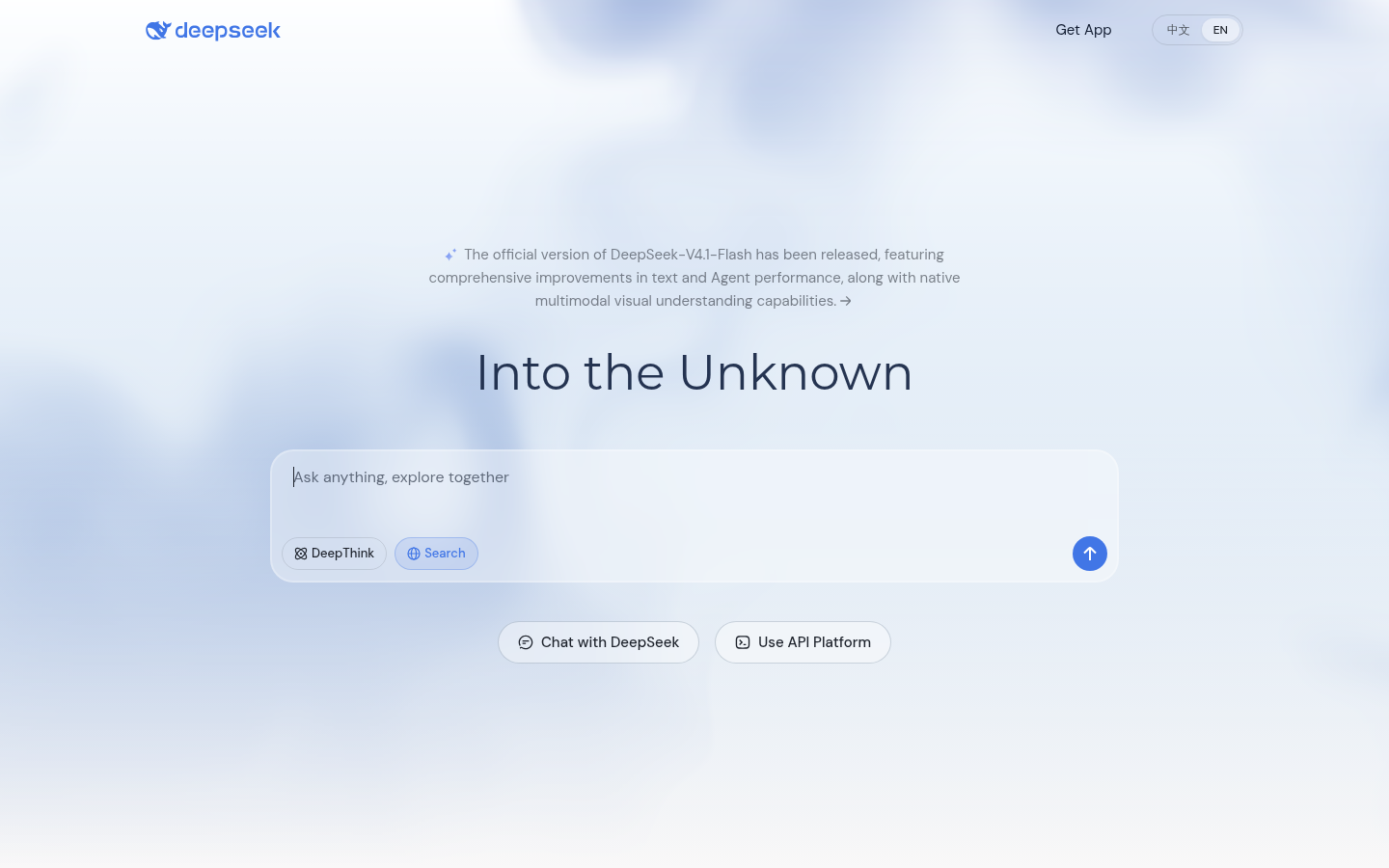
DeepSeek functions as both a consumer-facing AI chat assistant and a model provider for developers. Through the web app and mobile apps (iOS and Android), users can converse with DeepSeek's models for general Q&A, deep reasoning, and intelligent search tasks. The latest release referenced on the site, DeepSeek-V4.1-Flash, adds native multimodal visual understanding alongside improved text and agent performance, with the company positioning it as faster and lower-cost than prior versions. For technical teams, DeepSeek offers an API platform with documentation and a public service-status page, enabling integration of DeepSeek's language models into custom applications, agents, and internal tools. The open-source angle means model weights for releases like DeepSeek-R1 and DeepSeek-V3 are published for researchers and engineers to inspect, self-host, or build on.
Key capabilities
- Multi-model lineup: Access to a family of models — DeepSeek-V4.1, DeepSeek-V4, DeepSeek-V3.2, DeepSeek-V3.1, DeepSeek-R1, and DeepSeek-V3 — each with different performance and reasoning trade-offs.
- Native multimodal support: DeepSeek-V4.1-Flash introduces built-in visual understanding alongside text and agent capabilities, rather than relying on a bolted-on vision module.
- Deep reasoning and search modes: The chat interface offers dedicated "deep thinking" and "intelligent search" modes for tasks that require multi-step reasoning or retrieval-augmented answers.
- Open-source model releases: Several flagship models are open-sourced, allowing developers and researchers to self-host, audit, or fine-tune them instead of depending exclusively on a hosted API.
- Developer API platform: A dedicated API portal with documentation and pricing pages, plus a live service-status page, supports production integration and monitoring.
- Cross-platform access: Available as a web app, native mobile apps for iOS and Android, and a "DeepSeek Harness" tool referenced alongside the API for developer workflows.
Pricing
DeepSeek's public materials describe an API pricing page and a chat platform without stating specific consumer subscription tiers in the reviewed source content. The chat product appears accessible for direct use on web and mobile, while API access is billed separately through DeepSeek's developer platform. No verified consumer subscription price points were found in the available source material, so specific figures are not stated here; the model catalog and open-source releases suggest a mixed free-and-paid structure typical of frontier LLM providers offering both hosted access and open weights.
Editorial review
DeepSeek's strongest asset is its willingness to open-source frontier-class models, a stance that distinguishes it from most large-model vendors that keep weights closed. This makes it particularly attractive to developers and researchers who want transparency, the ability to self-host, or a base for fine-tuning rather than being locked into a single vendor's hosted inference. The rapid model iteration cadence — from V3 through V4.1 in a short span — signals active investment in both raw capability and multimodal support. For everyday users, the chat product offers reasoning and search-oriented modes that go beyond a generic chatbot, which suits users doing research, analysis, or coding assistance.
The trade-offs are mostly around documentation depth and pricing transparency on the marketing site itself: consumer plan pricing and detailed feature comparisons across model tiers are not clearly surfaced in the primary landing page, requiring users to dig into API docs or pricing pages for specifics. Enterprises evaluating DeepSeek for production use will likely want to review the service-status history and API documentation directly before committing, given that uptime and support-tier information isn't detailed on the homepage. Overall, DeepSeek is best suited to developers, AI researchers, and technically curious users who value open-weight access and competitive reasoning performance over polished enterprise-grade account management tooling.