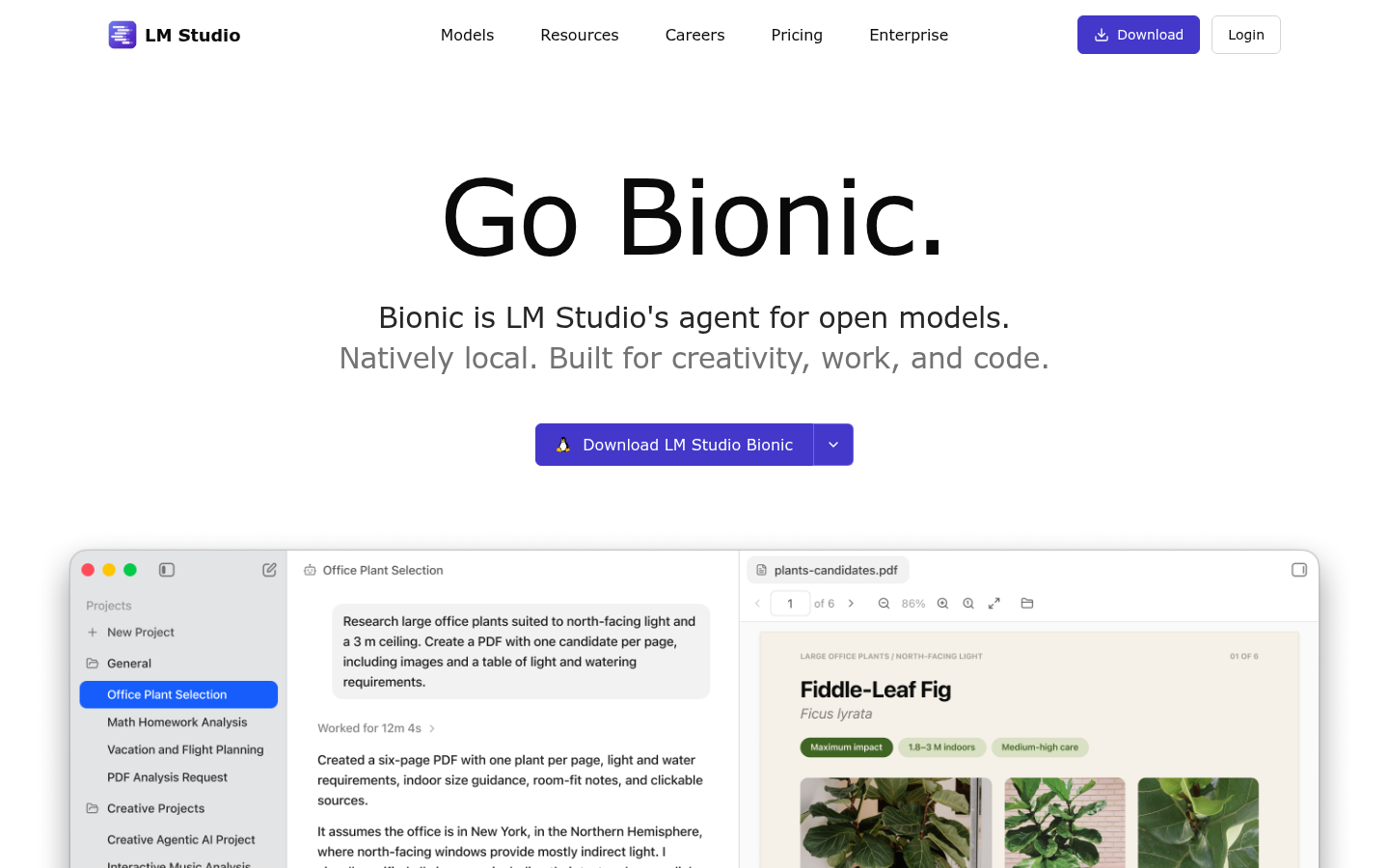
LM Studio Bionic is an AI agent built by LM Studio, aimed at professionals, students, and developers who want to generate real work outputs—documents, slides, PDFs, and code—using either locally-run models or select frontier open models. It extends LM Studio's core local-inference platform into an agentic workflow layer, where a single prompt can trigger document creation, voice-driven input, or code generation, without requiring the underlying model to run exclusively in the cloud. The tool positions itself for users who care about model choice and data locality while still wanting an assistant that completes multi-step work tasks. Based on the available material, it is best understood as a desktop-first agent layered on top of LM Studio's existing local model infrastructure, with an accompanying Linux download path highlighted on the homepage.
What it does
LM Studio Bionic acts as a task-completing agent rather than a simple chat interface. Users can describe a document, presentation, or piece of software in natural language, and Bionic drives the underlying model—local or frontier open model—to produce the output directly, such as a PDF report or a slide deck. It also supports voice input, with local voice transcription controls that keep spoken prompts processed on-device rather than sent to a remote transcription service. The core value proposition is flexibility of model sourcing: users are not locked into a single hosted model provider, and can switch between models running on their own hardware and select open models with more frontier-level capability, depending on the task's complexity and privacy requirements.
Key capabilities
- Document and file generation: Converts prompts into finished documents, slide decks, and PDF outputs rather than returning only chat text.
- Code and software creation: Extends the same agent workflow to generate software artifacts, positioning Bionic as a coding-capable agent alongside its document features.
- Local voice transcription: Includes on-device voice transcription controls, allowing spoken prompts to be converted to text without relying on cloud transcription.
- Model flexibility: Supports both local models (run on the user's own machine via LM Studio) and select frontier open models, giving users control over the privacy/performance trade-off.
- Built on LM Studio's local-inference foundation: Leverages LM Studio's established local model runtime, so users already familiar with LM Studio gain agentic capabilities without switching tools entirely.
- Linux-available download: The homepage explicitly surfaces a Linux download path, indicating desktop distribution beyond a browser-only experience.
Pricing
LM Studio Bionic is offered with a free tier, consistent with LM Studio's broader distribution model of free local model tooling with premium options layered on top. No specific price points, plan names, or billing details are confirmed in the available source material, so exact premium pricing cannot be stated with confidence. Prospective users should check the official site directly for current plan details before assuming feature limits on the free tier.
Editorial review
LM Studio Bionic's clearest differentiator is combining agentic document/code generation with the option to run inference locally, which matters for users concerned about sending sensitive prompts or documents to third-party cloud APIs. Pairing local voice transcription with local model execution is a coherent privacy-first design choice that distinguishes it from purely cloud-based "AI office agent" products. The emphasis on frontier open models (rather than only proprietary hosted LLMs) also signals a strategy aimed at users who want more control over which model family powers their agent, useful for developers, researchers, or privacy-sensitive professionals.
The trade-offs are less clear from available material: performance and output quality when running fully local models will vary significantly based on the user's hardware, and the source content does not detail which specific open models are supported, how large documents or codebases can get, or what premium tiers unlock. There's also no confirmed information on team/collaboration features, version history, or integrations with common office or IDE tools, which may matter for users evaluating it against established cloud-based agent products. Overall, LM Studio Bionic looks best suited to individual power users, developers, and students who already use or are open to using LM Studio's local model ecosystem and want an agent that can act on documents and code rather than just converse—provided they're comfortable with the hardware requirements local inference implies.