
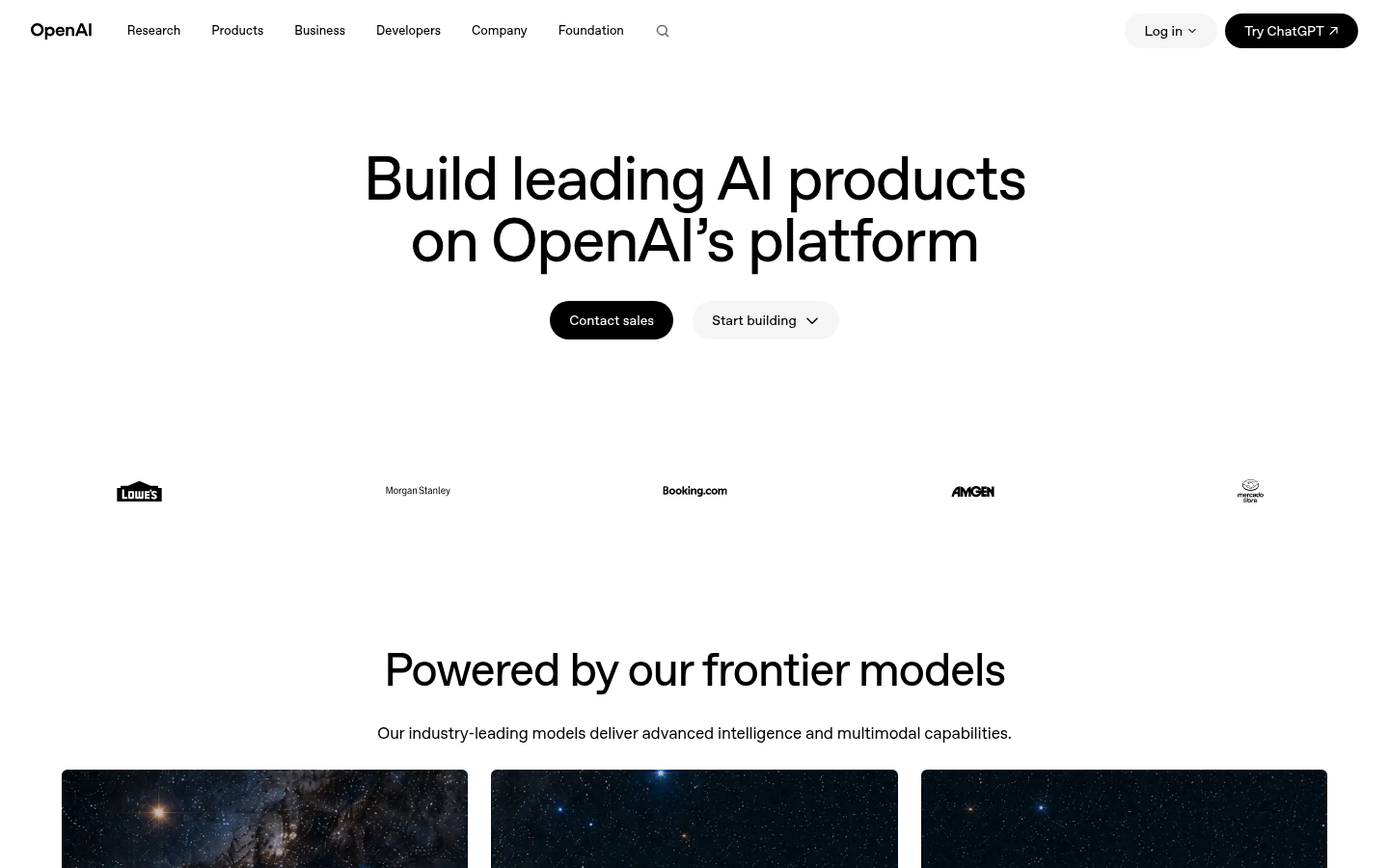
The OpenAI API Platform is a developer-facing API service that gives programmatic access to OpenAI's language, image, and voice models for building AI-powered applications, agents, and automations. It targets developers, data scientists, and businesses that need to embed generative AI capabilities — such as chat, code generation, reasoning, retrieval, and tool-calling — directly into their own software rather than through a consumer chat interface. The core workflow centers on calling model endpoints (text, image, and audio generation, plus agentic tool use) via API keys, SDKs, and documentation, then customizing behavior through prompts, function calling, and connected tools like web search or code execution. It is positioned as the infrastructure layer behind many production AI features, from customer support bots to coding assistants and research tools.
What it does
OpenAI API Platform provides API access to OpenAI's model family (including GPT-series language models) for tasks such as code generation, customer support automation, content generation, research and data analysis, personalized recommendations, and education tools. Developers integrate the API into their own products using OpenAI's SDKs and REST endpoints, sending prompts and receiving completions, structured outputs, or agentic tool calls in return. The platform also documents safety best practices, positioning itself for teams that need to deploy generative AI responsibly in production environments. Unlike ChatGPT, this is not an end-user chat app — it is the underlying API and developer tooling layer that powers custom applications, internal tools, and third-party integrations (referenced examples include Slack, Gmail, Salesforce, and GitHub-style integrations, as well as a Yelp-related demo).
Key capabilities
- Model access via API: Direct programmatic access to OpenAI's language and multimodal models for text, code, and image-related tasks.
- Agent and tool-calling support: Support for connecting models to external tools (e.g., code execution, search, and custom functions) to build agentic workflows rather than single-turn responses.
- Multi-use-case coverage: Documented use cases spanning coding assistance, customer support, content generation, research/data analysis, personalized recommendations, and education.
- Third-party integration patterns: Reference examples showing integration with common business tools, useful for teams building internal or customer-facing AI features.
- Developer documentation and safety guidance: Includes guides intended to help developers follow safety best practices when deploying models in production.
- SDK and command-line friendly workflow: Built around code-first usage (visible in example Python agent configuration scripts) rather than a no-code interface.
Pricing
Based on available source material, the API Platform is usage-based and developer-oriented; the marketing page itself does not list fixed consumer-style pricing tiers, but references a freemium-style structure with free basic usage and paid access to premium model capabilities. Exact per-token or per-request pricing is not confirmed in the reviewed content, so developers should check OpenAI's official pricing documentation before estimating costs for production workloads.
Editorial review
OpenAI API Platform's core strength is breadth: a single API surface covering text, code, image-related, and agentic tool-calling use cases, backed by extensive documentation and a large existing developer ecosystem. This makes it a practical default choice for teams that don't want to evaluate multiple model vendors before shipping a feature. The inclusion of safety guidance alongside technical docs is a meaningful differentiator for regulated or customer-facing deployments, where responsible-AI documentation is often an afterthought elsewhere.
The trade-off is that this is infrastructure, not a finished product — teams need engineering resources to design prompts, handle rate limits, manage costs, and build their own UI or workflow layer around the API. Usage-based pricing (typical of LLM APIs) means costs scale with volume and model choice, and the reviewed page does not surface transparent tiered pricing, so budgeting requires checking OpenAI's dedicated pricing pages separately. Best-fit users are software engineering teams, data science teams, and technical product teams building custom AI features, coding assistants, support automation, or research tools; it is less suited to non-technical users looking for a ready-made chatbot or no-code automation tool, who would be better served by OpenAI's consumer ChatGPT product or third-party no-code AI builders. Overall, it's a strong, well-documented entry point for production LLM integration, provided teams have the engineering capacity to build around it.