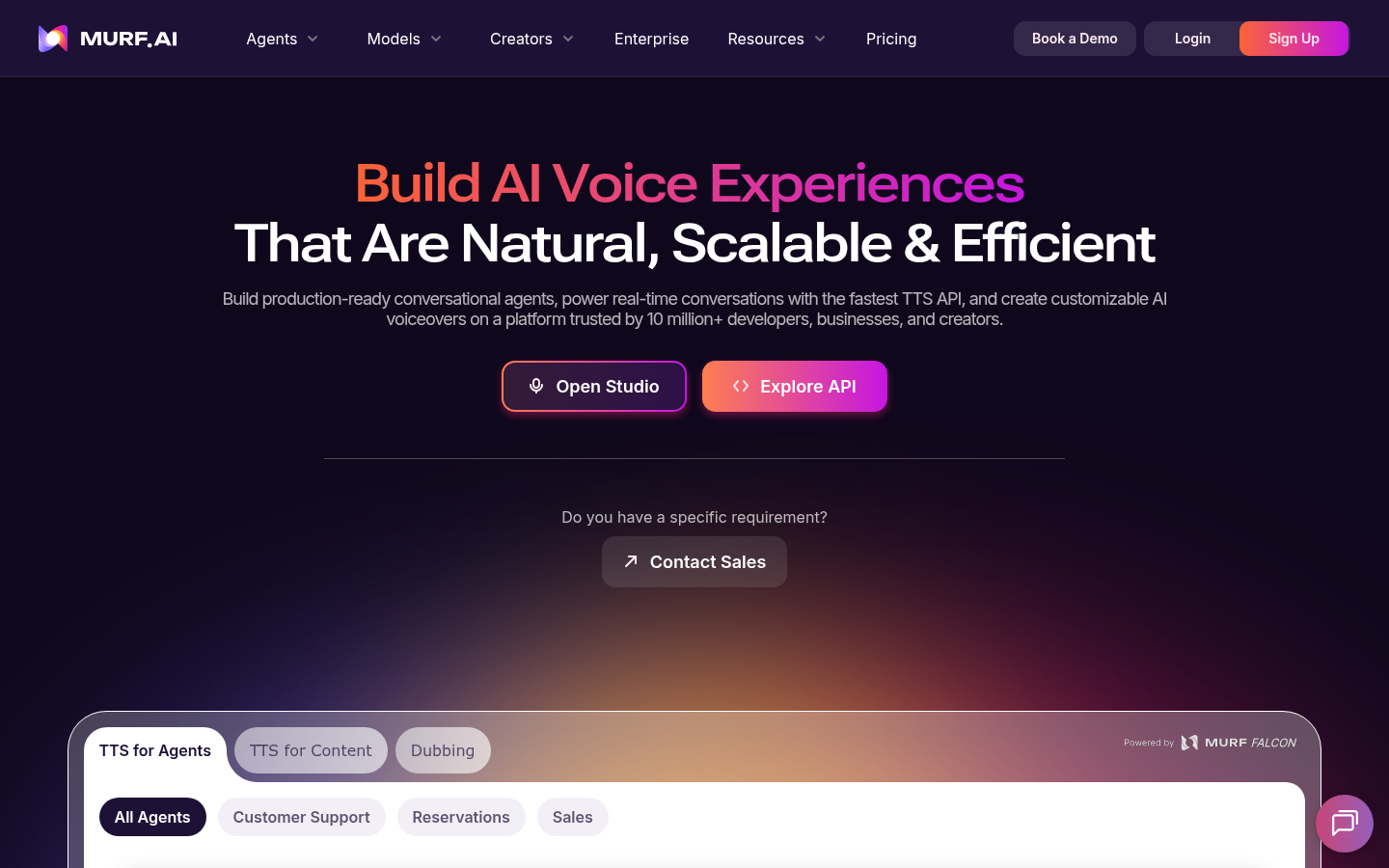
Murf AI is an AI voice and conversational agent platform built for businesses, developers, and content creators who need human-like speech generation at scale. It combines a text-to-speech studio, a voice API, and tools for building voice agents into a single system. The platform targets teams building customer-facing voice experiences, localization workflows, and production content that requires natural-sounding narration without hiring voice actors.
What it does
Murf converts written text into natural-sounding speech and lets teams deploy conversational voice agents for use cases such as AI receptionists, AI recruiters, AI call centers, cold calling, sales outreach, SDR workflows, consumer lending, and customer service. Developers can access the underlying capability through a text-to-speech API described as fast and efficient, purpose-built for voice agent infrastructure, while non-technical users can work directly in the Murf Studio web app to produce voiceovers, dub existing video content into other languages, and edit audio without recording equipment. The platform is positioned for enterprises building conversational agents, developers embedding voice into products, and creators or localization teams producing multilingual voice content.
Key capabilities
- Text-to-speech generation: Converts scripts into natural, human-like speech across a library of AI voices, using what the company describes as a Gen 2 voice model.
- Conversational voice agents: Provides templates and infrastructure for building production-ready voice agents targeted at industries including banking, insurance, contact centers, dealerships, and general customer support.
- Text-to-speech API: Offers a developer API for integrating speech synthesis into applications, marketed around low latency for real-time voice agent use cases.
- AI dubbing: Translates and re-voices existing video or audio content into other languages, aimed at localization teams handling multilingual content.
- Voice changer and voice cloning: Includes tools for altering or cloning voice characteristics for custom voice production.
- Third-party integrations: Connects with tools such as Canva, Google Slides, PowerPoint, Adobe Captivate, and offers a Windows-based voice reader in addition to the core Murf Studio and Dubbing products.
Pricing
Murf operates on a freemium model with a free trial and paid subscription tiers for the Studio product, alongside separate API-based pricing for developers integrating text-to-speech or voice agents into their own applications. Exact plan names, credit allowances (referred to internally as Voice Generation Time), and current price points are documented on the company's help center and are subject to change, so conservative treatment of specific numbers is warranted here. Pricing page: View pricing
Editorial review
Murf's strength lies in covering both ends of the voice AI spectrum: a no-code Studio for creators and localization teams who need quick, natural-sounding voiceovers, and a developer-facing API/agent infrastructure for teams building production voice agents at scale. The breadth of use cases listed—from AI receptionists and recruiters to lending and sales agents—suggests the platform is being pushed increasingly toward enterprise conversational AI rather than staying purely a text-to-speech tool, which is a meaningful shift from its original positioning as a voiceover generator. This dual focus is a differentiator versus narrower TTS-only tools, but it also means prospective users should clarify which product line (Studio, API, or Agents) fits their need, since pricing and capabilities likely diverge across them. The integrations with presentation and e-learning tools (Canva, PowerPoint, Adobe Captivate) make it a reasonable fit for training and marketing content teams, while the API and agent tooling target technical teams building customer-facing automation. Missing from the public-facing material is granular pricing detail and independent verification of latency or voice-quality claims, so teams evaluating Murf for high-volume or latency-sensitive voice agent deployments should test the API directly before committing. Overall, it appears best suited to mid-size and enterprise teams needing multilingual voiceover production, dubbing, or a foundation for building voice-based conversational agents, rather than hobbyists seeking a single low-cost TTS utility.