
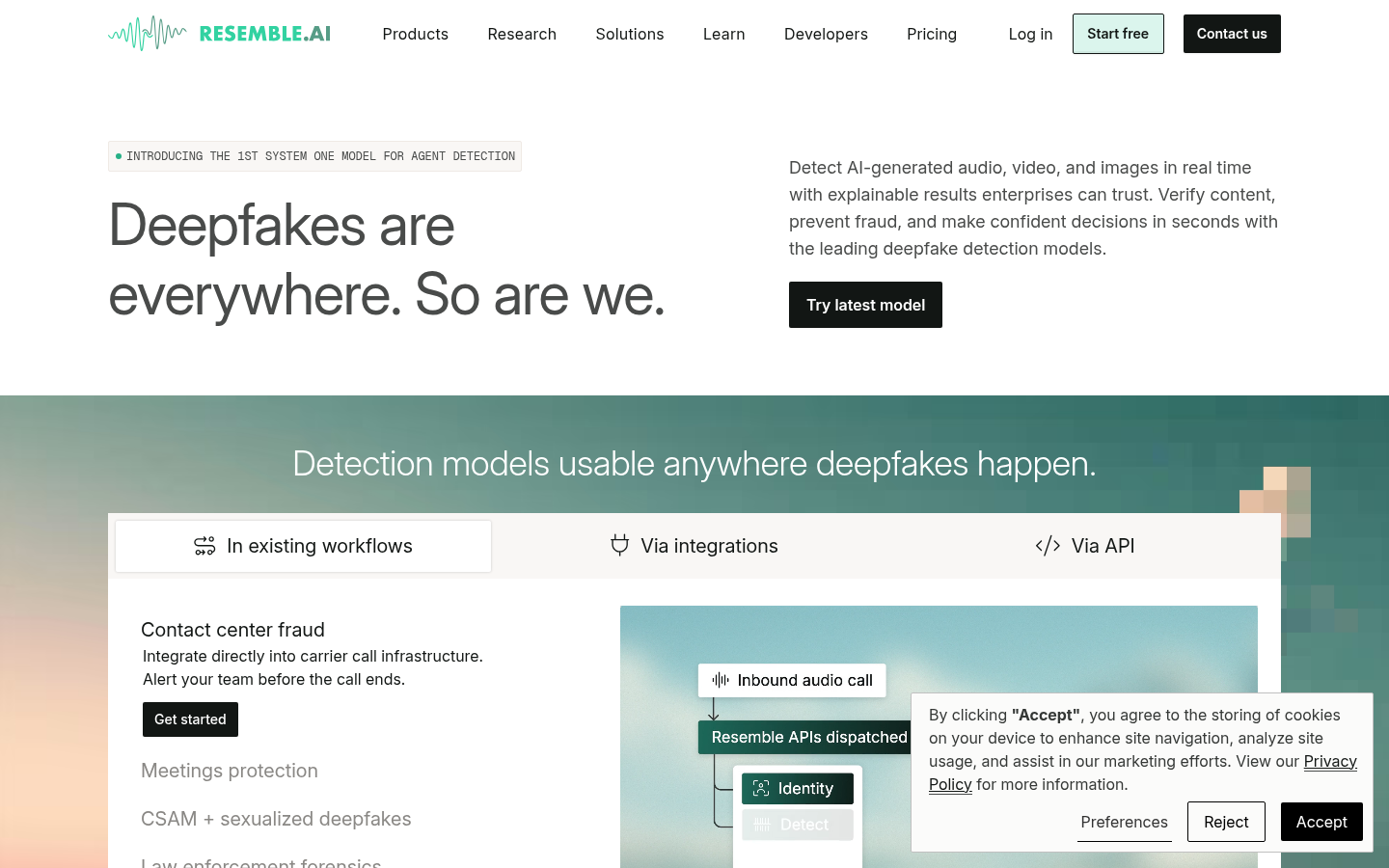
Resemble AI Detection is a multimodal deepfake detection and watermarking platform built for enterprises, financial institutions, contact centers, and corporate security teams that need to verify whether audio, video, or images are AI-generated. It targets organizations facing synthetic media risk, including voice-cloning fraud in call centers, impersonation on video meetings, executive and brand impersonation, KYC and onboarding fraud, document and receipt forgery, CSAM triage, and law enforcement forensics. The core workflow centers on real-time, explainable detection results that can be embedded into existing carrier call infrastructure, meeting platforms, browsers, or backend systems via API, so teams can flag suspicious content before a call ends or a claim is approved. It is offered as a cloud or on-premises deployment, positioning it for organizations with strict data residency or compliance requirements.
What it does
Resemble AI Detection analyzes audio, video, and image content to determine whether it was generated or manipulated by AI, returning explainable, human-readable results rather than an opaque score. It is aimed at use cases where trust in media authenticity has direct financial or legal consequences: verifying callers in contact centers, screening participants in video meetings, authenticating identity during KYC and account onboarding, checking the legitimacy of submitted documents or receipts, moderating user-generated content for trust-and-safety teams, and producing reproducible reports for law enforcement forensics. The product also includes watermarking technology intended to support provenance and content-authentication standards such as C2PA, allowing organizations to embed verifiable markers into AI-generated or human-generated content at the point of creation. Detection models are described as usable directly inside existing workflows, through third-party integrations (including a featured Microsoft Teams integration), via a browser extension, or through direct API access for custom builds.
Key capabilities
- Real-time contact center fraud detection: Integrates into carrier call infrastructure to detect synthetic voices and alert teams before a fraudulent call concludes.
- Meeting protection: Detects synthetic voices and faces live on major video meeting platforms, including a one-click Microsoft Teams integration.
- Multimodal watermarking: Embeds imperceptible watermarks across modalities to support content provenance and C2PA compliance.
- Identity registration and matching: Enrolls and authenticates a person's voice or likeness for ongoing identity verification.
- Explainability layer: Returns structured, plain-language findings alongside detection results rather than raw confidence scores alone.
- Deployment flexibility: Available via API, SDK, Chrome extension, or on-premises/cloud deployment for enterprises with compliance or data-residency constraints.
- Deepfake incident database: Maintains a public log of reported deepfake fraud cases, used as an educational and threat-intelligence resource.
Pricing
Resemble AI Detection is a paid, usage-based platform described as "pay as you go" for individual API/product use, with custom enterprise plans available for larger deployments. A free-start option and trial access are mentioned for putting real-time detection into a workflow before committing to a paid tier, but no specific dollar pricing, credit amounts, or plan tiers are disclosed on the pages reviewed. Enterprise pricing requires direct contact with the company. Pricing page: View pricing
Editorial review
Resemble AI Detection stands out for scoping itself narrowly around enterprise fraud and compliance use cases rather than general-purpose deepfake curiosity tools, which shows up in its contact-center, KYC, and forensic-report-oriented feature set. The emphasis on explainable results and on-prem deployment options suggests it is designed to satisfy audit and compliance requirements rather than just flag "fake/real" probabilities, which is a meaningful differentiator for regulated industries like finance and telco. The breadth of integration paths — carrier infrastructure, meeting platforms, browser extension, and API — makes it flexible for teams that want detection embedded at different points in their stack rather than as a standalone dashboard.
The trade-off is a lack of transparent, self-serve pricing detail beyond a general "pay as you go" framing, which means smaller teams evaluating cost will likely need to start a free trial or contact sales before understanding total cost of ownership. The platform's value also depends heavily on integration quality with specific carrier and CCaaS systems (Genesys, Five9, Avaya, Salesforce, Zendesk, and similar platforms are listed as partners), so prospective buyers should confirm their own stack is supported before assuming plug-and-play deployment. Overall, this looks best suited to mid-market and enterprise security, fraud, and compliance teams — particularly in financial services, telco, and public-sector contexts — rather than individual creators or small businesses needing a lightweight, low-cost detection check.







