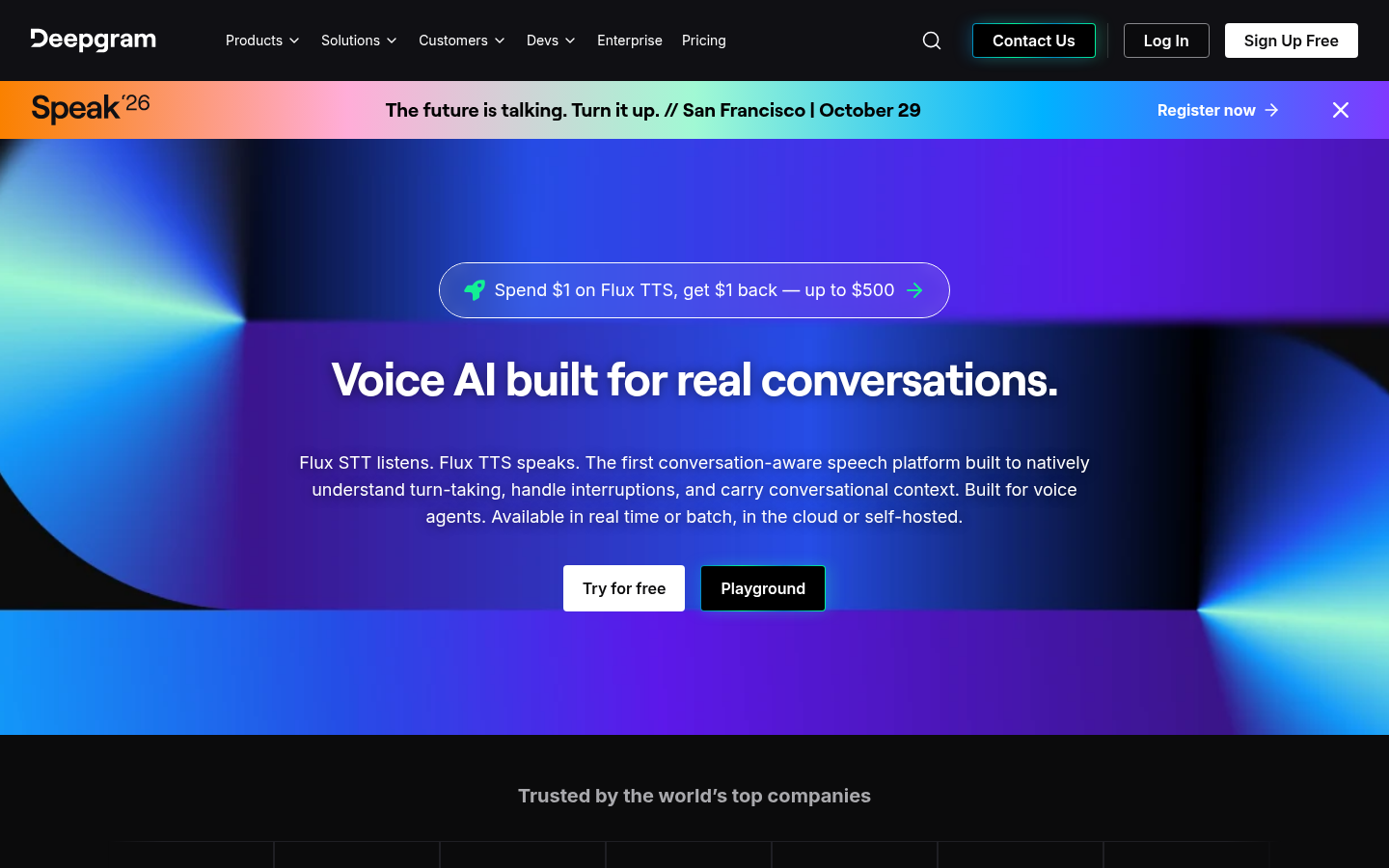
Deepgram is a voice AI platform built for developers and enterprises that need to add speech recognition, speech synthesis, or conversational voice agents into their products. It targets teams building call center automation, transcription pipelines, voice bots, and real-time conversational applications, and is delivered as a set of developer-facing APIs rather than a consumer app. The core value proposition is unifying Speech-to-Text (STT), Text-to-Speech (TTS), and autonomous Voice Agent orchestration under one API surface, deployable as a managed cloud service, inside a customer's VPC, or fully self-hosted. Customers referenced on the site include Twilio, Cloudflare, Sierra, IBM, Daily, Cresta, Granola, Vapi, Decagon, Kore.ai, NICE-Cognigy, and Coval, signaling adoption among both infrastructure providers and applied AI companies.
What it does
Deepgram converts spoken audio into text and text into natural-sounding speech using AI models, and it packages these capabilities alongside a Voice Agent API so builders can orchestrate full voice conversations without stitching together separate ASR, TTS, and dialogue-management systems. It is aimed at engineering teams inside enterprises and startups who need real-time transcription, multi-language voice support, or voice-driven agents embedded into call centers, customer support tools, meeting software, or telephony platforms. The platform emphasizes low-latency performance and accuracy at production scale rather than offline or hobbyist use, and supports flexible deployment models (managed API, in-VPC, or self-hosted) so that regulated or latency-sensitive organizations can keep audio processing closer to their own infrastructure.
Key capabilities
- Speech-to-Text (STT) API: Real-time and batch transcription designed for accuracy across live audio streams and recorded files, with multi-language support for global deployments.
- Text-to-Speech (TTS) API: Generates natural-sounding synthetic speech output, including a newer "Flux TTS" capability highlighted on the homepage as a headline product update.
- Unified Voice Agent API: A single API for orchestrating autonomous voice agents, combining STT, TTS, and conversational logic instead of requiring separate integrations for each component.
- Audio Intelligence features: Additional audio-analysis capabilities layered on top of raw transcription, referenced alongside the core STT/TTS/Agent feature set.
- Flexible deployment options: Available as a managed API with US, EU, and Australia endpoints, or deployed in-VPC or fully self-hosted for organizations with data residency or compliance requirements.
- Developer-first integration: API-based access designed for direct integration into existing software stacks, telephony systems, and third-party voice platforms (evidenced by partners like Twilio, Vapi, and Daily building on top of it).
Pricing
Deepgram operates on a freemium/usage-based model: a free tier is available for initial access and testing, with pay-as-you-go pricing for enterprise-scale usage of the STT, TTS, and Voice Agent APIs. Exact current per-minute or per-character rates were not confirmed in the available source material, so specific figures should be verified directly on Deepgram's site before budgeting. No dedicated pricing page URL was available in the crawled data.
Editorial review
Deepgram positions itself firmly at the infrastructure layer of the voice AI stack, competing less on consumer polish and more on latency, accuracy, and deployment flexibility for regulated or high-volume environments. The breadth of named customers and partners (Twilio, IBM, Cloudflare, Sierra, Cresta, Decagon, Kore.ai, NICE-Cognigy) suggests real enterprise traction in call center, customer support, and conversational AI verticals rather than early-stage speculation. The unification of STT, TTS, and Voice Agent orchestration into one API is a meaningful differentiator versus assembling a stack from separate vendors, and the option to self-host or run in-VPC is notable for healthcare, finance, or government buyers with strict data-handling requirements.
The trade-off is that Deepgram is not a plug-and-play consumer product: it requires engineering resources to integrate, and detailed pricing transparency is limited without visiting the console or contacting sales. Teams evaluating it should expect to prototype against the API directly to validate accuracy and latency for their specific audio conditions (accents, background noise, telephony codecs) since marketing claims alone won't substitute for real testing. Overall, Deepgram is best suited to product and engineering teams building voice-enabled software—contact centers, meeting transcription tools, voice bots, and telephony platforms—who need a scalable, deployment-flexible voice AI backend rather than a finished end-user application.