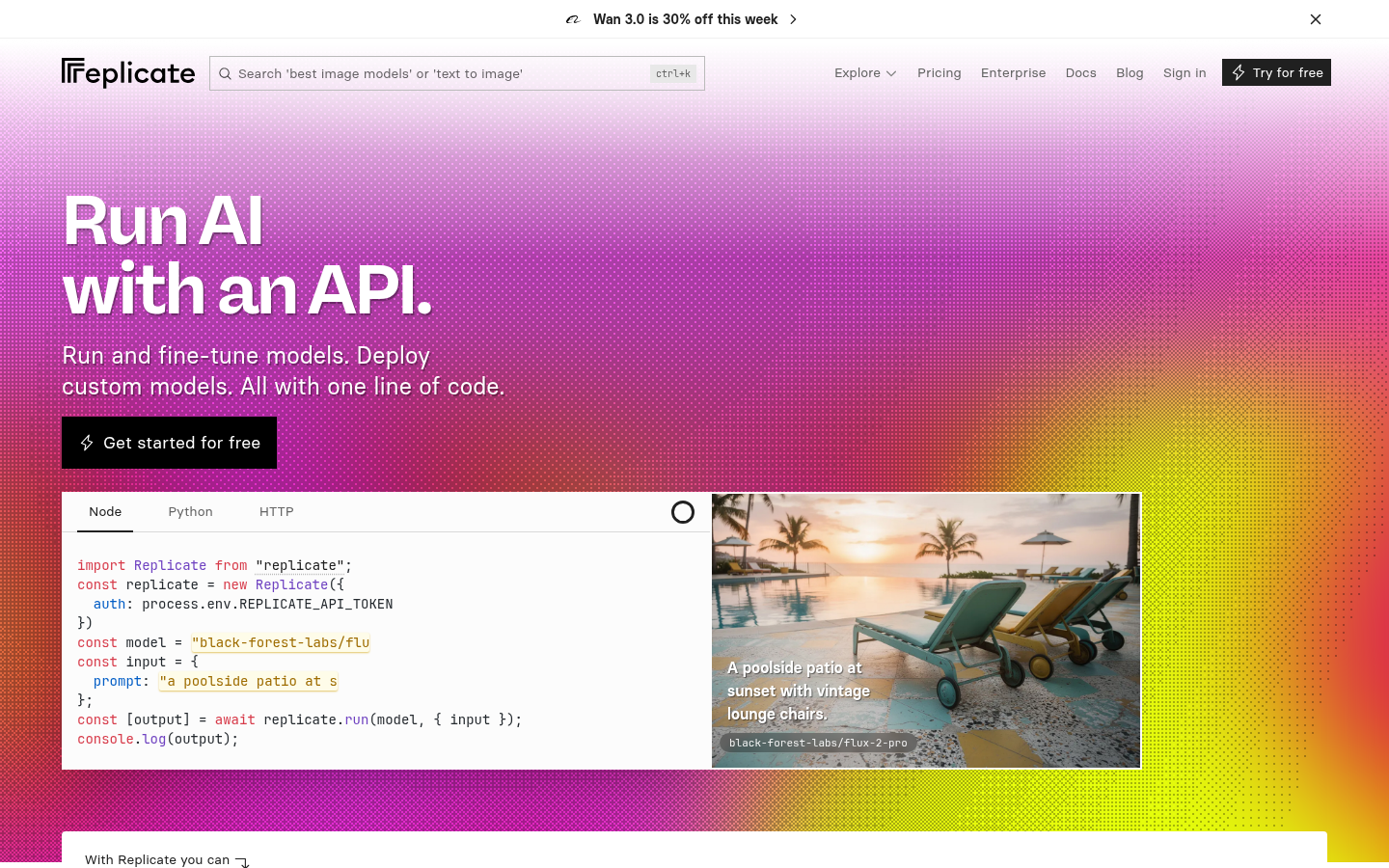
Replicate is a cloud API platform for developers who want to run machine learning models without managing GPU infrastructure. It targets developers, data scientists, and AI-focused product teams who need to add image generation, video generation, speech, music, LLM, or image-restoration capabilities to an application with minimal setup. The core workflow is simple: pick a model from Replicate's public library or upload a custom one, call it with a few lines of Node, Python, or an HTTP request, and receive output without provisioning servers. Its main differentiator is breadth — thousands of community-contributed and official models sit behind one consistent API interface, alongside tools for fine-tuning and deploying custom models.
What it does
Replicate lets users run open-source and proprietary machine learning models through a hosted cloud API, so teams can add AI functionality to software without building or maintaining their own inference infrastructure. It solves the problem of model deployment complexity: instead of setting up GPU servers, managing dependencies, and scaling inference, developers call a model endpoint directly from their codebase. The platform hosts models from labs and contributors including Black Forest Labs (FLUX), Google (Imagen, Nano Banana), OpenAI (GPT Image), ByteDance (Seedream), Anthropic (Claude), and DeepSeek, alongside community-uploaded checkpoints. Use cases span text-to-image generation, image editing, image-to-video conversion, speech and music generation, image captioning, image restoration, and running large language models — all callable via the same API pattern.
Key capabilities
- One-line API calls: Run any hosted model with a single API call in Node.js, Python, or raw HTTP, using a consistent input/output pattern across model types.
- Model marketplace with thousands of options: Browse and compare text-to-image, image-to-video, LLM, speech, and music models from official partners and independent contributors, with usage counts and example outputs shown per model.
- Fine-tuning and custom model deployment: Fine-tune existing models on custom data or deploy proprietary/custom models to a private or public endpoint using the same tooling.
- In-browser Playground: Compare outputs across multiple models side by side before committing to one in production code.
- Usage-based billing granularity: Most public models bill by compute time (price-per-second based on hardware), while some newer models bill per input/output token or per generated image/video-second, with per-model cost estimates shown on each model page.
- Official model badges: Certain models are marked "Official," indicating they are actively maintained with predictable pricing, distinguishing them from community-uploaded alternatives.
Pricing
Replicate uses a pay-as-you-go, usage-based model rather than flat subscription tiers. Public models are billed either by processing time (price-per-second varies by hardware) or by input/output units — for example, per output image, per thousand output tokens, or per second of generated video. Sample rates referenced on the pricing page include figures like $0.04 per output image for one FLUX model and $0.01 per thousand output tokens for a reasoning model, with exact costs varying per model and shown on each model's page. A free tier and trial usage appear to be available for getting started, and account setup is required to obtain an API token. Because pricing is model-specific and usage-based, actual costs depend heavily on which models and volume a project uses. Pricing page: View pricing
Editorial review
Replicate's core strength is breadth combined with a low-friction developer experience: the same simple API call pattern works across an unusually wide range of model types — image, video, audio, and text — which reduces integration overhead for teams building multi-modal AI features. The inclusion of major-lab models (OpenAI, Google, Anthropic, Black Forest Labs) alongside a large community catalog gives it more model variety than most single-vendor AI APIs. The usage-based, per-model pricing structure is transparent in that costs are shown per model, but it also means budgeting requires care, since rates differ significantly across models and billing units (time vs. tokens vs. output count). This makes Replicate a strong fit for developers and startups prototyping or shipping AI features who want flexibility to swap models without re-architecting their integration, and less ideal for teams wanting a single flat-rate subscription or full control over self-hosted infrastructure. Enterprise-specific features and SLAs are referenced but not detailed in the available material, so larger organizations should verify support and compliance details directly before committing.