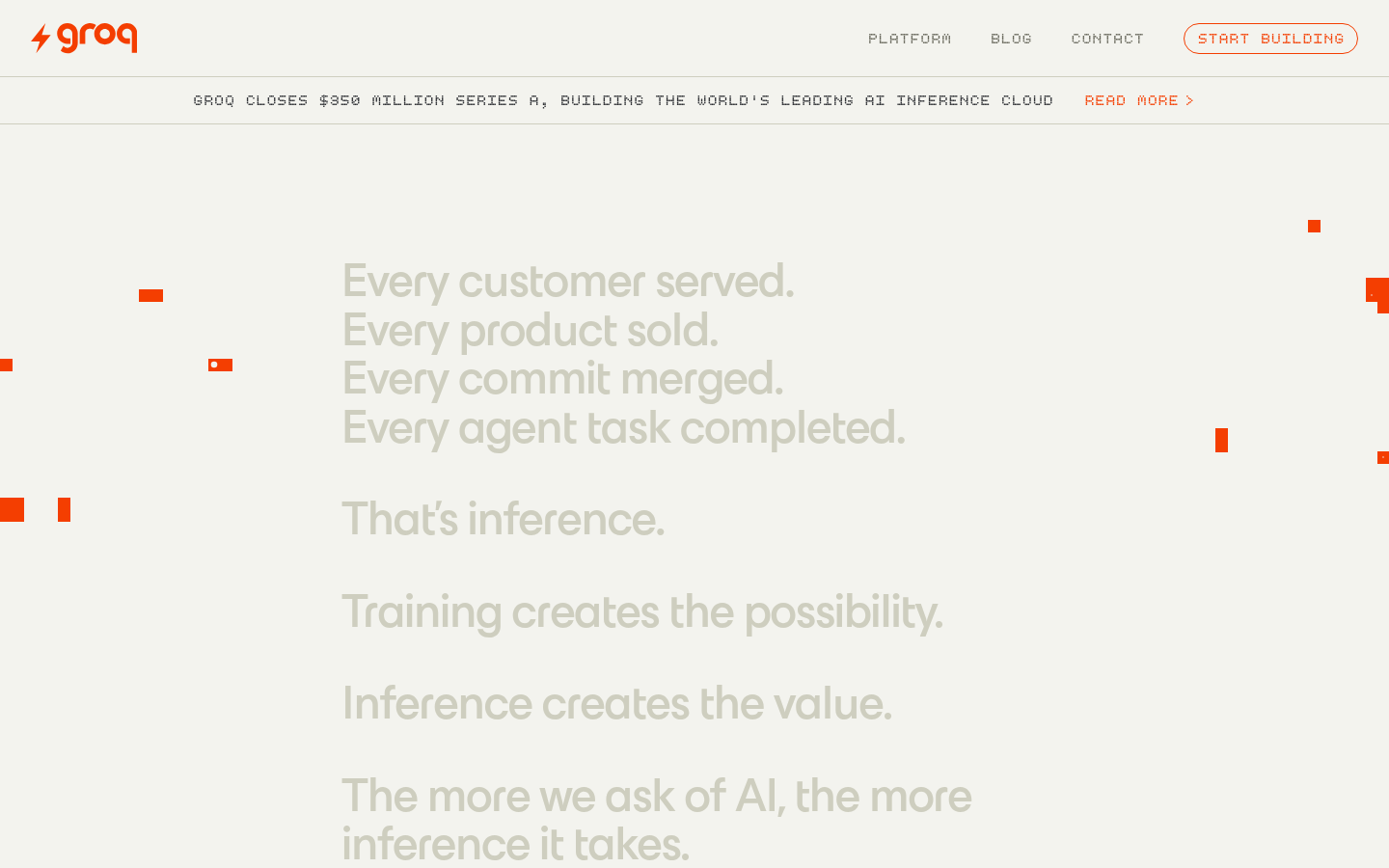
Groq is an inference-focused cloud platform built for developers and businesses running large language models and other AI workloads in production. Rather than competing on model training, Groq positions itself specifically around inference: the runtime step where trained models actually serve predictions to customers, agents, and applications. It targets teams that have already built or adopted AI models and now need to run them fast, reliably, and at scale without the latency or cost overhead typical of general-purpose GPU clouds. The platform combines custom hardware, cloud infrastructure, and developer tooling into a single integrated stack rather than requiring customers to stitch together separate compute, orchestration, and inference layers.
What it does
Groq operates as a cloud inference platform (accessed via web and API) that lets developers deploy and query AI models with low latency and high throughput. It is aimed at engineering teams building AI-powered products—chatbots, agents, copilots, and automated workflows—where response speed and cost per token directly affect user experience and unit economics. The core problem Groq addresses is the "inference bottleneck": as AI usage shifts from training to live, high-volume serving, standard infrastructure often becomes slow or expensive at scale. Groq's answer is a purpose-built inference stack, originally centered on its own LPU (Language Processing Unit) chip architecture, now extended with "LPX" technology that runs alongside NVIDIA's next-generation GPUs to combine speed with broader hardware capacity.
Key capabilities
- Custom inference silicon (LPU): Groq's proprietary Language Processing Unit is designed specifically for the sequential, latency-sensitive nature of language model inference, differentiating it from repurposed training-optimized GPUs.
- Hybrid LPU/GPU architecture (LPX): Combines Groq's own chips with NVIDIA's next-generation GPUs in a single platform, aiming to remove the traditional trade-off between inference speed and affordability.
- Fully integrated inference stack: Bundles infrastructure, inference execution, and platform controls into one system rather than requiring separate provisioning, scaling, and monitoring tools.
- High-volume, developer-facing platform: Positioned to support very large request volumes, with the company stating that developers collectively run large numbers of tokens through the platform on a weekly basis.
- Expanding data center capacity: Groq describes active build-out of hundreds of megawatts of compute capacity, signaling a focus on scaling for enterprise and high-throughput workloads rather than small-scale experimentation.
- API and platform access for builders: Provides a "Start building" entry point and platform documentation aimed at developers integrating inference directly into their own applications.
Pricing
Groq's public marketing pages do not list specific self-serve prices, plans, or credit amounts. The available information indicates a commercial, contact-based or usage-based paid model typical of infrastructure and inference platforms, rather than a free consumer product. No confirmed free tier, trial terms, or published price list is available in the reviewed source material, so specific figures should not be assumed until verified directly on Groq's platform or pricing pages.
Editorial review
Groq's strongest differentiator is its narrow, explicit focus on inference rather than the broader training-and-inference bundle most cloud providers offer. By building custom LPU silicon and now pairing it with NVIDIA GPUs under the LPX approach, the platform makes a clear architectural bet: that inference workloads have different performance characteristics than training, and deserve purpose-built hardware. This is a credible and increasingly relevant position as more AI spend shifts toward serving live traffic rather than training new models.
The trade-off is transparency. The public site emphasizes scale and speed in broad terms—capacity build-outs, token volume, "fast or affordable is no longer a tradeoff"—but offers little in the way of published benchmarks, concrete pricing, or self-serve onboarding details in the reviewed content. Teams evaluating Groq will likely need to engage directly with sales or the platform console to understand real-world latency numbers, cost per token, and contract terms.
Groq is best suited to engineering teams and companies already running production AI applications at meaningful volume—chat products, AI agents, or high-throughput API consumers—where inference latency and cost are measurable business constraints. It is less relevant for hobbyists, early-stage prototypes, or teams still in the model-training phase. Organizations should independently verify current pricing, supported model list, and integration requirements before committing, since none of these specifics were confirmed in the available source material.