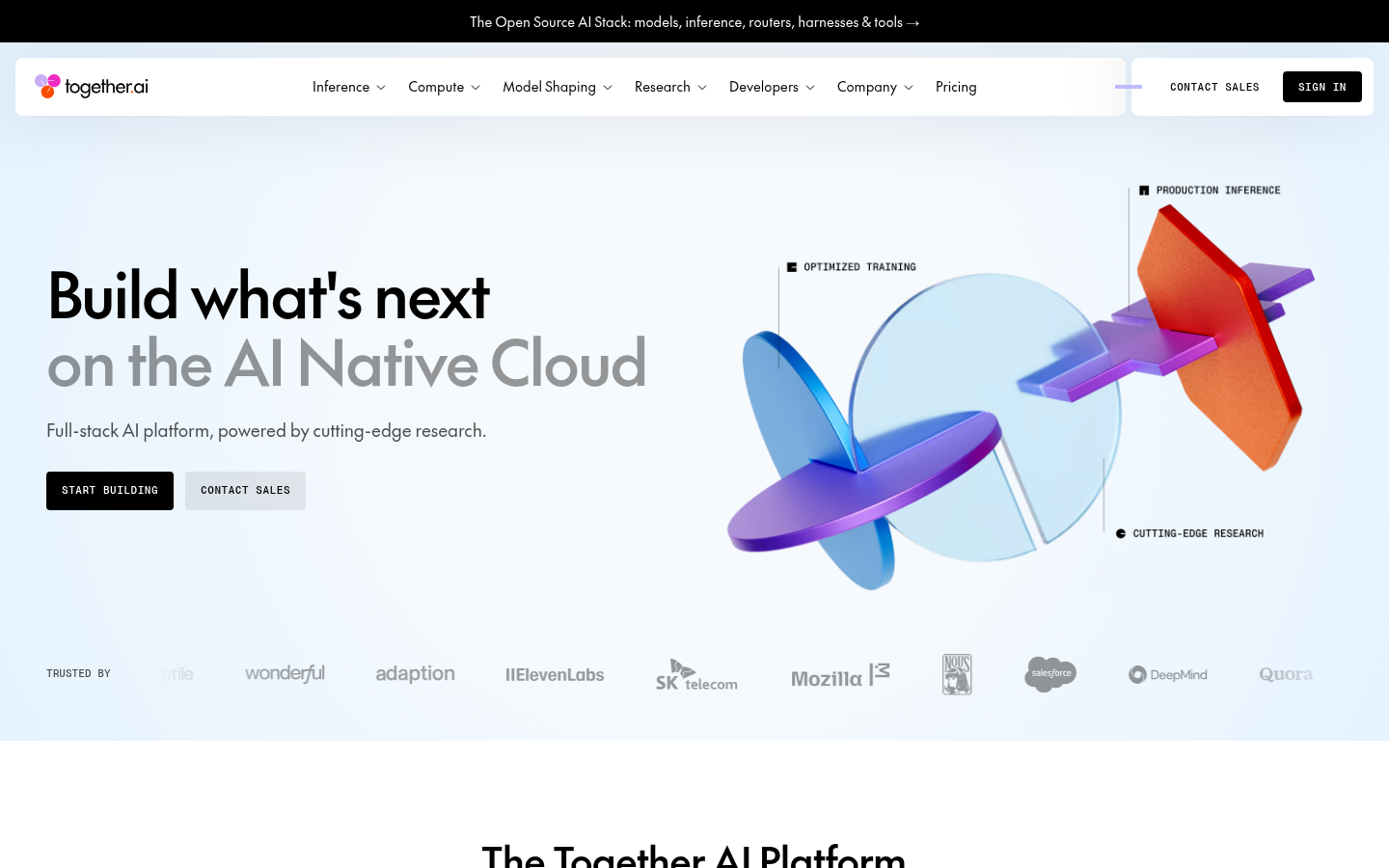
Together AI is a cloud infrastructure platform built for developers and companies that need to run, customize, and scale large language models and other AI workloads without managing their own hardware. It targets AI-native startups, ML engineers, and enterprises that need production-grade inference, model fine-tuning, and GPU compute in one place instead of stitching together separate vendors. The platform is positioned around research-driven performance gains, offering serverless and dedicated inference, provisioned throughput, and post-training tooling on top of a managed cloud stack. It also serves as a model hosting layer for popular open-weight models from providers like DeepSeek, Meta, Qwen, Google, MiniMax, Kimi, and Z.ai. Based on the source material, Together AI is best understood as an "AI-native cloud" rather than a single point-solution app.
What it does
Together AI provides a full-stack cloud platform for building and deploying AI applications, covering the lifecycle from model inference to fine-tuning to raw GPU cluster access. It is delivered as a web-based platform with an API layer, so engineering teams call hosted models or provision infrastructure programmatically rather than through a desktop or mobile client. Core use cases include running inference on frontier and open-weight models via an OpenAI-compatible API, fine-tuning and post-training custom models, evaluating model performance, and renting GPU clusters for large-scale training or pre-training jobs. The company publishes its own benchmark research comparing models like GLM-5.3 vs. GLM-5.3 Flash and DeepSeek V4 Pro vs. GPT-5.6 Sol on coding tasks, using these findings to justify performance and cost-efficiency claims and to guide customers on model selection and routing strategies (e.g., cascading a cheaper model first and escalating to a stronger one on failure).
Key capabilities
- Serverless and dedicated inference: Run inference on hosted open-weight and third-party models via an OpenAI-compatible API, with options for shared serverless endpoints or dedicated model deployments.
- Provisioned throughput: Reserve guaranteed throughput for production workloads that need predictable latency and capacity rather than best-effort serverless access.
- Fine-tuning and post-training: Customize base models with fine-tuning and post-training workflows, supported by managed storage for datasets and checkpoints.
- GPU clusters for training and pre-training: Provision GPU clusters directly for large-scale model training, with claimed pre-training speed gains from the in-house Together Kernel Collection.
- Evaluation tooling and sandbox environment: Test and benchmark models in a sandbox before production rollout, using built-in evaluation tools to compare accuracy, cost, and latency trade-offs.
- Model routing and cascade strategies: Published research (e.g., DeepSWE benchmark comparisons) demonstrates practical patterns like routing between a fast/cheap model and a stronger fallback model to balance cost and task success rate.
Pricing
Together AI's public marketing does not display a fixed consumer-style pricing table on the homepage; the platform is usage/infrastructure-oriented, with cost examples referenced per model and per task in its own benchmark posts (for example, per-rollout costs ranging from fractions of a cent to several dollars depending on the model). The site offers a way to start building directly as well as a "Contact Sales" path for enterprise GPU cluster and dedicated inference needs, suggesting a mixed self-serve plus custom-quote structure typical of GPU/inference cloud providers. No explicit free-forever tier or fixed monthly consumer price is confirmed in the available source content, so pricing should be treated as usage-based and model-dependent rather than a flat subscription. Pricing page: View pricing
Editorial review
Together AI's strongest asset is its research-backed positioning: rather than only marketing features, it publishes granular, model-vs-model cost and accuracy comparisons (GLM-5.3 vs. Flash variant, DeepSeek V4 Pro vs. GPT-5.6 Sol) using real benchmark rollouts, which gives technical buyers concrete data to justify model and routing choices. This is a meaningful differentiator versus generic "AI cloud" providers that rely on marketing claims alone. The breadth of the stack — serverless inference, dedicated inference, provisioned throughput, fine-tuning, evaluations, GPU clusters, and a sandbox — makes it a plausible one-stop shop for teams that want to avoid juggling separate inference and training vendors. The trade-off is that this breadth also means the platform is squarely aimed at technical users (ML engineers, infra teams) rather than non-technical business users; there is no evident low-code or consumer-facing UI emphasis in the source material. Pricing transparency is a limitation: without a clear self-serve rate card in the reviewed content, prospective users need to dig into usage-based model pricing or contact sales, which may slow evaluation for smaller teams. Together AI appears best suited for startups and enterprises already running LLM-dependent products who need reliable inference at scale, teams doing custom model fine-tuning or pre-training, and technically sophisticated buyers who will actually use the published benchmark data to inform model selection and cost optimization decisions.