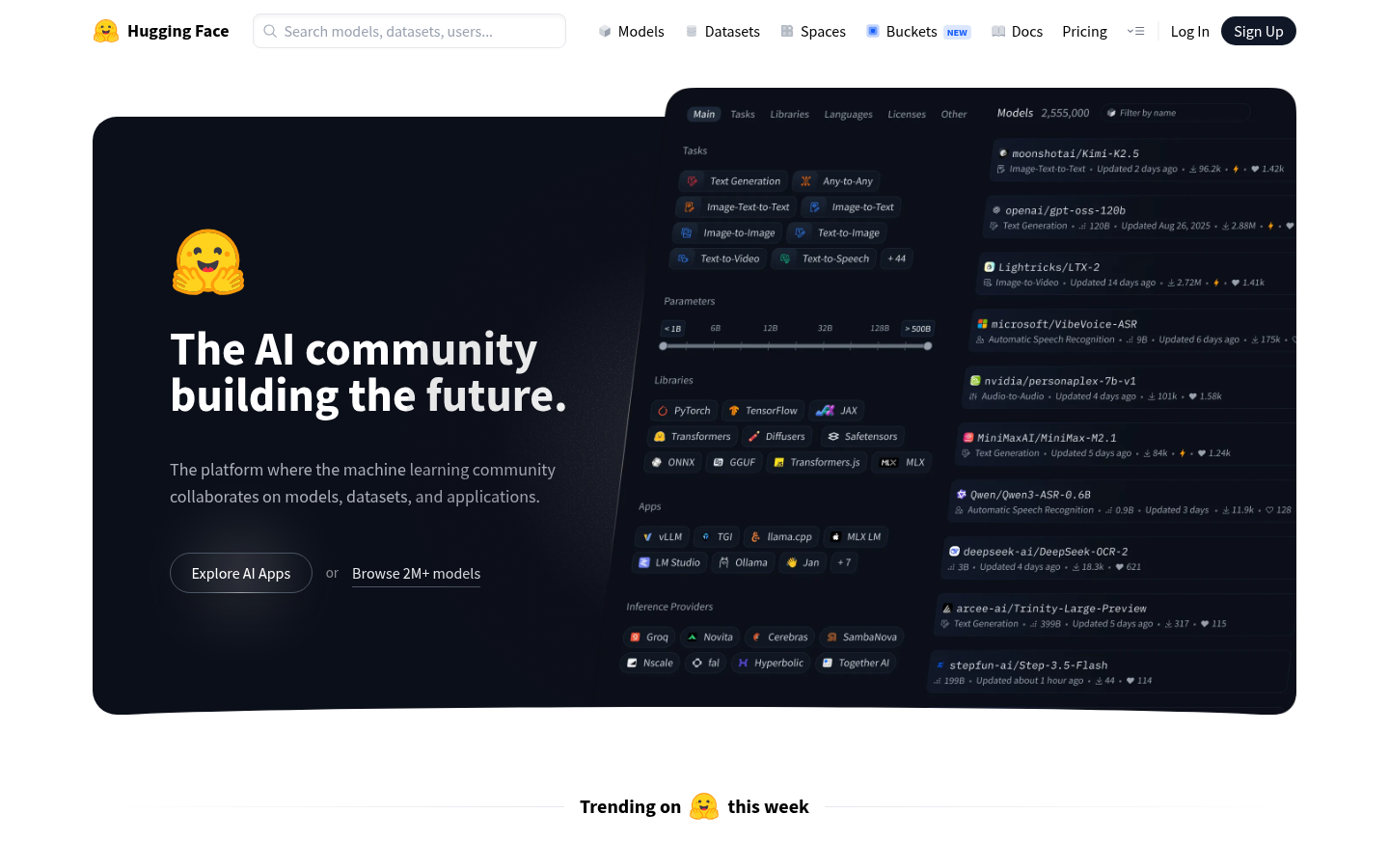
Hugging Face is a machine learning collaboration platform built for AI researchers, developers, and data scientists who need to find, share, and deploy models and datasets without building infrastructure from scratch. It functions as a public hub — often called the GitHub of machine learning — where teams host models, datasets, and interactive applications ("Spaces"), then move from experimentation to production using the same open-source stack. Individuals and organizations use it to browse millions of pre-trained models, publish their own research, run live demos, and access on-demand compute for training or inference. The core workflow centers on the Hub: search or filter models and datasets by task or modality, test them directly in a browser-based Space, then pull them into code via open-source libraries or hosted APIs.
What it does
Hugging Face operates as a web-based hub for the machine learning community, combining a model registry, dataset repository, and app-hosting environment ("Spaces") in one platform. Users can browse over 2 million models, 1 million applications, and hundreds of thousands of datasets covering text, image, video, audio, and 3D modalities. It's aimed at ML practitioners who need a place to publish research, discover state-of-the-art models, collaborate on open-source projects, or build a public ML portfolio. Rather than replacing training frameworks outright, it acts as the distribution and collaboration layer around them, with API access for pulling models into production code.
Key capabilities
- Model and dataset hosting: Unlimited public models, datasets, and Spaces for hosting and sharing ML artifacts with version control built in.
- Spaces for live demos: Deploy interactive applications (chatbots, image generators, video tools) that run directly in the browser, many powered by community-contributed Gradio or Streamlit apps.
- Inference Providers: Access thousands of models from third-party providers through a unified API for running inference without managing your own GPU infrastructure.
- On-demand GPU compute: Pay-as-you-go hardware for training and inference starting at low hourly rates, alongside dedicated inference endpoints.
- Multi-modal coverage: Support for text, image, audio, video, and 3D tasks across the model and dataset catalog.
- Enterprise-grade controls: Single sign-on, regional data controls, audit logs, resource groups, and private dataset viewers for organizational deployments.
Pricing
Hugging Face offers a free tier for browsing, hosting public models/datasets/Spaces, and building an ML profile. Paid options include Team & Enterprise plans starting at $20/user/month with SSO, regions, priority support, audit logs, resource groups, and private dataset viewers. On-demand GPU compute starts at $0, and dedicated inference endpoints start at roughly $0.033/hour. A Hugging Face PRO plan is also available for individuals wanting expanded features. Pricing page: View pricing
Editorial review
Hugging Face's strength is network effect: an enormous, actively updated catalog of models, datasets, and demo apps that makes it the default first stop for anyone evaluating open-source ML options. The Spaces feature lowers the barrier to testing a model before writing any code, which is valuable for both researchers and non-technical stakeholders doing quick evaluations. The addition of Inference Providers and dedicated GPU compute shows a clear path from experimentation to production without leaving the platform, which is a meaningful differentiator versus pure model-hosting sites.
The trade-offs are typical of an open, high-volume community hub: content quality varies widely since anyone can publish, so vetting models and datasets for production use still requires diligence. Enterprise pricing details beyond the $20/user/month starting point aren't fully transparent on the marketing pages, and organizations with strict compliance needs will want to confirm audit log and region support directly. The platform is best suited to ML engineers, researchers, and data science teams already working with open-source frameworks (Transformers, Diffusers, etc.) rather than non-technical users looking for a polished, no-code AI app; the interface and depth of options assume some familiarity with ML workflows. For teams building on open or mixed-provider models, evaluating fine-tuned checkpoints, or needing a public venue to showcase ML work, it remains one of the most comprehensive options available.