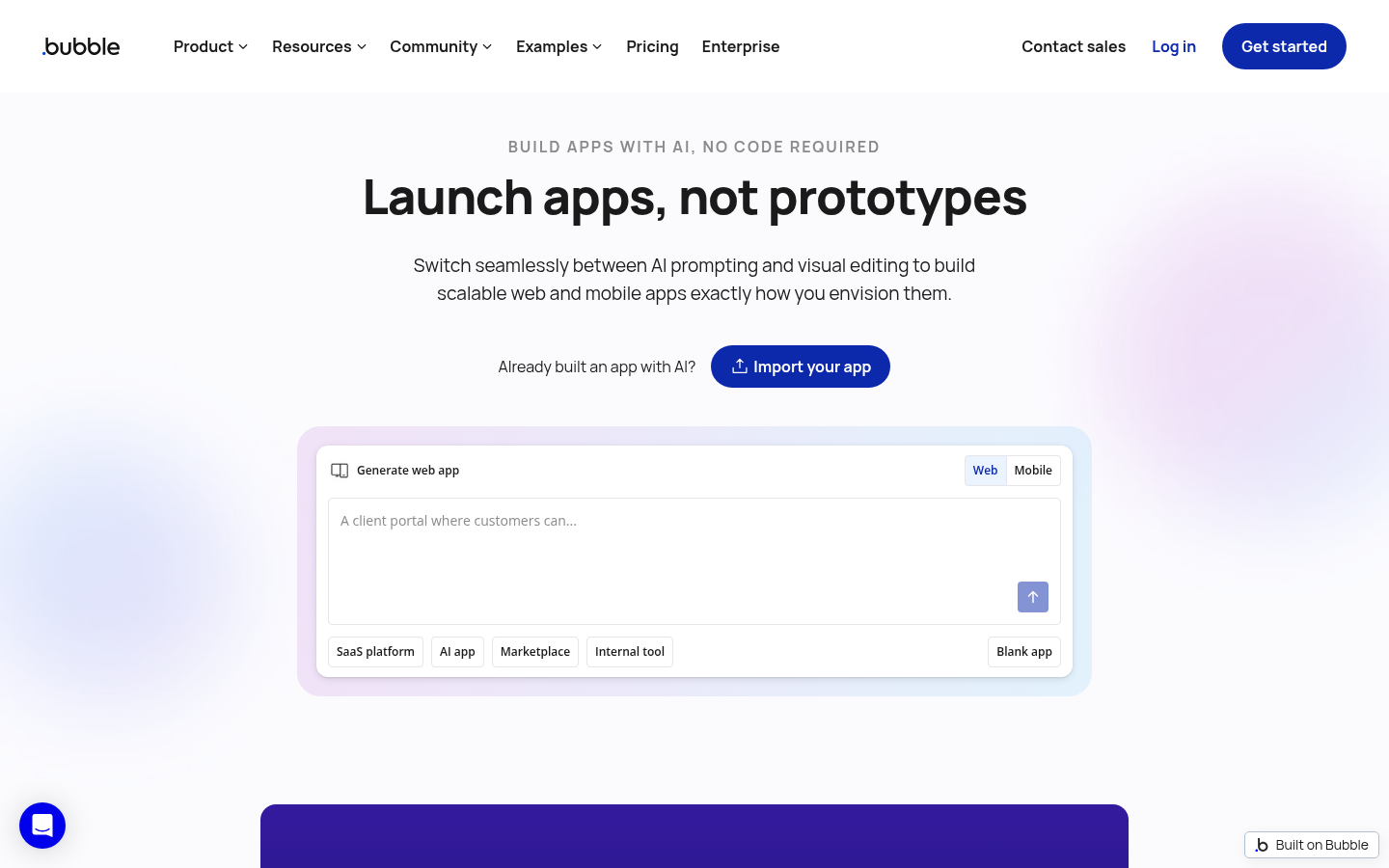
Bubble is a no-code application development platform aimed at entrepreneurs, startups, and business teams that need to build functional web and mobile apps without writing traditional code. It combines an AI-assisted generation layer for fast scaffolding with a visual, point-and-click editor for precise control over design, database structure, logic, and privacy rules. The core workflow lets users move from an idea to a deployed application by describing what they want, then refining the result visually across frontend layout, backend data, and workflow logic. Bubble positions itself for teams that want to prototype quickly but also need the depth to build production-grade software rather than simple mockups.
What it does
Bubble functions as a full-stack no-code builder: it handles the visual interface, the underlying database, application logic (workflows), and user authentication in one connected environment. Users can generate an initial app structure with AI, then switch into a visual canvas to adjust layout responsiveness, edit data types and fields, configure conditional workflows, and set privacy rules that control who can see or edit specific data. Because the frontend, database, and logic layers are unified in the same builder, changes to one area (for example, adding a new data field) can be reflected across the app's UI and workflows without separate coding steps. The platform is used to build customer-facing web apps, internal tools, marketplaces, SaaS products, and mobile app experiences, based on the customer examples referenced on the site (health platforms, community apps, AI-powered utilities, and enterprise internal tools).
Key capabilities
- AI-assisted app generation: Users can describe an app concept and have Bubble generate an initial structure (screens, data, and logic) to accelerate the starting point before manual refinement.
- Visual editor for precision: A drag-and-drop canvas lets builders fine-tune design, responsive layout behavior, and component placement without code.
- Database and workflow logic: Built-in database management lets users define custom data types and relationships, paired with a workflow engine for conditional logic and automation.
- Privacy rules and access control: Native privacy settings allow granular control over which users or roles can view or modify specific data records.
- User authentication out of the box: Sign-up, login, and account management can be configured natively within the builder rather than through a separate service.
- API and integration support: Bubble supports connecting external APIs, allowing apps to pull in or send data to third-party services.
- Custom domain and cross-platform output: Finished apps can be published under a custom domain and are built to work across web and mobile form factors.
Pricing
Bubble uses a freemium pricing model: a free tier is available for building and testing apps, with paid plans required to unlock production features such as custom domains, higher capacity, and advanced platform limits. Exact current plan names and tier-by-tier pricing were not confirmed in the available source content, so specific dollar figures are not stated here. Prospective users should check the live pricing page for up-to-date plan details.
Editorial review
Bubble's main strength is its scope: rather than being a simple landing-page or form builder, it combines database modeling, workflow logic, authentication, and visual design into a single environment capable of supporting real production applications, as evidenced by customer examples ranging from healthcare platforms to AI-powered tools. Layering AI generation on top of the traditional visual editor is a meaningful update — it lowers the barrier to a working first draft while still giving experienced no-code builders the manual control they need for complex logic and edge cases.
The trade-off is depth versus learning curve: Bubble's flexibility means the workflow and database configuration can get complex for non-technical users building anything beyond a simple app, and mastering privacy rules, nested workflows, and API connections typically requires real time investment. It is not a plugin or browser extension — it's a standalone web-based builder that outputs deployable web and mobile applications.
Best-fit users are startup founders and small teams validating an MVP, agencies building client applications without dedicated developers, and internal-tool builders inside larger organizations (the site cites enterprise customers such as Seagate). Teams needing highly custom performance-critical software, or deep native mobile capabilities beyond what a no-code layer supports, may find Bubble's abstraction limiting compared to hand-coded development. Overall, Bubble remains one of the more mature and capable entries in the no-code app-builder category, particularly for teams that value having AI speed and manual precision available in the same tool.