
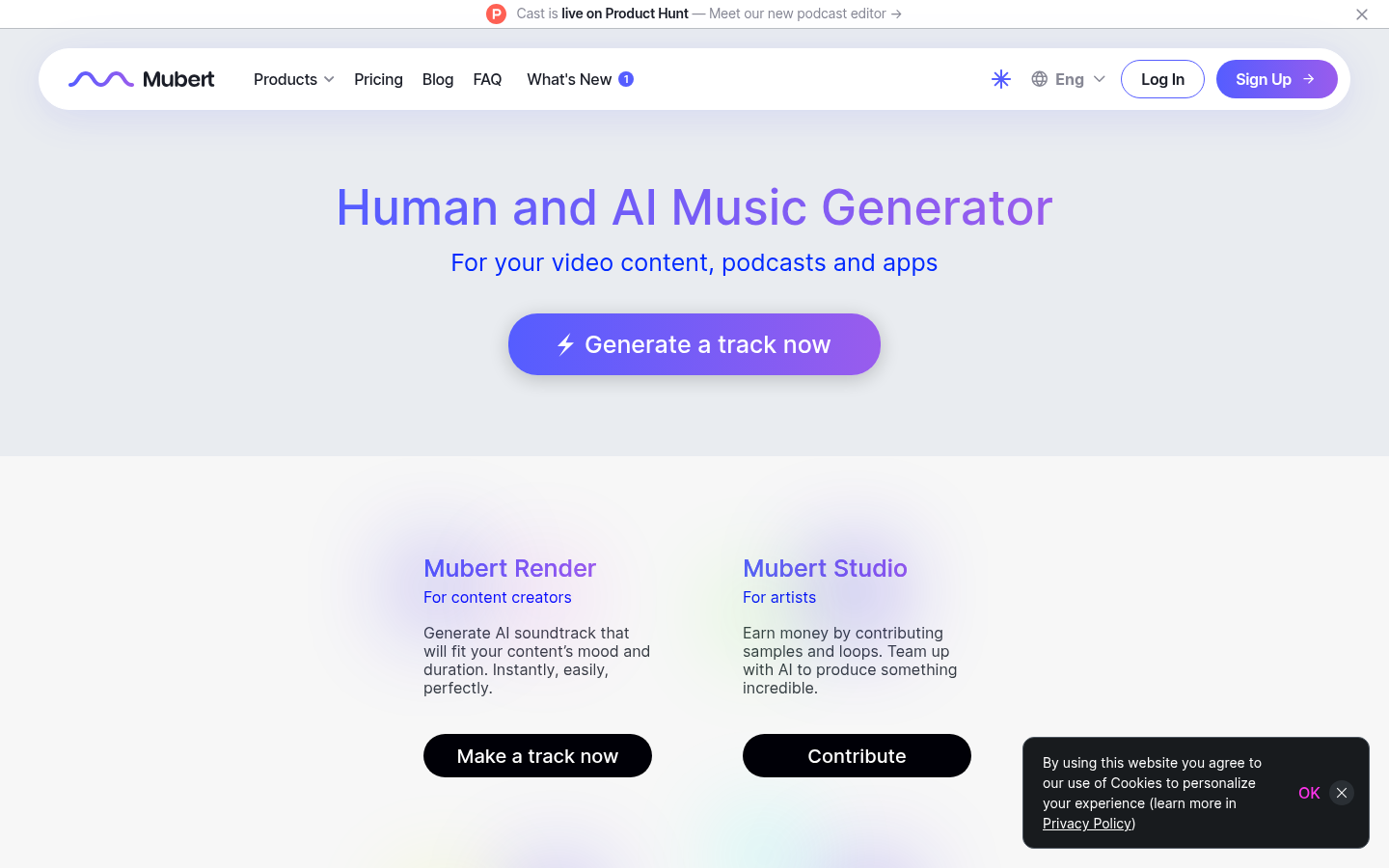
Mubert is an AI music generation platform built for content creators, developers, and brands that need royalty-free background music without licensing headaches. It converts text prompts, mood, genre, or BPM selections into finished audio tracks in seconds, and it also offers a developer API for embedding dynamic soundtracks directly into apps and games. The product spans four sub-products—Render, Studio, API, and Play—covering everything from one-off track generation to programmatic music delivery at scale. It is aimed at YouTubers, TikTok creators, podcasters, app developers, agencies, and enterprise brands looking for scalable, customizable audio.
What it does
Mubert generates AI-composed, royalty-free music tailored to a specified mood, genre, BPM, or written prompt, using a library built from samples contributed by human music producers combined with AI composition. The core consumer-facing tool, Mubert Render, lets creators pick parameters and generate a soundtrack of a defined length and style in a few clicks—useful for YouTube videos, TikTok clips, podcasts, and other video content. Mubert Studio lets artists contribute loops and samples to the underlying library and earn money when those elements are used in generated tracks. Mubert API is the developer-facing product, allowing software teams to integrate on-demand AI music generation into apps, games, or digital products, with text-to-music and image-to-music generation modes. Mubert Play is a listening app for streaming AI-generated music by mood or activity (focus, sleep, workout, etc.).
Key capabilities
- Text-to-music and image-to-music generation: Create tracks from written prompts or image inputs rather than manually arranging stems.
- Parameter-based track building: Select mood, genre, BPM, and duration (up to roughly 25 minutes on paid plans) to generate a fitted soundtrack.
- Track editing tools: Higher tiers include stem regeneration/removal, quick remix, duration changes, and on paid Pro/Business plans a full track editor for restructuring sections.
- Lossless export and commercial licensing: Paid plans unlock WAV/lossless downloads plus commercial-use licenses for freelance, agency, and app/service work.
- Developer API with webhooks and curated library access: API plans expose a catalog of 12,000+ curated tracks, streaming-minute quotas, and sub-licensing/distribution options for apps and games.
- Contributor marketplace (Mubert Studio): Musicians and producers can supply samples/loops to the generation engine and earn royalties from usage.
Pricing
Mubert uses a freemium model. The free "Ambassador" tier is non-commercial, limited to 25 fixed-duration MP3 tracks per month with 5 downloads and no stem editing. Paid consumer plans include Creator ($11.69/mo billed annually, $149.29/mo annually) with 1,000 tracks/month for apps and agency work. Separately, the Mubert API for developers is tiered as Build ($14/mo monthly) with 500 tracks/month and lossless unlimited downloads for freelance/commercial use, Pro ($32.49/mo annually) adding a full track editor, and Business ($49/mo promotional, listed at $99), Startup ($199/mo promotional, listed at $249) with 5,000 generations/streaming minutes and a 12,000+ track library, and Startup+ (~$499/mo promotional, listed at $999) with 30,000 generations/month; a custom enterprise plan is available on request. All paid plans are stated as non-refundable, and generated tracks cannot be sold standalone, uploaded to streaming platforms, or registered in Content ID systems. Pricing page: View pricing
Editorial review
Mubert's strength is speed and structure: instead of a blank generation box, it offers defined parameters (mood, genre, BPM, duration) plus text and image prompts, which makes output more predictable for creators who need a soundtrack that fits a specific video length or brand feel. The tiered API pricing with clear generation and streaming-minute caps is a plus for developers evaluating integration costs upfront, and brand logos referenced on the site (Adidas, PwC, BBDO) suggest enterprise usage history. Trade-offs include a fairly restrictive free tier (5 downloads/month, fixed duration, no commercial rights) and licensing terms that explicitly block distribution on streaming platforms or Content ID registration—important for creators who monetize via YouTube's Content ID system specifically rather than direct ad revenue. Best-fit users are video creators, podcasters, and small-to-mid app/game developers who need fast, licensable background music and are comfortable with subscription pricing rather than one-time licensing fees.









