
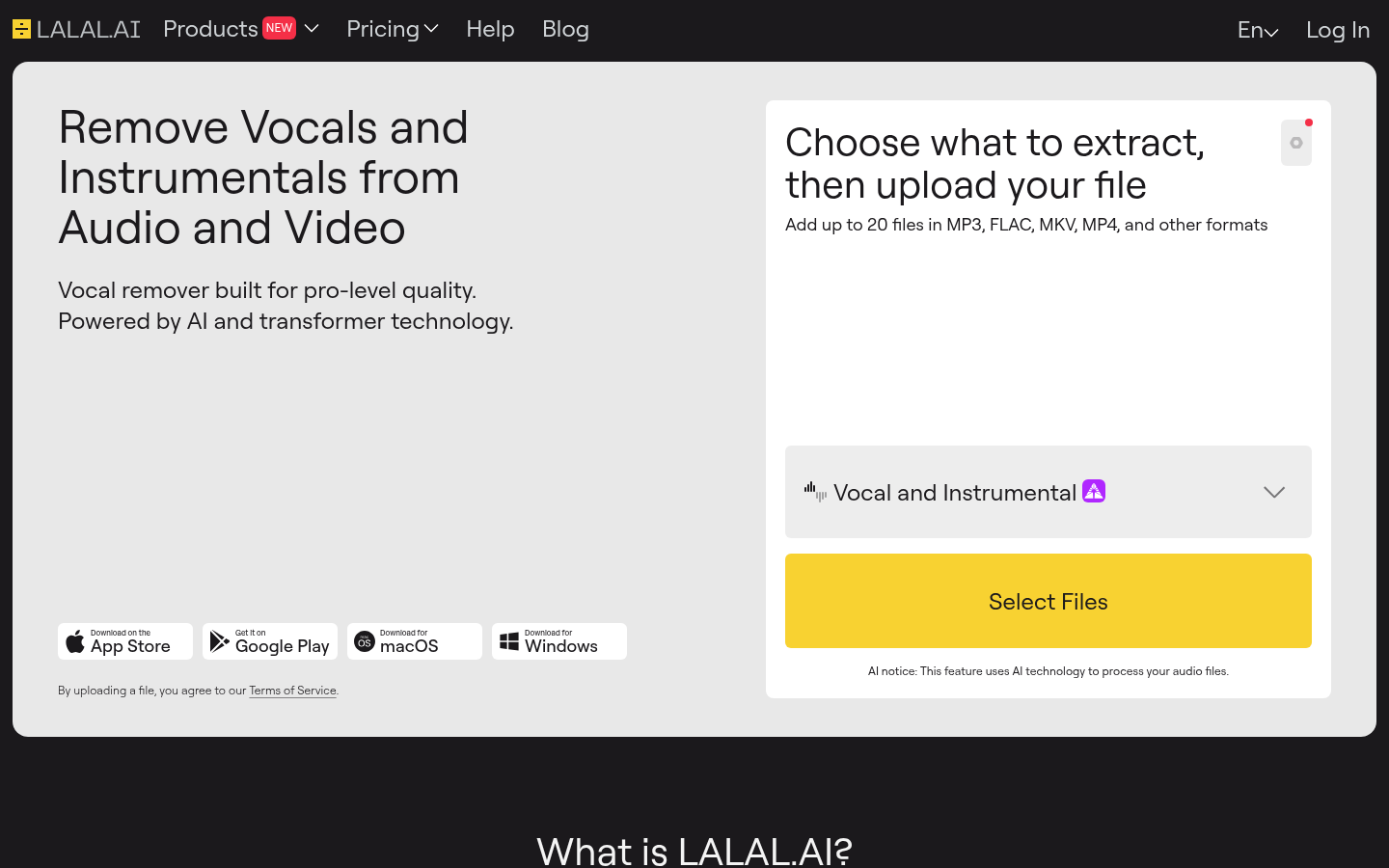
LALAL.AI is an AI-based audio processing platform built for musicians, producers, podcasters, and content creators who need to separate vocals from instrumentals or clean up voice recordings. Its core workflow is simple: upload an audio or video file, let the AI analyze the waveform, and download separated stems or a cleaned-up voice track within seconds. The service has expanded from a single-purpose vocal remover into a broader suite covering stem splitting, noise and reverb removal, voice changing, and voice cloning.
What it does
LALAL.AI removes vocals and instrumentals from audio and video files using a proprietary AI model the company calls its "sixth-generation" separation engine. Users upload a track (a song, podcast, or video soundtrack) and the tool isolates vocals, instrumentals, drums, bass, guitars, piano, synthesizer, strings, and wind into individual stems. This makes it useful for creating karaoke tracks, extracting acapellas, prepping remix stems, isolating dialogue for video editing, or removing unwanted background noise from voice recordings. Beyond stem splitting, the platform also offers a Voice Cleaner for noise/reverb removal, a Voice Changer for altering accent and tonality, a Voice Cloner for generating synthetic voiceovers, and a Lead/Back Splitter that separates lead vocals from backing vocals and instrumental mix. An Enterprise tier adds API access for bulk, secure audio processing.
Key capabilities
- Multi-stem separation: Extracts vocals, instrumentals, drums, bass, guitars (acoustic/electric), piano, synthesizer, strings, and wind from a single upload.
- Voice Cleaner: Removes background noise and unwanted sounds to produce clearer vocal or dialogue tracks.
- Echo & Reverb Remover: Targets roomy or echo-heavy recordings to improve voice clarity for podcasts and video.
- Lead/Back Splitter: Separates lead vocals, backing vocals, and instrumental/backing-plus-music mixes for detailed remix or editing work.
- Voice Changer and Voice Cloner: Adjusts accent/tonality for creative voice use, or clones a voice for producing ad reads and voiceovers.
- Cross-platform access: Available as a web app plus dedicated iOS and Android mobile apps, alongside a VST plugin and API access on higher plans.
Pricing
LALAL.AI uses a freemium model with three consumer tiers listed on its pricing page: a free "Starter" plan offering 10 minutes in the Relaxed processing queue with a 200MB upload limit; a "Lite" plan at $7.5/month (billed annually at $90) adding unlimited Relaxed Queue minutes, 90 Fast Queue minutes/month, a 2GB upload limit, and one Voice Pack slot; and a "Pro" plan at $15/month (billed annually at $180) that raises Fast Queue minutes to 250/month, adds three Voice Pack slots, batch processing, VST plugin access, and API access. One-time Top-Up packs for extra Fast Queue minutes are also available (e.g., a "Master" pack with 750 minutes for $50). An Enterprise plan with custom API integration exists but pricing is not publicly listed. Pricing page: View pricing.
Editorial review
LALAL.AI's strength lies in its narrow but well-executed focus: stem separation and voice cleanup, backed by several generations of model iteration (the site references a "sixth-gen" engine after six years of development). The free Starter tier is genuinely usable for testing output quality before paying, which is a meaningful trade-off versus competitors that gate results behind a paywall entirely. The tiered queue system (Fast vs. Relaxed) is a transparent way to manage server load, though users on lower tiers may face variable wait times once Fast Queue minutes run out mid-month. The expansion into Voice Cloner and Voice Changer positions the product beyond pure music production into podcast and voiceover workflows, but these newer tools appear less central to the brand than the original vocal remover. The VST plugin and API access being Pro-only will matter to producers who want in-DAW processing or developers building bulk pipelines — casual users on Lite won't get these. Overall, LALAL.AI is best suited for musicians and remixers needing quick stem extraction, podcasters cleaning up noisy recordings, and content creators who need karaoke or acapella tracks without manual audio engineering. It is less clear how it compares on raw separation quality against rival tools since no independent benchmarks are cited on the site itself.





