
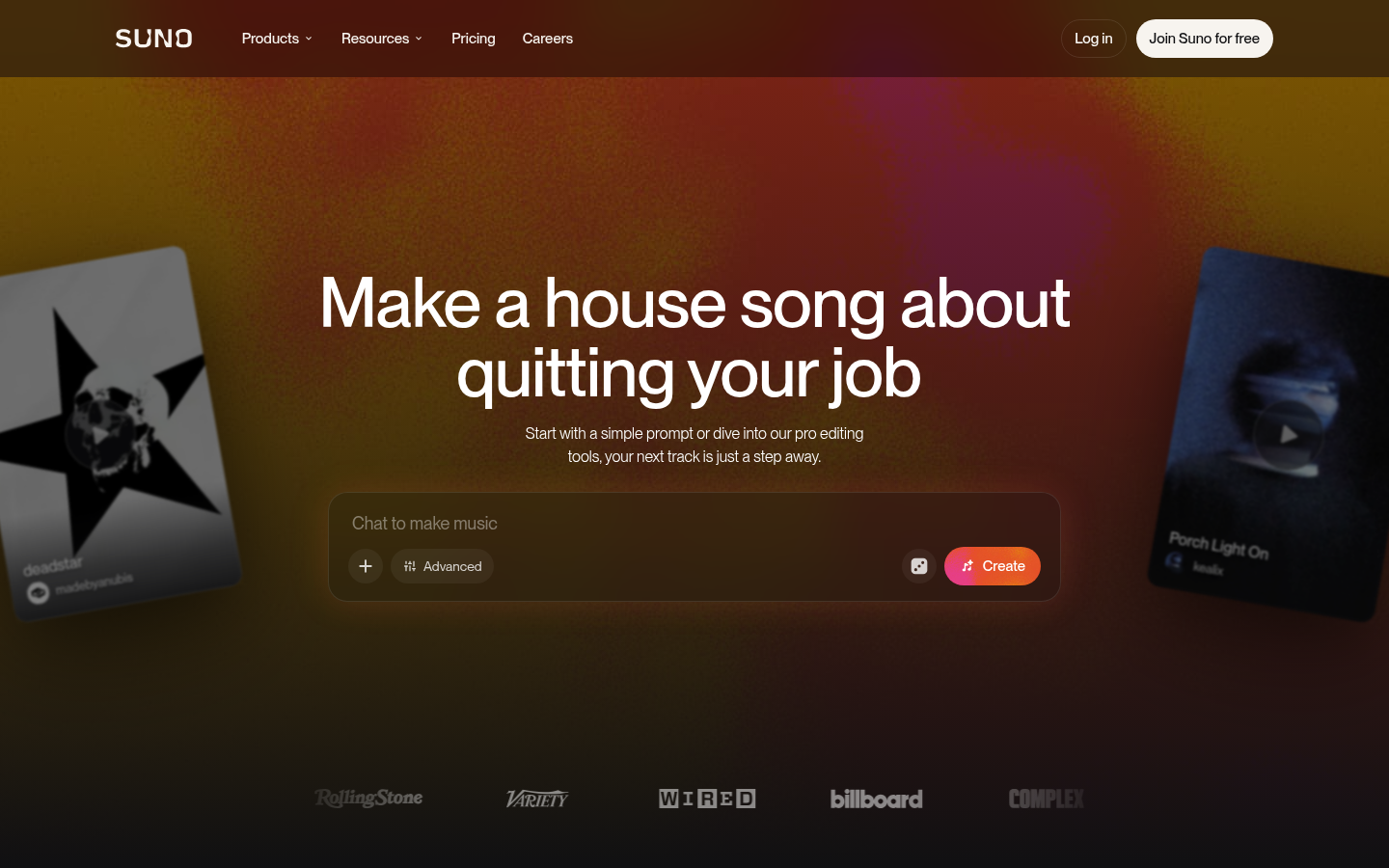
Suno is an AI music generation platform built for musicians, content creators, producers, and hobbyists who want to turn an idea, lyric, or melody into a finished song without traditional production skills. The core workflow starts with a simple text prompt or written lyrics, which Suno's models turn into a complete track with vocals and instrumentation, and extends into browser-based editing tools for users who want more control over arrangement and mixing.
What it does
Suno is a web-based AI music generator (with companion iOS and Android apps) that produces original songs from natural-language prompts, uploaded lyrics, or hummed ideas. It targets two overlapping audiences: casual creators who want quick, shareable tracks, and more advanced users—producers, artists, and content creators—who need commercial-ready audio with granular editing control. Instead of just generating a static audio clip, Suno positions itself as an end-to-end music creation environment, covering everything from initial generation to final mix, and includes a social/discovery layer where users can browse and remix tracks made by others.
Key capabilities
- Prompt-to-song generation: Converts a short description, mood, or genre prompt into a full track with vocals and instrumentation using Suno's latest model (referred to as v6), which the company describes as improving vocal fidelity and arrangement detail over prior versions.
- Suno Studio: A browser-based DAW for arranging, editing, and mixing individual song parts, including MIDI editing, effects, and automation on higher-tier plans.
- Voice cloning for songs: Users can record a short voice sample and have it sing custom lyrics in different styles, enabling personalized vocal tracks.
- Stem separation: Splits finished songs into isolated, time-aligned stems (vocals, instruments) that can be exported into external DAWs; the number of separation types available scales with plan tier.
- Remix and rewrite tools: Existing tracks can be restyled, have lyrics rewritten, or be rebuilt with new vocals/instrumentals rather than generated from scratch.
- Custom model creation: Paid tiers allow training or configuring custom models for more consistent, personalized output across multiple songs.
Pricing
Suno uses a freemium model. The Free plan costs $0/month and includes access to free models, 50 credits per day, and standard-only features, but no commercial rights, no stem separation, and no monthly song downloads. The Pro plan is $8/month (billed annually, with an annual discount) and adds 2,500 credits/month, 20 song downloads/month, commercial use rights, two stem separation types, custom model creation, and voice recording. The Premier plan is $24/month (billed annually) and unlocks Suno Studio with MIDI, effects, and automation, 10,000 credits/month, 60 downloads/month, three stem separation types, and support for longer audio uploads (up to 30 minutes). Add-on credit purchases are available on paid tiers. Pricing page: View pricing.
Editorial review
Suno's biggest strength is speed-to-output: a text prompt or lyric sheet becomes a listenable, full-length song with vocals in a short amount of time, which is a meaningfully different experience from instrumental-only AI music tools. The addition of Suno Studio, stem separation, and voice-based vocal customization signals a push toward serving intermediate and semi-professional creators rather than just novelty use cases, and the tiered stem-separation and credit structure gives a fairly transparent sense of what each plan unlocks.
The trade-offs are also clear from the pricing structure itself: the free tier explicitly excludes commercial rights and stem separation, which limits it to personal or exploratory use rather than monetized content. Users needing commercial rights, custom models, or professional mixing tools will need at least the Pro tier, and full production-style editing is gated behind the Premier plan. Suno appears best suited to independent musicians, YouTubers, podcasters, and social content creators who want fast original soundtracks or vocal tracks without hiring session musicians, while professional studios may still find the editing depth secondary to a full traditional DAW. Prospective users should treat any specific quality or output claims from marketing copy with some skepticism and evaluate generated audio directly against their genre and production needs before committing to a paid tier.









