
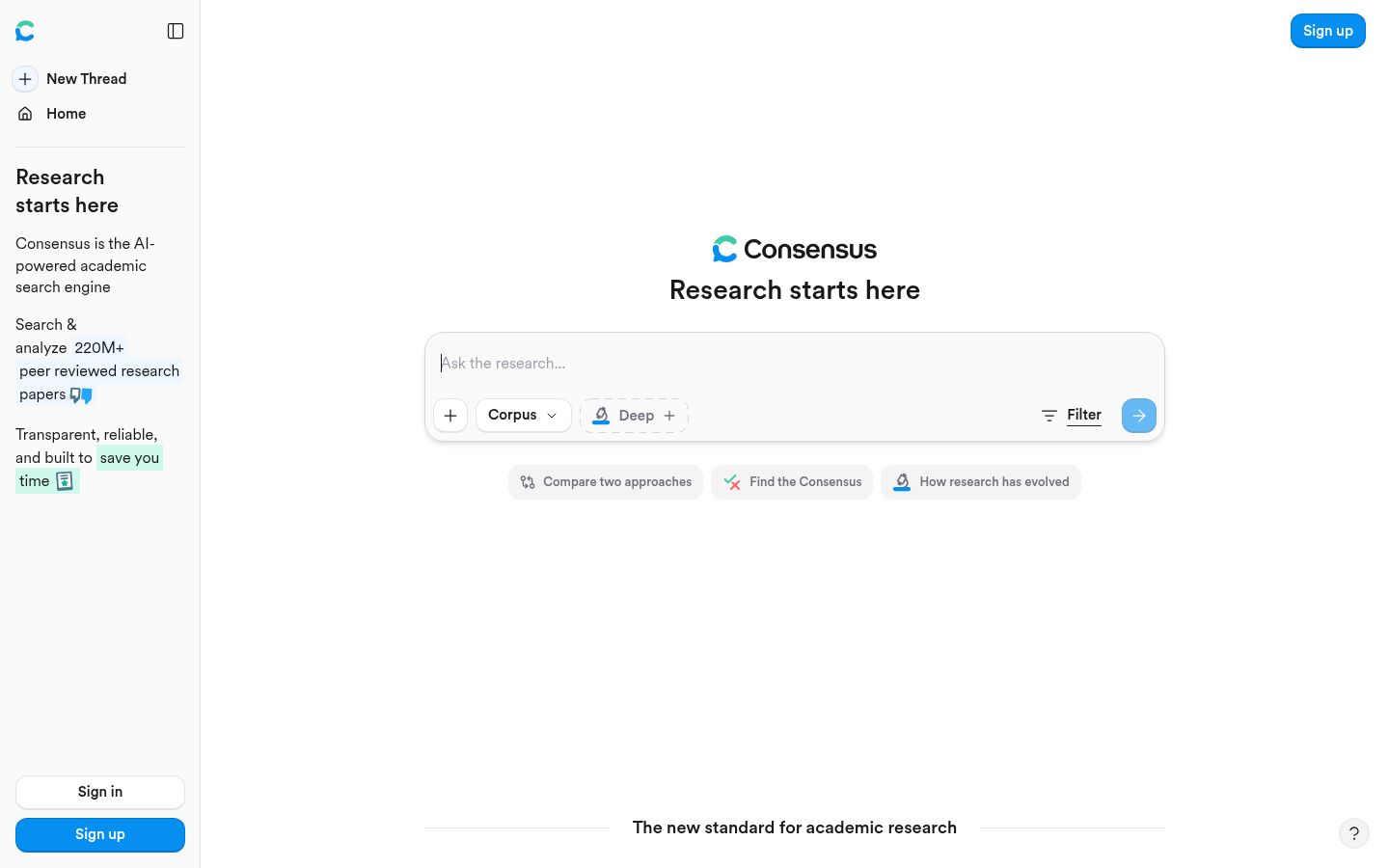
Consensus is an AI-driven academic search engine built for researchers, students, and professionals who need fast, evidence-based answers from peer-reviewed literature. Rather than returning a list of links like a traditional search engine, Consensus reads across a large corpus of scientific papers and surfaces direct, sourced answers to research questions. It is positioned as a "research OS"—a single workspace for finding, organizing, and analyzing scientific evidence significantly faster than manual literature review. The tool targets anyone who regularly needs to ground claims in published science, from graduate students writing literature reviews to professionals fact-checking scientific claims for reports or content.
What it does
Consensus functions as an AI research assistant layered on top of a database of peer-reviewed academic papers. Users type a research question in natural language, and Consensus searches its corpus, extracts relevant findings, and generates a synthesized, source-backed answer rather than making users click through dozens of abstracts. This addresses a common pain point in academic and professional research workflows: sifting through search engine results or academic databases to determine what the actual scientific consensus is on a given topic. Instead of guessing which papers are relevant, users get AI-generated summaries with direct links back to the original studies, allowing them to verify claims and dig deeper into specific sources. The product is aimed at literature review, evidence gathering, fact-checking, and general scientific inquiry use cases.
Key capabilities
- AI-generated, sourced answers: Enter a question and receive a synthesized answer drawn from multiple peer-reviewed papers, with citations linking back to original sources.
- Large corpus of peer-reviewed literature: Search spans a substantial database of academic and scientific papers rather than the open web, improving relevance for research-specific queries.
- Customizable search filters: Narrow results by criteria such as study type or other filterable attributes to refine which papers inform the generated answer.
- DeepFilter-style refinement: The interface references filtering mechanisms that let users drill into the corpus for more precise, topic-relevant results.
- Cross-platform access: Available as a web application as well as iOS and Android apps, letting users search literature from desktop or mobile.
- Research organization workflow: Positioned not just as a search tool but as an ongoing workspace for finding, organizing, and analyzing research findings over time.
Pricing
Consensus follows a freemium pricing model: the core search and question-answering functionality is available for free, with premium options offering expanded capabilities for heavier or more advanced use. Specific plan names, tiers, and prices were not available in the reviewed source material, so exact costs should be confirmed directly on the Consensus website before making a purchasing decision.
Editorial review
Consensus fills a specific niche between generic web search engines and traditional academic databases like Google Scholar or PubMed. Its core strength is reducing the time needed to get a directional answer to a research question, particularly useful for early-stage literature scanning, drafting arguments that need scientific backing, or quickly checking whether a claim has research support. The citation-linked answer format is a meaningful differentiator versus general-purpose AI chatbots, since it grounds outputs in identifiable, peer-reviewed sources rather than unverifiable AI-generated text.
That said, users should treat Consensus as a starting point rather than a substitute for full literature review. AI-synthesized summaries of scientific findings can oversimplify nuance, conflicting results, or methodological caveats present in the underlying papers, so verifying key claims against the original sources remains important for rigorous academic or professional work. The tool also depends heavily on the breadth and currency of its underlying paper corpus; niche or very recent research may be underrepresented compared to specialized subject databases.
Consensus is best suited for students, academic researchers, science journalists, and knowledge workers who need to quickly orient themselves in a body of research or support a written argument with credible sources. It is less suited as a replacement for domain-expert systematic reviews or meta-analyses, where exhaustive, manually vetted coverage is required. The availability of mobile apps alongside the web platform is a practical plus for researchers who want to search literature outside a desktop environment, and the freemium model lowers the barrier to trying the core functionality before committing to any paid tier.








