
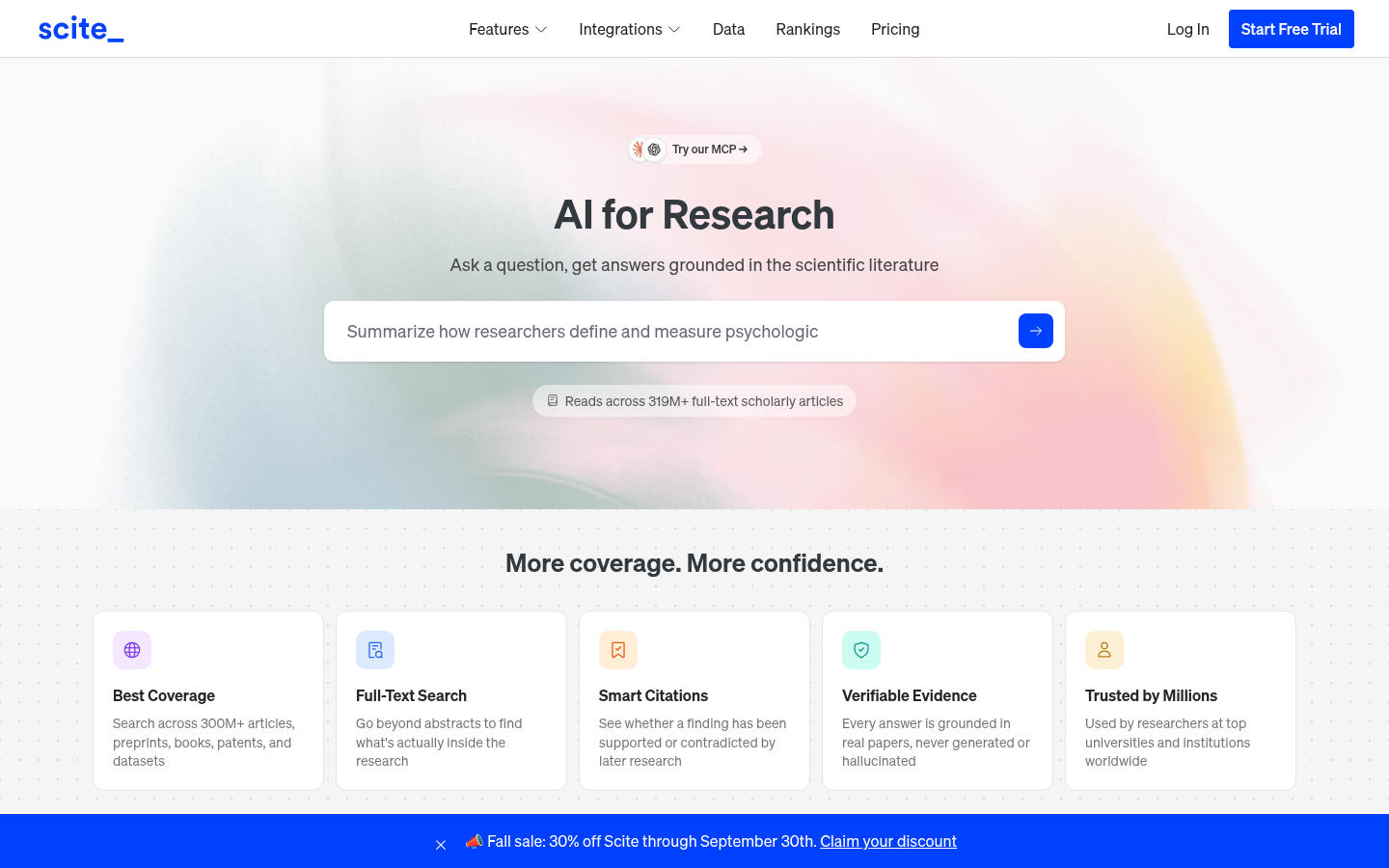
Scite is an AI-powered research platform built for academics, students, and R&D teams who need to verify claims in scientific literature rather than just find papers. It searches full text across hundreds of millions of scholarly articles, preprints, patents, and datasets, then shows whether a given finding has been supported, contradicted, or merely mentioned by later research. The core workflow centers on "Smart Citations," which classify citation context so users can judge the strength of evidence behind a paper, method, author, journal, or claim without manually reading through the full citing literature. Scite is available as a web application, with a browser extension, Zotero plugin, API, and MCP connector for linking AI agents like Claude and ChatGPT to its evidence base.
What it does
Scite functions as an AI research assistant that answers scientific questions with citations traceable to the exact sentence in the source paper, rather than generating unsupported text. It is aimed at researchers, graduate students, librarians, and institutions that need citation-backed answers for literature reviews, systematic reviews, or fact-checking research claims. The underlying database combines licensed full-text agreements with 44+ publishers (including Wiley, SAGE, and Frontiers) with the open-access corpus, letting it search inside paywalled content that many other tools cannot access. Its stated differentiator is going beyond abstract-only search to full-text indexing across articles, patents, clinical trials, grants, and books.
Key capabilities
- Smart Citations: Classifies citations as supporting, contrasting, or mentioning a given claim, giving a quick read on whether a finding still holds up in later literature.
- AI Assistant grounded in research: Answers research questions using retrieved passages from real papers, with citations tied to specific sentences to reduce hallucination risk.
- Full-text citation search: Searches inside the body text of scholarly articles rather than just titles and abstracts, surfacing content other search tools miss behind paywalls.
- Collections and citation alerts: Lets users organize papers into collections (size limits vary by plan) and monitor them via citation dashboards and alerts.
- Integrations across the research stack: Includes a Zotero plugin for citation data inside reference managers, a browser extension for citation badges on any page, a developer API for programmatic access, and an MCP connector for using Scite's data inside Claude, ChatGPT, and other AI tools.
- Broad content coverage: Indexes 300M+ articles, preprints, books, patents, and datasets through direct publisher agreements plus open-access sources.
Pricing
Scite uses a freemium structure. A free "Connect" plan offers limited monthly MCP credits for using Scite inside AI tools like ChatGPT and Claude but excludes Assistant and Search access. Paid individual plans include "Basic" (full Assistant and Search access, article Smart Citation reports, collections up to 1,000 papers, citation alerts) and "Pro" (adds API access, larger MCP credit allowances, collections up to 10,000 papers, and patent/clinical trial/grant datasets), both billed yearly at discounted monthly rates according to the pricing page. Separate Team and Enterprise pricing is also referenced but not detailed in the source material. Student and academic discounts are mentioned as available on request. Pricing page: View pricing.
Editorial review
Scite's strongest asset is its evidence-classification model: rather than treating a citation as a simple count, it tells users whether later research actually backs up or challenges a claim, which is genuinely useful for literature review and due diligence on contested findings. The full-text search and publisher partnerships give it real reach into paywalled content that citation-count tools like plain reference managers cannot match. The MCP and API integrations position it well for teams building AI agents that need literature grounding rather than hallucinated citations.
The trade-offs are that meaningful use requires a paid Basic or Pro subscription, since the free tier is restricted to limited AI-tool credits without Search or Assistant access. Collection size caps and credit-based limits on paid tiers mean heavy users doing large-scale systematic reviews may need to budget for the higher Pro tier or Enterprise plan. Scite is best suited to individual researchers, graduate students, and institutions already invested in evidence-based literature review workflows, rather than casual readers looking for a general-purpose search engine.








