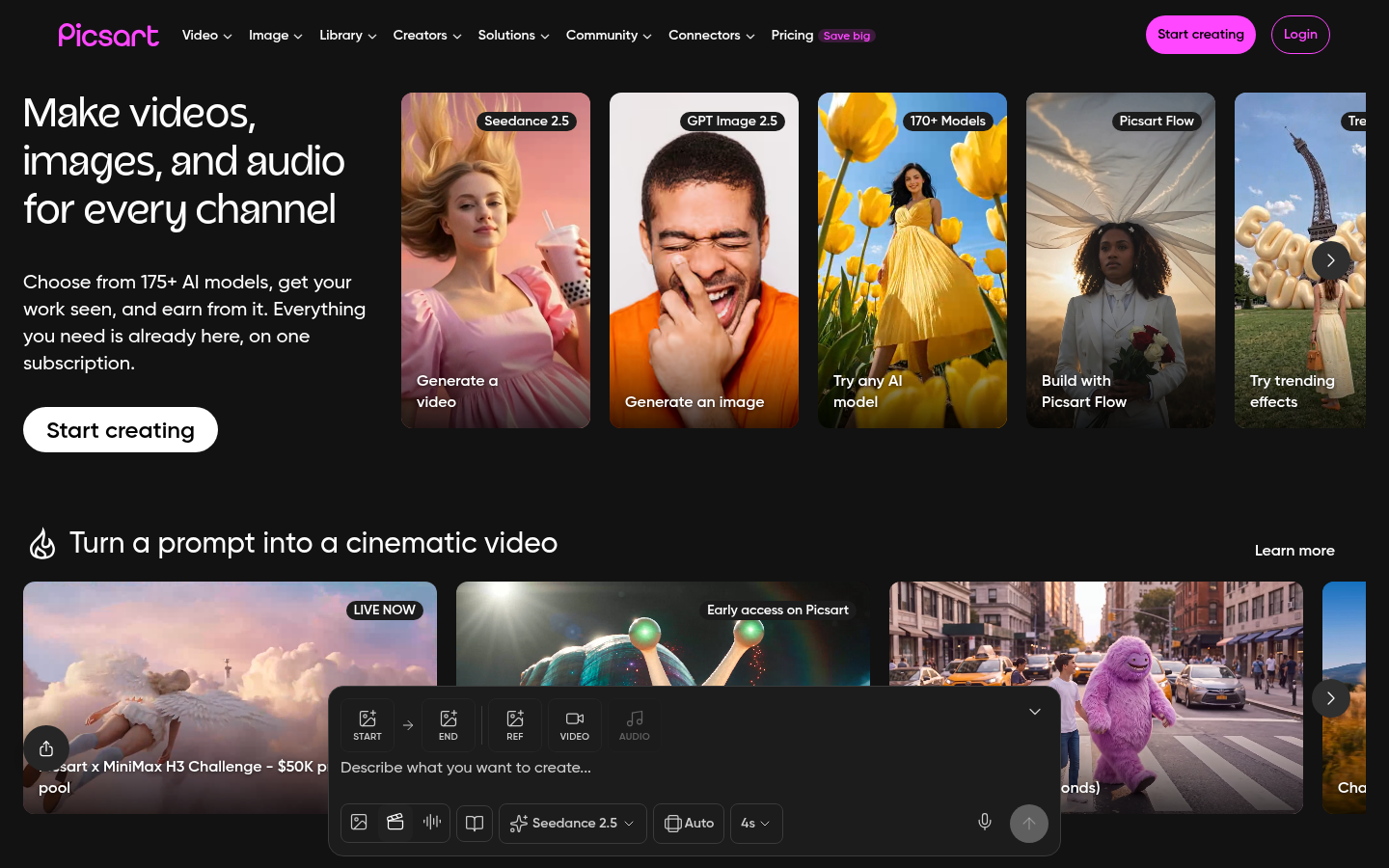
Picsart is an all-in-one AI creative platform for content creators, marketers, and small businesses that need to produce images, videos, and audio without juggling multiple subscriptions. It combines traditional photo and video editing tools with access to a large catalog of third-party and proprietary AI models in a single web and mobile app. The core workflow centers on prompt-based generation, template-driven editing, and one-click creative "agents" that automate multi-step production tasks like ad campaigns or brand assets. It is positioned for users who post to social platforms regularly and want speed over deep manual control. Based on the source material, Picsart works well for solo creators, social media managers, and small marketing teams producing high-volume visual content.
What it does
Picsart functions as a browser-based (with iOS, Android, and Windows apps) creative suite that merges classic editing features—background removal, collage making, filters, cartoonify effects—with generative AI tools for text-to-image, text-to-video, and image-to-video creation. Its "AI Playground" component aggregates over 170 AI models from more than 30 providers (including Google VEO, OpenAI's Sora and GPT Image, Kling, Runway, Flux, Recraft, and ElevenLabs) under one account, letting users run the same prompt across multiple models and compare outputs side by side. A separate feature called Picsart Flow lets users chain steps into repeatable workflows, such as producing a full product video campaign or a brand style guide in a fixed number of steps. The platform also includes a library of stock assets, fonts, templates, and Getty video clips, plus tools for animating still images and building AI personas or "twins."
Key capabilities
- Multi-model AI generation: Access to 170+ third-party and proprietary models for image, video, and audio generation from a single prompt bar, including Seedance 2.5, Kling 3.0, Veo 3.1, Nano Banana Pro, and Recraft V4.1.
- Picsart Flow workflows: Pre-built, multi-step templates (4–14 steps) for tasks like ad campaigns, product mockups, brand trailers, and packaging visuals.
- Creative AI agents: Specialized agents (e.g., a "Reel Director," "Brand Designer," "Video Director," "Interior Designer") that plan and execute multi-part creative jobs rather than single generations.
- Core editing toolkit: Background/object removal, frame expansion, image and video upscaling, bulk editing of up to 50 images at once, and brand kit support for consistent assets.
- Trend and template library: A large collection of trending effects, filters, and templates (e.g., cartoonify, anime scenes, AI makeover, transitions) aimed at fast social content production.
- Developer/agent integrations: A Picsart CLI and MCP support for using the platform inside tools like Claude Code, Cursor, and ChatGPT.
Pricing
Picsart follows a freemium model: core editing and a selection of AI tools are free to use, with paid Pro and Ultra subscription tiers unlocking higher generation credits, parallel video generations, larger cloud storage, more brand kits, and access to the full roster of AI models and agents. Paid plans are billed monthly or yearly, with yearly billing advertised at a discount (up to 30% savings cited on the pricing page). Specific credit allotments and per-model costs vary by plan and are detailed on the pricing page rather than the general marketing site. Pricing page: View pricing.
Editorial review
Picsart's main strength is consolidation: rather than subscribing separately to a dozen AI image, video, and audio generators, users get one login, one credit pool, and one asset library covering a wide swath of the current generative AI landscape. This is a genuine differentiator for creators who want to compare outputs from models like Sora, VEO, and Kling without managing multiple accounts. The trade-off is that Picsart is a aggregator/editor layer on top of other companies' models, so quality and licensing terms for any given output depend on the underlying provider, not Picsart itself. The addition of "creative AI agents" and CLI/MCP integrations suggests an effort to move upmarket toward automated production pipelines, but these appear model-based on the pricing page copy rather than independently verified feature depth. Best-fit users are individual creators, social media managers, and small marketing teams who need fast, template-driven output across many formats; teams needing tight brand governance, advanced manual editing precision, or guaranteed model-specific licensing may want to evaluate the underlying model providers directly before committing to a paid tier.