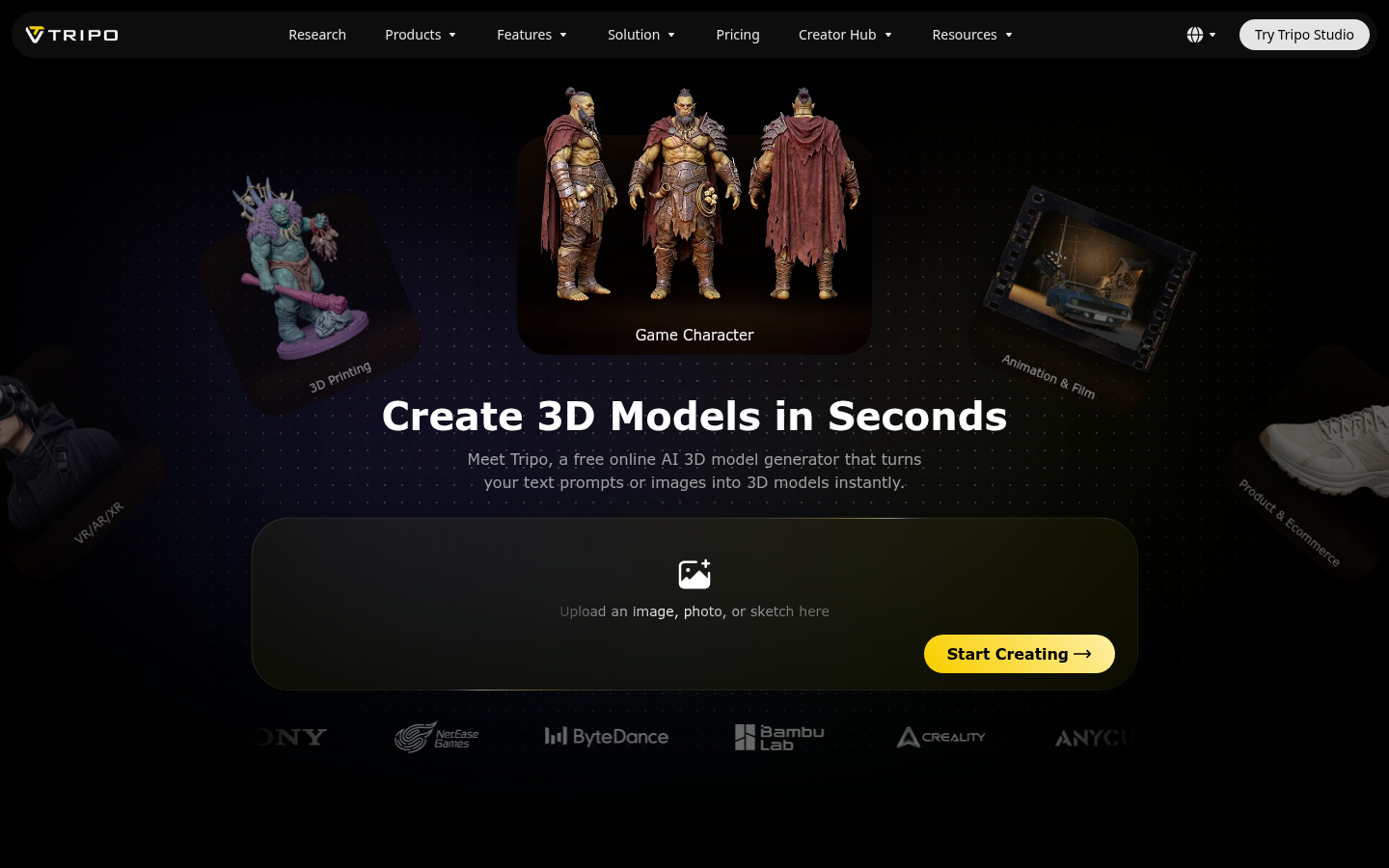
Tripo AI 3D Model Generator is a web-based AI modeling platform built for game developers, product designers, 3D artists, and hobbyist makers who need usable 3D assets without manual sculpting or CAD work. It converts a text prompt or a reference image into a textured 3D model, then offers AI-assisted cleanup steps such as remeshing and part segmentation so the output can go directly into a game engine, a 3D printer slicer, or an animation/previs pipeline. The core value proposition is speed: what typically takes hours of manual modeling is compressed into a generation cycle measured in seconds to minutes.
What it does
Tripo AI takes either a written description or an uploaded image and generates a corresponding 3D mesh with applied textures. The tool is aimed at two overlapping workflows: asset creation for interactive media (games, VR/XR, animation previs) and physical fabrication (3D printing miniatures, product prototypes, industrial design mockups). Rather than positioning itself as a full 3D modeling suite, Tripo focuses narrowly on the generation and preparation stage — producing a base mesh and then refining it with AI-driven remeshing and segmentation before export. The homepage examples show a broad range of intended outputs, including e-commerce product renders (sneakers), industrial design concepts (a foldable drone), game characters (an orc warrior with armor and weapons), tabletop miniatures (a troll warrior split into printable parts), and film previs assets (a stylized muscle car scene), indicating the tool is marketed as a general-purpose 3D content generator rather than a single-niche tool.
Key capabilities
- Text-to-3D generation: Enter a written prompt and receive a corresponding textured 3D model, useful for rapid concepting when no reference image exists.
- Image-to-3D conversion: Upload a photo or reference image and convert it into a 3D mesh, useful for replicating real objects or matching existing concept art.
- High-detail segmentation: Automatically splits a generated model into discrete parts (demonstrated on a drone and a troll warrior miniature), which supports multi-color prints, painting, or animation rigging.
- AI-powered remeshing: Cleans up and optimizes generated topology, which matters for game-engine performance and for models intended for further editing.
- Multi-part 3D printing support: Outputs designed to be printed as separate components rather than a single fused mesh, easing post-processing for miniatures and props.
- Cross-device access: Available as a web app alongside iOS and Android apps, allowing model generation and review outside a desktop workstation.
Pricing
Tripo AI follows a freemium model: the core generation tools are available for free, with paid tiers unlocking additional capacity or features. The website markdown does not surface a detailed pricing table or plan-by-plan breakdown in the scraped content, so specific plan names, credit limits, and monthly generation caps cannot be confirmed here. Prospective users should check the in-product pricing page directly before committing to a paid tier, since no reliable numeric figures beyond the general freemium structure could be verified from the available source material.
Editorial review
Tripo AI's strongest signal is breadth of demonstrated output: the same pipeline is shown producing e-commerce product shots, industrial design concepts, game-ready characters, tabletop miniatures, and film previs assets, suggesting reasonable versatility across creative and technical use cases rather than a single specialized niche. The segmentation and remeshing steps are a meaningful differentiator over bare text-to-3D generators, since raw AI mesh output is often unusable for printing or game engines without manual retopology — automating that step lowers the skill floor for hobbyist makers and speeds up iteration for professional teams. The listed partner logos (game studios, 3D printer manufacturers, and hardware/software companies) imply the tool has traction beyond a hobbyist audience, though the scraped content doesn't specify the exact nature of those partnerships.
The main trade-off for a prospective buyer is a lack of transparent, granular pricing detail in the available material — the freemium structure is confirmed, but exact free-tier limits and paid-tier pricing beyond a general reference point are not verifiable from this source. Users evaluating Tripo for production pipelines (e.g., game studios needing consistent topology or e-commerce teams needing brand-accurate geometry) should test the free tier first to judge mesh quality, texture fidelity, and export compatibility with their target engine or slicer before upgrading. Overall, Tripo AI looks best suited to indie game developers, 3D printing hobbyists, and design teams doing early-stage concepting, rather than teams requiring pixel-perfect, production-final assets without further manual refinement.